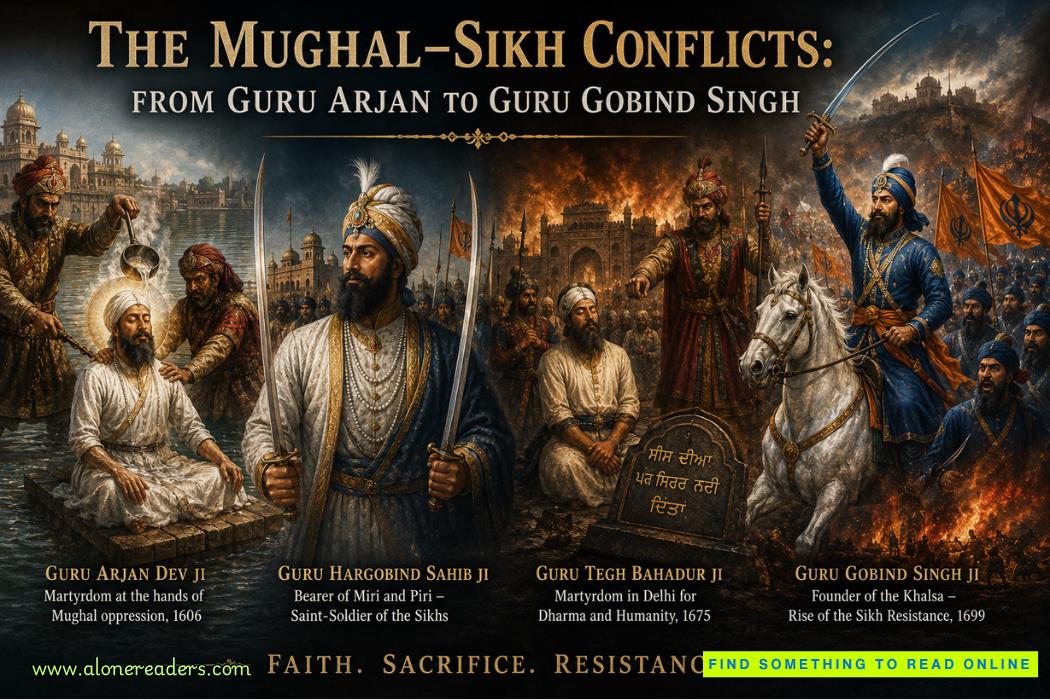
The Mughal–Sikh conflicts represent one of the most transformative and intense phases in the history of the Indian subcontinent, marking the evolution of Sikhism from a spiritual movement into a formidable socio-political force. This prolonged period of confrontation, stretching from the martyrdom of Guru Arjan in the early seventeenth century to the militarization under Guru Gobind Singh, reflects a complex interplay of faith, authority, resistance, and identity formation within the Mughal imperial framework.
At the dawn of the seventeenth century, Sikhism had established itself as a distinct spiritual path rooted in devotion, equality, and social justice. Under Guru Arjan, the fifth Sikh Guru, the community experienced remarkable growth and institutional consolidation. Guru Arjan compiled the Adi Granth, the sacred scripture of Sikhism, and oversaw the construction of the Harmandir Sahib in Amritsar, which became the spiritual nucleus of the faith. However, this growing influence attracted the attention and suspicion of the Mughal state, particularly under Emperor Jahangir.
The execution of Guru Arjan in 1606 marked a critical turning point. Jahangir perceived the Guru not merely as a religious leader but as a potential political threat, especially given his association with Prince Khusrau, a rebel claimant to the Mughal throne. Guru Arjan’s refusal to alter Sikh teachings or submit to imperial demands resulted in his arrest and subsequent execution. This event is remembered as the first martyrdom in Sikh history, symbolizing both religious persecution and the beginning of organized resistance.
Following this tragedy, the Sikh community underwent a profound transformation under Guru Hargobind, the sixth Guru. Recognizing the need for self-defense, Guru Hargobind introduced the concept of Miri and Piri, representing temporal and spiritual authority. He donned two swords to embody this dual responsibility and established the Akal Takht as a seat of temporal power. This marked the militarization of Sikh identity, as he raised an armed force and fortified Sikh centers.
The tensions between the Sikhs and the Mughals intensified during this period, leading to several armed confrontations. Although these early conflicts were limited in scale, they signaled a shift in the nature of Sikh resistance—from passive endurance to active defense. Guru Hargobind’s approach did not aim to overthrow Mughal rule but to assert the community’s right to exist and practice freely.
After Guru Hargobind, the Sikh Gurus maintained a relatively cautious stance toward the Mughal authorities, but the underlying tensions never fully dissipated. The situation dramatically escalated during the reign of Emperor Aurangzeb, whose orthodox policies and religious intolerance exacerbated existing divisions. Aurangzeb’s emphasis on Islamic orthodoxy and his policies toward non-Muslim communities created an environment of heightened persecution.
Guru Tegh Bahadur, the ninth Guru, emerged as a central figure in this renewed phase of conflict. His defense of religious freedom extended beyond Sikhism, as he stood in solidarity with Kashmiri Pandits who faced forced conversions. His arrest and execution in Delhi in 1675 represent one of the most powerful moments of moral resistance in Indian history. Guru Tegh Bahadur’s martyrdom was not only a defense of Sikh principles but a broader assertion of freedom of conscience, making it a pivotal event that deepened the Sikh commitment to resisting oppression.
The execution of Guru Tegh Bahadur profoundly influenced his son and successor, Guru Gobind Singh, who would take the transformation of the Sikh community to its ultimate form. Guru Gobind Singh recognized that survival in the face of sustained persecution required not only spiritual resilience but also military strength and collective unity. In 1699, he established the Khalsa, a brotherhood of initiated Sikhs bound by a strict code of conduct and a shared identity.
The creation of the Khalsa was a revolutionary moment. It abolished distinctions of caste and social hierarchy, emphasizing equality and collective responsibility. Initiates adopted the Five Ks as symbols of their commitment and identity, and the Khalsa was envisioned as a community of saint-soldiers—individuals who combined spiritual devotion with martial readiness. This redefinition of Sikh identity fundamentally altered the dynamics of the Mughal–Sikh relationship.
Under Guru Gobind Singh’s leadership, the conflicts with the Mughal state intensified into full-scale warfare. The battles of Anandpur Sahib, Chamkaur, and Muktsar exemplify the fierce resistance mounted by the Khalsa against overwhelming Mughal forces. These encounters were marked not only by military strategy but by extraordinary acts of courage and sacrifice. The loss of Guru Gobind Singh’s four sons, particularly the execution of his younger sons by Mughal authorities, underscores the deeply personal cost of this struggle.
Despite these hardships, Guru Gobind Singh’s leadership ensured that the Sikh community emerged stronger and more unified. His decision to end the line of human Gurus and declare the Guru Granth Sahib as the eternal Guru institutionalized the spiritual foundation of Sikhism while preserving its collective leadership structure. This move ensured continuity and stability in the face of ongoing conflict.
The Mughal–Sikh conflicts were not merely a series of battles but a profound historical process that reshaped identities and power structures. For the Mughal Empire, these conflicts revealed the limitations of imperial authority in managing diverse religious communities through coercion. For the Sikhs, this period forged a resilient identity rooted in sacrifice, justice, and resistance.
One of the most significant aspects of these conflicts is how they transformed Sikhism into a community that could navigate both spiritual and temporal challenges. The evolution from Guru Arjan’s peaceful leadership to Guru Gobind Singh’s militarized Khalsa illustrates a dynamic response to changing political realities. It also highlights the adaptability of Sikh philosophy, which remained anchored in its core principles even as its outward expression evolved.
The legacy of the Mughal–Sikh conflicts extends far beyond the seventeenth century. These events laid the groundwork for the eventual rise of Sikh political power in the eighteenth century, culminating in the establishment of the Sikh Empire under Maharaja Ranjit Singh. The memory of martyrdoms, battles, and sacrifices became integral to Sikh collective consciousness, shaping its traditions, rituals, and historical narratives.
At a broader level, these conflicts offer insights into the nature of resistance against centralized authority and the role of religious identity in political struggle. They demonstrate how communities can transform adversity into strength and how leadership can redefine the trajectory of an entire people. The Sikh experience during the Mughal period stands as a powerful example of resilience in the face of oppression and the enduring quest for dignity and freedom.
The Mughal–Sikh conflicts, therefore, should not be viewed solely through the lens of violence but as a complex historical dialogue between power and principle. They reveal the tensions inherent in a diverse empire and the capacity of marginalized communities to assert their identity and rights. From the martyrdom of Guru Arjan to the formation of the Khalsa under Guru Gobind Singh, this period encapsulates a journey of transformation that continues to resonate in historical and contemporary contexts alike.



 The Hundred Days Offensive: How the Allies Defeated Germany in World War I
 The Second Battle of the Marne: The Turning Point of World War I in 1918
 The Spring Offensive of 1918: Germany's Final Gamble to Win World War I
 The Treaty of Brest-Litovsk: How Russia Left World War I
 The Russian Revolution and World War I: How War Brought Down the Tsar
 The Zimmermann Telegram Explained: Germany's Secret Offer to Mexico in World War I