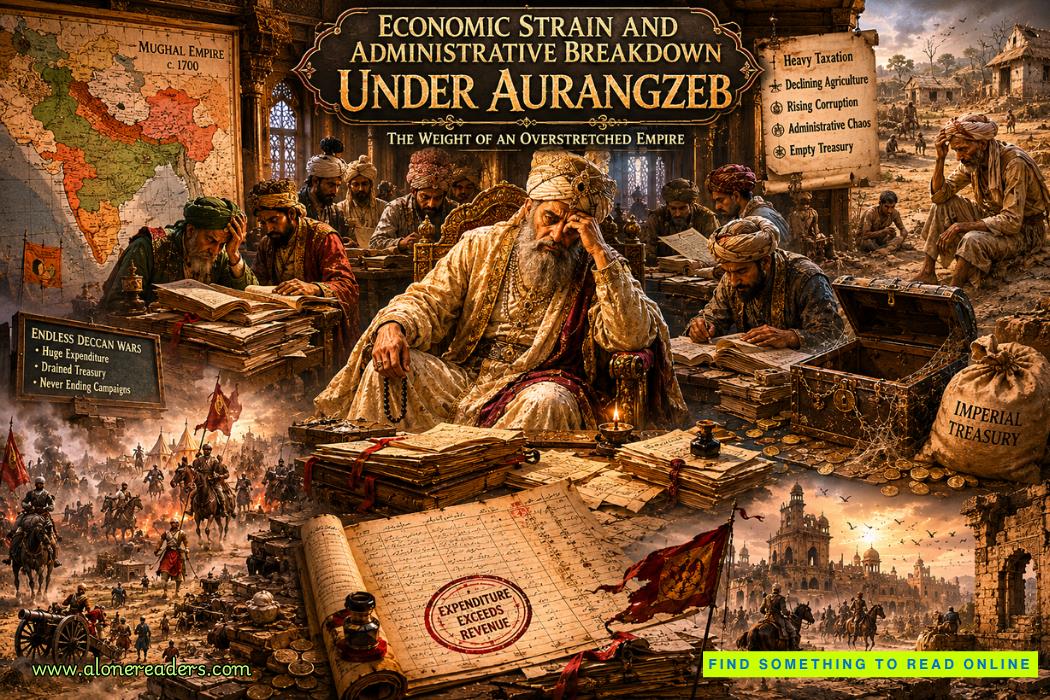
Aurangzeb’s reign, which lasted from 1658 to 1707, stands as one of the most paradoxical periods in Mughal history. On the surface, the empire reached its maximum territorial extent, stretching across nearly the entire Indian subcontinent. Yet beneath this apparent expansion lay deep and irreversible fractures. The period was marked by severe economic strain and a growing administrative breakdown that gradually weakened the very foundations of Mughal authority. These systemic issues were not sudden developments but the result of sustained policy choices, military overreach, and structural inefficiencies that intensified over time.
One of the most critical factors contributing to economic strain under Aurangzeb was the prolonged military campaigns in the Deccan. Unlike earlier Mughal emperors who balanced expansion with consolidation, Aurangzeb became deeply entangled in southern conflicts, particularly against the Marathas, the Sultanates of Bijapur and Golconda, and later various insurgent groups. These campaigns lasted for decades and consumed enormous financial resources. The Mughal treasury, once filled through efficient land revenue systems and prosperous trade, began to deplete under the weight of constant warfare. Maintaining large armies far from the imperial center required not only salaries but also logistics, supplies, and administrative support, all of which strained imperial finances to a breaking point.
The Jagirdari system, a cornerstone of Mughal administration, also began to collapse during Aurangzeb’s reign. Under this system, nobles and officials were granted land (jagirs) in exchange for military or administrative service. However, as the empire expanded, the number of officials increased disproportionately, while the availability of productive land did not keep pace. This led to what historians often describe as a “jagir crisis.” Officials were assigned lands that were either already over-assessed or incapable of generating sufficient revenue. As a result, they resorted to excessive taxation and exploitation of peasants to meet revenue demands, which further destabilized rural economies.
The burden on peasants grew increasingly unbearable. Heavy taxation, combined with irregular assessments and corruption among local officials, led to widespread agrarian distress. Farmers abandoned their lands, agricultural productivity declined, and rural unrest became more frequent. This was not merely an economic issue but a social one, as discontent among the peasantry often translated into support for rebellions. The rise of groups such as the Jats, Sikhs, and Marathas was partly fueled by these grievances, turning localized resistance into sustained challenges against Mughal authority.
Aurangzeb’s religious policies also played an indirect yet significant role in economic decline. The reimposition of the jizya tax on non-Muslims, along with the destruction of certain temples and restrictions on religious practices, alienated large segments of the population. While the economic impact of these policies may not have been immediate, they contributed to a broader climate of political instability and reduced cooperation between the state and its subjects. Merchants, traders, and local elites who once supported Mughal governance began to withdraw their loyalty, affecting trade networks and revenue flows.
Trade, which had flourished under earlier emperors like Akbar and Jahangir, began to suffer due to instability and lack of administrative efficiency. Internal trade routes became less secure as law and order weakened in various regions. Banditry increased, and local governors often acted autonomously, prioritizing personal gain over imperial interests. This fragmentation of authority disrupted commercial activity, leading to reduced customs revenues and weakening the economic backbone of the empire.
The administrative machinery itself showed clear signs of deterioration. The Mughal bureaucracy, once known for its efficiency and discipline, became increasingly corrupt and ineffective. Officials were often appointed based on loyalty rather than competence, and many were more interested in extracting wealth than maintaining order. Communication between the central authority and provincial administrations became slower and less reliable, especially as the empire expanded geographically. This led to delays in decision-making and a lack of coordinated governance.
Aurangzeb’s personal style of rule further exacerbated administrative problems. He centralized authority to an extreme degree, involving himself in detailed matters of governance. While this might suggest strong leadership, it had the unintended effect of overburdening the central administration and reducing the autonomy of capable local officials. As the empire grew larger, this centralized approach became increasingly impractical, leading to inefficiencies and administrative paralysis.
Another significant issue was the militarization of governance. As more resources were diverted to military campaigns, civil administration suffered. Funds that could have been used for infrastructure, irrigation, and public welfare were instead spent on sustaining armies. This neglect of civil development further weakened the economic structure, as agriculture and trade—the primary sources of revenue—were not adequately supported.
The decline in revenue collection was both a cause and a consequence of administrative breakdown. As corruption increased and local officials exploited their positions, less revenue reached the imperial treasury. At the same time, the central government’s inability to enforce accountability meant that these practices continued unchecked. The resulting financial shortfall forced the state to impose even higher taxes, creating a vicious cycle of economic distress and declining productivity.
The Deccan campaigns also had a psychological and political impact on the empire. Aurangzeb spent the last decades of his life in the south, far from the traditional centers of power in northern India. This physical distance weakened central control and allowed regional powers to assert greater independence. Governors and military commanders began to act as semi-autonomous rulers, further eroding the unity of the empire.
Currency instability and inflation added another layer of economic difficulty. As silver inflows fluctuated and administrative control weakened, maintaining a stable currency system became challenging. This affected trade and reduced confidence in the imperial economy. Merchants faced uncertainties in pricing and transactions, which discouraged long-distance commerce and investment.
The cumulative effect of these factors was a gradual but undeniable decline in the strength of the Mughal state. What makes Aurangzeb’s period particularly significant is that the decline was not due to a single catastrophic event but rather a combination of systemic weaknesses and policy-driven pressures. The empire was still vast and powerful at the time of his death, but it was internally fragile, with cracks that would soon widen under his successors.
It is important to recognize that Aurangzeb was not an incapable ruler. In many respects, he was a disciplined and determined leader who sought to uphold what he believed to be moral and administrative order. However, his policies—especially the emphasis on military expansion, strict religious governance, and centralized control—proved unsustainable in the long run. The administrative system he inherited was not designed to handle such prolonged stress without reform, and his failure to adapt it to changing circumstances contributed significantly to its collapse.
The legacy of economic strain and administrative breakdown during Aurangzeb’s reign serves as a critical turning point in Mughal history. It illustrates how even a powerful empire can begin to decline when its economic foundations are weakened and its administrative structures fail to function effectively. The issues that emerged during this period did not end with Aurangzeb’s death; rather, they set the stage for the rapid disintegration of the empire in the eighteenth century.
In examining this period, one can see a clear pattern: overextension without consolidation, revenue extraction without sustainability, and authority without adaptability. These factors combined to create a situation where the Mughal Empire, despite its size and legacy, could no longer maintain its dominance. The decline was not immediate, but it was inevitable, shaped by the very policies that once aimed to strengthen it.



 The Hundred Days Offensive: How the Allies Defeated Germany in World War I
 The Second Battle of the Marne: The Turning Point of World War I in 1918
 The Spring Offensive of 1918: Germany's Final Gamble to Win World War I
 The Treaty of Brest-Litovsk: How Russia Left World War I
 The Russian Revolution and World War I: How War Brought Down the Tsar
 The Zimmermann Telegram Explained: Germany's Secret Offer to Mexico in World War I