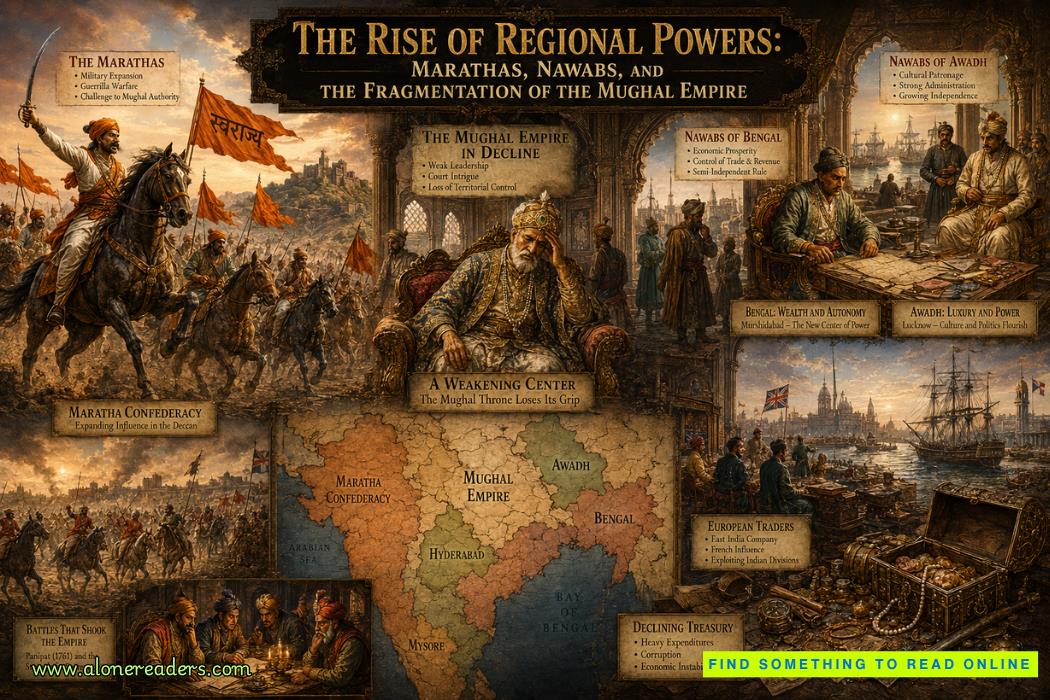
The early eighteenth century marked a turning point in the history of the Indian subcontinent, as the once-mighty Mughal Empire began to lose its grip over vast territories. What followed was not merely a decline but a profound political transformation characterized by the emergence of powerful regional states. Among these, the Marathas and various Nawabs played decisive roles in reshaping the political landscape. This period of fragmentation was neither sudden nor chaotic in isolation; rather, it was the outcome of deep structural weaknesses within the Mughal system combined with the ambitions of regional elites who sought autonomy and authority.
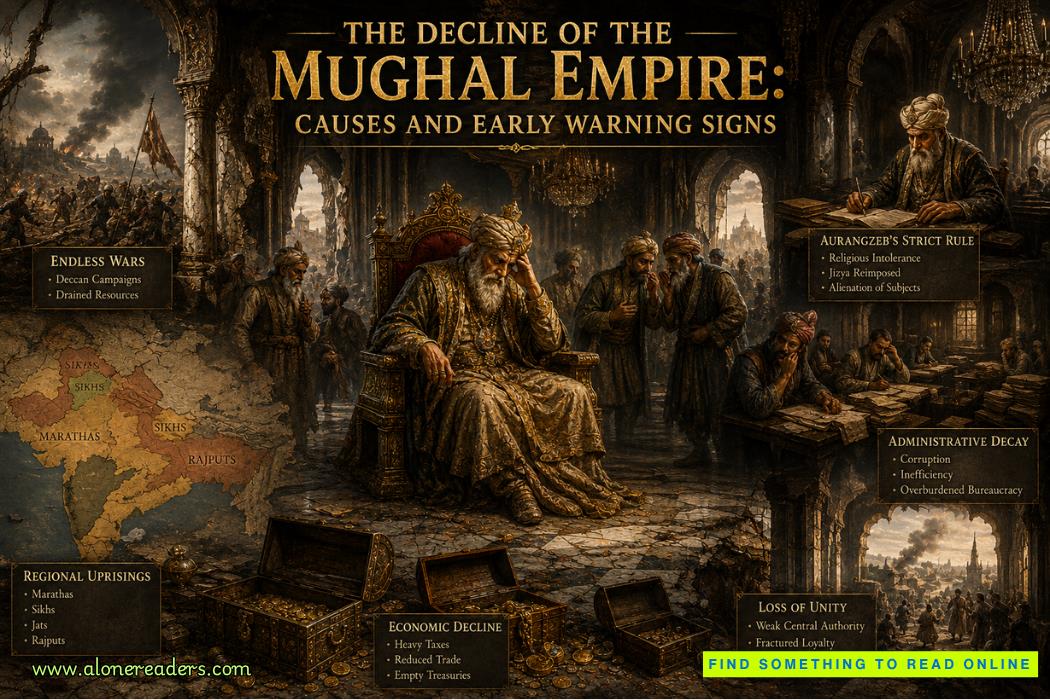
The Mughal Empire, at its zenith under rulers like Akbar and Shah Jahan, had established a centralized administrative system that relied heavily on a delicate balance between imperial authority and local governance. However, by the time of Aurangzeb’s death in 1707, the empire was already overstretched. His long and costly Deccan campaigns drained the treasury, strained military resources, and disrupted administrative cohesion. The empire’s dependence on mansabdars—officials granted land revenue assignments in exchange for service—began to falter as revenue collection became inconsistent and corruption increased. The central authority weakened, and provincial governors found themselves with greater autonomy than ever before.
In this environment of declining imperial control, the Marathas emerged as one of the most formidable forces in India. Originating in the rugged terrains of the Western Deccan, the Marathas had initially risen under the leadership of Shivaji in the seventeenth century. Shivaji’s vision of a sovereign Hindu kingdom, combined with his innovative military tactics such as guerrilla warfare, laid the foundation for Maratha expansion. By the early eighteenth century, under leaders like the Peshwas, the Marathas transformed from a regional power into a dominant political force across much of India.
The Maratha expansion was driven by a combination of military prowess and administrative ingenuity. They developed a system of revenue extraction known as chauth and sardeshmukhi, which allowed them to collect taxes from territories even beyond their direct control. This not only enriched their treasury but also extended their influence into Mughal provinces. Their mobile cavalry units enabled rapid campaigns, allowing them to strike deep into northern India, including Delhi itself. By the mid-eighteenth century, the Marathas had effectively become the arbiters of power in large parts of the subcontinent.
However, the rise of the Marathas was not without challenges. Their confederacy structure, which allowed semi-autonomous chiefs like the Holkars, Scindias, and Bhonsles to operate independently, often led to internal rivalries. While this decentralized system enabled rapid expansion, it also made coordination difficult, especially when facing external threats such as the Afghan invasions under Ahmad Shah Abdali. The Third Battle of Panipat in 1761 was a defining moment that exposed the vulnerabilities of the Maratha system. Despite their earlier successes, the Marathas suffered a devastating defeat, which temporarily halted their expansion and weakened their political dominance.
Parallel to the rise of the Marathas was the emergence of powerful Nawabs in various regions of the former Mughal Empire. These Nawabs, originally appointed as provincial governors, gradually asserted their independence as the central authority weakened. In Bengal, Awadh, and Hyderabad, Nawabs established dynasties that functioned as virtually independent states while maintaining a nominal allegiance to the Mughal emperor.
The Nawabs of Bengal, particularly under Murshid Quli Khan and later Alivardi Khan, transformed the province into one of the most prosperous regions in India. Bengal’s fertile lands and thriving trade networks made it a hub of economic activity. The Nawabs implemented efficient revenue systems and maintained a strong administrative structure, which allowed them to operate independently of Mughal control. However, their wealth also attracted the attention of European trading companies, particularly the British East India Company, which would later play a crucial role in altering the political dynamics of the region.
In Awadh, the Nawabs established a stable and culturally vibrant state. Leaders like Saadat Khan and Safdar Jang focused on consolidating power, improving revenue collection, and fostering cultural development. Awadh became known for its patronage of arts and architecture, reflecting a blend of Mughal traditions and regional influences. Similarly, in Hyderabad, the Nizam-ul-Mulk Asaf Jah founded a dynasty that maintained relative stability and autonomy in the Deccan. The Nizams skillfully navigated the complex political environment, balancing relations with the Marathas, the Mughals, and later the Europeans.
The rise of these Nawabs illustrates a key aspect of the period: the localization of power. As the Mughal center weakened, provincial elites adapted by creating their own administrative and military systems. This process was not merely a breakdown of order but a reconfiguration of authority. Regional rulers maintained elements of Mughal governance while tailoring them to local conditions, resulting in a diverse and dynamic political landscape.
Yet, this fragmentation also had significant consequences. The absence of a strong central authority led to increased conflicts among regional powers. The Marathas frequently clashed with the Nawabs, as well as with other emerging states such as Mysore under Haidar Ali and Tipu Sultan, and the Sikh misls in Punjab. These conflicts often drained resources and created instability, which in turn opened the door for external intervention.
One of the most critical outcomes of this fragmentation was the growing influence of European powers, particularly the British. The East India Company initially arrived as a commercial entity, but the political vacuum created by the decline of the Mughal Empire allowed it to expand its role. By exploiting rivalries among Indian states, the British were able to establish footholds in key regions. The Battle of Plassey in 1757 marked a turning point, as the Company gained control over Bengal, one of the richest provinces. This was followed by the Battle of Buxar in 1764, which further consolidated British power in northern India.
The interaction between regional powers and European companies was complex. Some Indian rulers sought alliances with the British to strengthen their own positions, while others resisted their expansion. The Nawabs of Bengal, for instance, initially underestimated the political ambitions of the East India Company, which ultimately led to their downfall. In contrast, the Marathas engaged in prolonged conflicts with the British, attempting to resist their encroachment. However, internal divisions and strategic miscalculations weakened their efforts.
The fragmentation of the Mughal Empire also had profound social and economic implications. While some regions experienced prosperity under efficient local governance, others suffered from instability and conflict. Trade routes were disrupted, agricultural production fluctuated, and the burden of taxation often increased as competing powers sought to finance their armies. At the same time, the cultural landscape evolved, as regional courts became centers of art, literature, and architecture. This period saw the blending of Mughal traditions with local styles, resulting in a rich and diverse cultural heritage.
It is important to understand that the rise of regional powers was not simply a story of decline but also one of adaptation and resilience. The Marathas and the Nawabs demonstrated remarkable ability to navigate a changing political environment. They built administrative systems, mobilized resources, and engaged in diplomacy and warfare to assert their authority. Their actions shaped the course of Indian history in significant ways, influencing the transition from a centralized empire to a mosaic of regional states.
At the same time, the limitations of these regional powers highlight the challenges of sustaining political unity in a vast and diverse subcontinent. The lack of coordination among them, combined with the pressures of external threats, ultimately prevented the emergence of a new unified authority. This fragmentation created conditions that allowed the British to gradually establish control, leading to a new phase of colonial rule.
In examining this period, one can see how the decline of a great empire gave rise to new forms of political organization. The Marathas, with their expansive ambitions and military innovations, and the Nawabs, with their administrative efficiency and regional focus, represent two distinct yet interconnected responses to the weakening of Mughal authority. Together, they illustrate the complexity of a transitional era that reshaped the political, economic, and cultural fabric of India.
The story of the rise of regional powers is therefore not merely a chapter of disintegration but a crucial phase of transformation. It reflects the interplay between continuity and change, as old structures gave way to new realities. Understanding this period provides valuable insights into the dynamics of power, the nature of political authority, and the forces that shaped the modern history of the Indian subcontinent.



 The Hundred Days Offensive: How the Allies Defeated Germany in World War I
 The Second Battle of the Marne: The Turning Point of World War I in 1918
 The Spring Offensive of 1918: Germany's Final Gamble to Win World War I
 The Treaty of Brest-Litovsk: How Russia Left World War I
 The Russian Revolution and World War I: How War Brought Down the Tsar
 The Zimmermann Telegram Explained: Germany's Secret Offer to Mexico in World War I