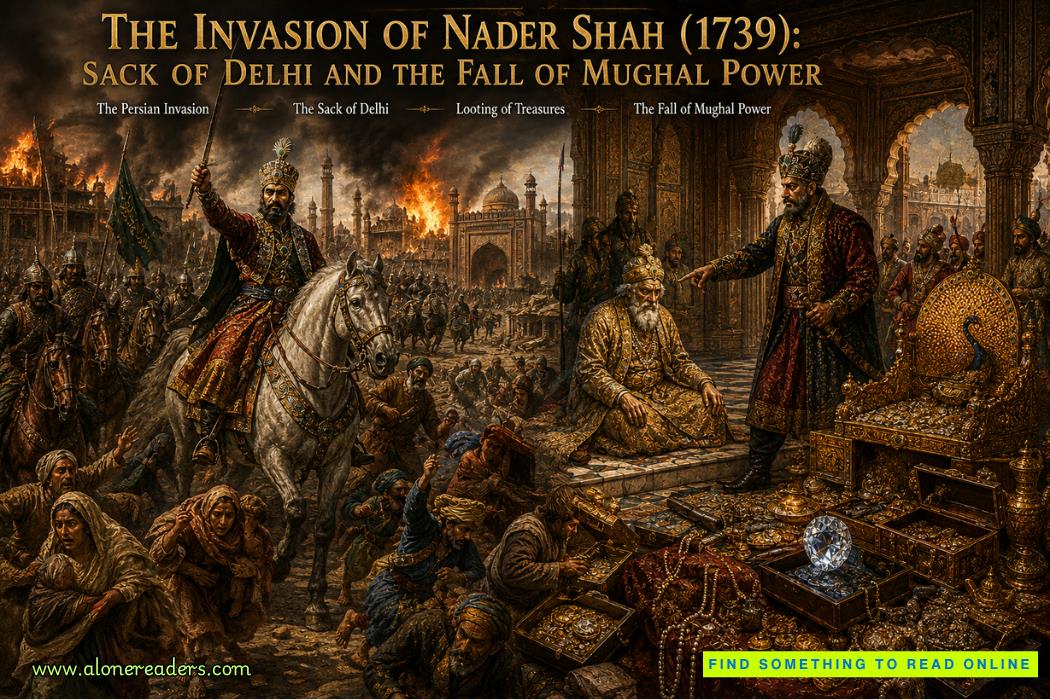
The invasion of Nader Shah in 1739 stands as one of the most catastrophic events in the history of the Indian subcontinent, marking a decisive turning point in the decline of the Mughal Empire. This episode was not merely a military campaign but a profound shock that exposed the fragility of imperial authority, devastated the economic foundations of northern India, and reshaped political dynamics for decades to come. The sack of Delhi, in particular, remains etched in historical memory as a moment of unparalleled violence, humiliation, and irreversible decline.
By the early eighteenth century, the Mughal Empire, once a symbol of wealth, administrative sophistication, and military might, had entered a phase of visible decay. After the long and exhausting reign of Aurangzeb, the empire struggled to maintain cohesion. Regional governors increasingly acted independently, central authority weakened, and factional conflicts plagued the imperial court. The emperor Muhammad Shah, often characterized as more interested in courtly pleasures than governance, presided over a system that was already fracturing from within. It was in this environment of political disunity and administrative weakness that Nader Shah, the ambitious and formidable ruler of Persia, saw an opportunity.
Nader Shah had risen from relatively humble origins to become one of the most powerful military leaders of his time. Through a combination of military genius, discipline, and relentless ambition, he had consolidated Persia and built a formidable army. His campaigns against the Afghans and Ottomans demonstrated his strategic brilliance, but his ambitions extended further. The wealth of the Mughal Empire, long celebrated across Asia and Europe, became an irresistible target. Moreover, disputes over the harboring of Afghan rebels by Mughal authorities provided a convenient pretext for invasion.
The Persian army advanced rapidly, encountering surprisingly weak resistance. The Mughal military system, once formidable under emperors like Akbar and Shah Jahan, had deteriorated significantly. Corruption, outdated tactics, and lack of coordination rendered it ineffective against Nader Shah’s disciplined forces. The decisive confrontation occurred at the Battle of Karnal in February 1739, a battle that starkly illustrated the imbalance between the two sides. Despite commanding a numerically superior force, the Mughal army suffered a humiliating defeat. Poor leadership, lack of strategic unity, and internal rivalries contributed to their collapse.
The defeat at Karnal effectively opened the gates to Delhi. Emperor Muhammad Shah had no choice but to negotiate, and Nader Shah entered the Mughal capital not as a mere invader but as a conqueror. Initially, his entry was marked by a semblance of restraint. He sought to present himself as a ruler asserting authority rather than a barbaric destroyer. However, this fragile calm would soon give way to one of the most brutal episodes in the city’s history.
The turning point came when rumors spread that Nader Shah had been assassinated. In the confusion that followed, sections of the local population attacked Persian soldiers. This incident triggered a devastating response. Enraged and determined to assert absolute control, Nader Shah ordered a general massacre. The violence that followed was indiscriminate and relentless. For hours, the streets of Delhi were soaked in blood as soldiers killed civilians, looted homes, and set parts of the city ablaze.
The sack of Delhi was not merely an act of retribution; it was a calculated display of power designed to crush any possibility of resistance. Contemporary accounts describe scenes of unimaginable horror—families torn apart, entire neighborhoods destroyed, and countless lives lost. The scale of the massacre remains a subject of debate, but there is little doubt that it was one of the most devastating urban catastrophes of the eighteenth century. The psychological impact on the population was profound, leaving a legacy of trauma that would endure for generations.
Equally significant was the systematic looting that accompanied the massacre. Nader Shah and his forces seized enormous amounts of wealth from the Mughal treasury, noble households, and merchants. Among the treasures taken were some of the most iconic symbols of Mughal opulence, including the legendary Peacock Throne and the Koh-i-Noor diamond. These were not merely valuable objects; they represented the cultural and political prestige of the empire. Their loss symbolized the transfer of power and the erosion of Mughal authority.
The economic consequences of this plunder were catastrophic. The Mughal Empire’s financial reserves, painstakingly accumulated over generations, were effectively drained in a matter of weeks. This sudden depletion crippled the state’s ability to maintain its administrative and military apparatus. Revenue collection systems faltered, provincial governors became even more autonomous, and the central government struggled to pay its troops and officials. In many ways, the invasion accelerated processes of decline that had already begun, transforming a weakening empire into a hollow shell.
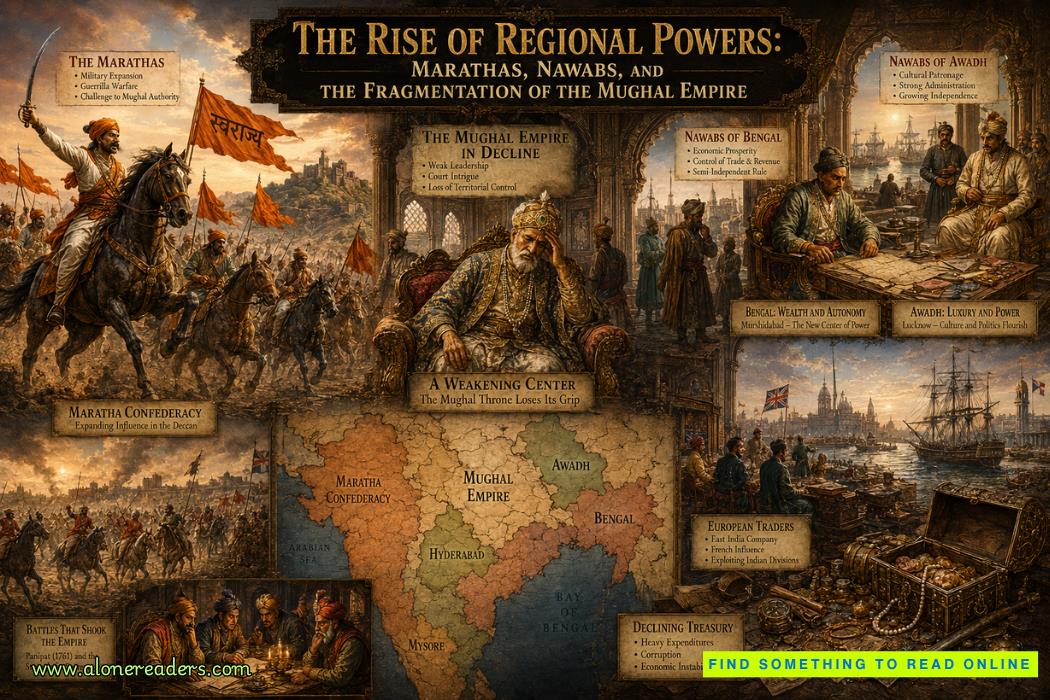
The impact of Nader Shah’s invasion extended beyond immediate destruction. It fundamentally altered the political landscape of the Indian subcontinent. With the Mughal center weakened beyond recovery, regional powers such as the Marathas, Sikhs, and various Nawabs gained greater autonomy and influence. The fragmentation of authority created a power vacuum that would, in time, be exploited by emerging European trading companies, particularly the British East India Company. While the invasion itself did not directly lead to colonial rule, it significantly weakened the structures that might have resisted such expansion.
Another important dimension of this event was its symbolic significance. The Mughal Empire had long been regarded as a bastion of stability and grandeur. The ease with which Nader Shah defeated its forces and looted its capital shattered this perception. It exposed the vulnerability of even the most established political systems when internal cohesion is lost. For contemporaries across Asia, the invasion served as a stark reminder of the shifting balance of power in the eighteenth century.
The personal humiliation of Emperor Muhammad Shah further underscored the depth of the crisis. Reduced to a subordinate position in his own capital, he was forced to comply with Nader Shah’s demands. This loss of dignity was not merely personal; it symbolized the erosion of imperial authority. The emperor, once the center of political and cultural life, now appeared powerless, further undermining confidence in the Mughal system.
From a broader historical perspective, the invasion of 1739 can be seen as both a culmination and a catalyst. It culminated decades of internal decline, administrative inefficiency, and military stagnation within the Mughal Empire. At the same time, it acted as a catalyst for new political configurations, accelerating the rise of regional states and setting the stage for future conflicts and transformations. The eighteenth century in India would be characterized by fluid alliances, shifting power centers, and increasing external interventions, all of which can be traced, in part, to the shock of Nader Shah’s invasion.
The cultural and social impact of the sack of Delhi also deserves attention. The city, long a center of art, literature, and commerce, suffered immense damage. Many scholars, artisans, and merchants were killed or displaced, leading to a decline in cultural production. Although Delhi would eventually recover to some extent, it never fully regained its former status as the undisputed heart of the empire. The trauma of 1739 lingered in collective memory, shaping narratives of decline and loss in subsequent generations.
It is also important to consider the strategic brilliance of Nader Shah within this context. His campaign demonstrated the effectiveness of mobility, discipline, and centralized command. In contrast, the Mughal military system, burdened by outdated structures and internal divisions, proved incapable of responding effectively to a dynamic and well-coordinated adversary. This contrast highlights broader changes in warfare during the period, where adaptability and organization increasingly determined success.
Yet, while Nader Shah emerged victorious, his invasion did not result in long-term control over India. After securing immense wealth, he withdrew, leaving behind a devastated but still politically complex landscape. His primary objective had been extraction rather than occupation, and in this sense, the invasion was both highly successful and deeply destructive. The wealth he carried back to Persia temporarily enriched his empire, but it also underscored the vulnerability of regions unable to defend their resources effectively.
In examining the legacy of the invasion, one is struck by its enduring relevance. It serves as a case study in how internal weaknesses can invite external aggression, how military and administrative decay can lead to rapid collapse, and how the consequences of such events can extend far beyond immediate destruction. The sack of Delhi was not an isolated event but a pivotal moment that reshaped the trajectory of South Asian history.
The invasion of Nader Shah in 1739 remains a powerful reminder of the fragility of even the most magnificent empires. It illustrates how wealth without strength, authority without unity, and tradition without adaptation can lead to downfall. The Mughal Empire did not collapse overnight, but the events of that year ensured that it would never recover its former glory. The echoes of that catastrophe would continue to reverberate through the subcontinent, influencing political developments, economic structures, and historical narratives for generations to come.



 The Hundred Days Offensive: How the Allies Defeated Germany in World War I
 The Second Battle of the Marne: The Turning Point of World War I in 1918
 The Spring Offensive of 1918: Germany's Final Gamble to Win World War I
 The Treaty of Brest-Litovsk: How Russia Left World War I
 The Russian Revolution and World War I: How War Brought Down the Tsar
 The Zimmermann Telegram Explained: Germany's Secret Offer to Mexico in World War I