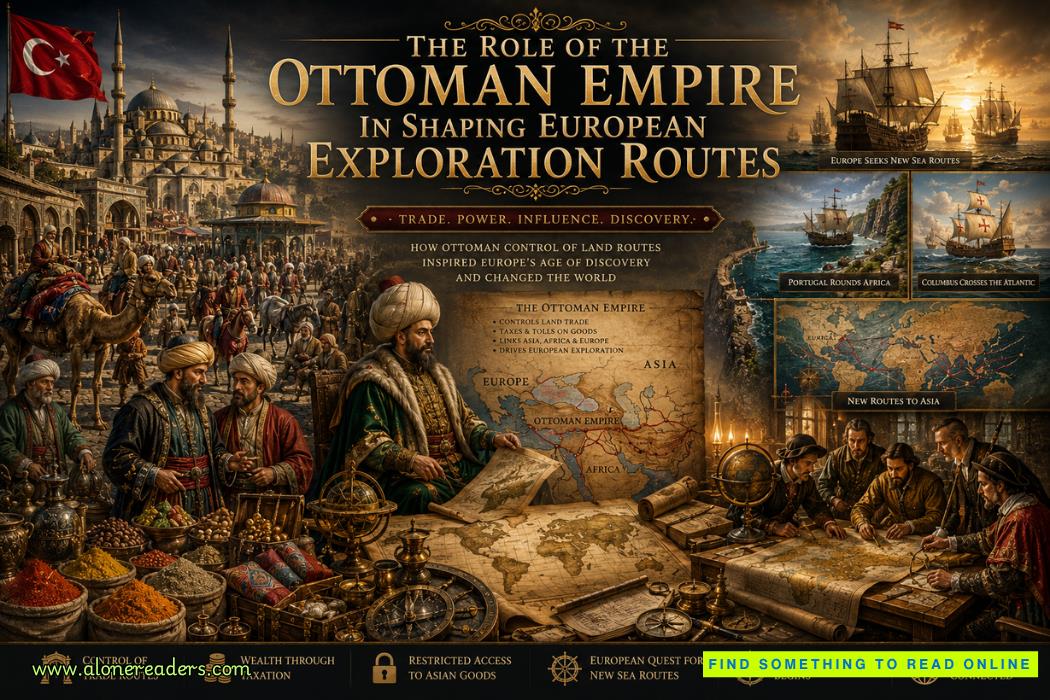
The Age of Discovery is often portrayed as a period driven by curiosity, technological innovation, and the ambitions of European monarchs. While these factors undoubtedly played important roles, the story of global exploration cannot be fully understood without examining the influence of the Ottoman Empire. In many ways, the expansion of the Ottoman Empire helped create the conditions that encouraged European nations to search for alternative routes to Asia. The rise of Ottoman power transformed trade networks, altered geopolitical balances, and influenced economic strategies across Europe. As a result, some of the most significant voyages in human history were undertaken in response to circumstances shaped by Ottoman dominance.
By the fifteenth century, Europe had developed an increasing appetite for luxury goods originating from Asia. Spices such as pepper, cinnamon, cloves, and nutmeg were highly prized not only for flavoring food but also for preserving meat and serving medicinal purposes. Silk from China, precious stones from India, fine textiles from Persia, and exotic products from Southeast Asia were equally valuable. These goods reached Europe through an extensive network of overland and maritime trade routes that connected East Asia, South Asia, the Middle East, and the Mediterranean world.
For centuries, these trade routes had operated through a series of intermediaries. Merchants transported goods across deserts, mountains, and seas before they eventually reached European markets. Italian city-states such as Venice and Genoa became major beneficiaries of this system, serving as crucial commercial links between Europe and the East. However, the political landscape surrounding these trade routes began to change dramatically with the emergence of Ottoman power.
The Ottoman state originated in northwestern Anatolia during the late thirteenth century. What began as a relatively small frontier principality gradually evolved into one of the most formidable empires in world history. Through military expansion, administrative efficiency, and strategic leadership, the Ottomans extended their influence across Anatolia, the Balkans, the Middle East, and North Africa. By the fifteenth century, they had become a dominant force in the eastern Mediterranean.
A pivotal moment occurred in 1453 when Ottoman forces under Mehmed II captured Constantinople. This event marked the end of the Byzantine Empire and transformed the city into the Ottoman capital. Renamed Istanbul over time, the city became one of the most important commercial and political centers in the world.
The conquest of Constantinople had profound symbolic and strategic consequences. The city occupied a critical position between Europe and Asia, controlling access to important land and sea routes. With the Ottomans firmly established there, European rulers became increasingly aware that a powerful empire now stood astride many of the commercial pathways connecting Europe to the East.
It is important to note that the Ottomans did not completely close trade routes to European merchants. Modern historical research demonstrates that trade continued throughout much of the period. Venetian merchants, for example, maintained commercial relationships with Ottoman authorities. Nevertheless, European perceptions of Ottoman control often mattered as much as the reality itself. The existence of a powerful Muslim empire controlling major trade corridors created economic uncertainty and strategic concerns among European states.
The Ottoman Empire possessed the ability to influence trade through taxation, regulation, military power, and diplomatic agreements. Merchants transporting goods across Ottoman territories frequently paid customs duties and transit fees. These costs contributed to higher prices for luxury products arriving in Europe. As demand for Asian goods continued to rise, European rulers and merchants became increasingly interested in finding ways to bypass intermediaries and gain direct access to sources of wealth.
This desire became particularly strong in the kingdoms of Portugal and Spain. Located on the Atlantic fringe of Europe, these states were less integrated into traditional Mediterranean trade networks than Italian city-states. Their geographic position encouraged them to look toward the ocean as a potential avenue for economic expansion.
Portugal emerged as a pioneer in maritime exploration during the fifteenth century. Under the patronage of Prince Henry the Navigator, Portuguese sailors began systematically exploring the western coast of Africa. Their objective was not merely geographical curiosity. Rather, they sought practical commercial advantages. By sailing around Africa, Portugal hoped to establish direct access to the lucrative markets of Asia without relying on routes influenced by Ottoman power.
Advances in shipbuilding, navigation, and cartography supported these ambitions. Portuguese mariners improved the design of the caravel, developed more accurate navigational methods, and accumulated valuable knowledge about winds and ocean currents. These innovations enabled increasingly ambitious voyages along the African coastline.
The significance of Ottoman influence becomes particularly evident when examining Portuguese strategic thinking. Portuguese leaders understood that direct maritime access to India could provide enormous economic benefits. Such a route would reduce dependence on middlemen and potentially grant Portugal access to spices at lower costs. The prospect of circumventing Ottoman-controlled territories served as a powerful incentive.
This effort culminated in 1498 when Vasco da Gama successfully reached India by sailing around the Cape of Good Hope. His voyage established a direct sea route between Europe and Asia. The achievement represented a turning point in world history. For the first time, Europeans possessed a practical maritime connection to Asian markets that largely avoided traditional overland routes.
Meanwhile, Spain pursued a different strategy. Inspired by the belief that Asia could be reached by sailing westward across the Atlantic Ocean, Christopher Columbus proposed an ambitious plan to the Spanish monarchy. Although his calculations underestimated the size of the Earth, his voyage in 1492 ultimately resulted in European contact with the Americas.
While Columbus was motivated by multiple factors, including religious aspirations and personal ambition, economic considerations were central to his proposal. Like the Portuguese, he sought access to Asian wealth through an alternative route. The broader context of Ottoman influence over traditional trade pathways formed part of the environment that made such proposals attractive to European rulers.
The Ottoman Empire itself recognized the importance of maritime commerce and actively responded to these developments. As Portuguese influence expanded into the Indian Ocean, competition between the Ottomans and Portugal intensified. The Ottomans sought to protect commercial interests, maintain influence over regional trade networks, and counter Portuguese expansion.
During the sixteenth century, Ottoman naval forces became increasingly active in the Red Sea, the Persian Gulf, and parts of the Indian Ocean. Ottoman authorities invested resources in fortifications, naval expeditions, and alliances designed to preserve their position within global commerce. This demonstrates that the Age of Discovery was not merely a story of European initiative but also one of interaction and competition among multiple powerful civilizations.
The Ottoman Empire was therefore not simply an obstacle to European exploration; it was an active participant in the evolving global system. Its policies, military capabilities, and commercial networks influenced strategic decisions made by European states. At the same time, Ottoman leaders adapted to changing circumstances created by expanding maritime trade.
The economic consequences of European exploration gradually reshaped global commerce. As maritime routes gained prominence, the relative importance of some traditional overland pathways declined. Atlantic ports began to eclipse Mediterranean centers in economic significance. Countries such as Portugal, Spain, England, and the Netherlands benefited from expanding oceanic trade networks.
This transformation had far-reaching implications. Wealth generated through maritime commerce contributed to the growth of powerful European states and empires. Colonial expansion accelerated. New trade systems connected continents on an unprecedented scale. Goods, people, technologies, diseases, and ideas moved across the globe with increasing frequency.
Yet it would be inaccurate to portray the Ottoman Empire as a victim of these developments. For centuries after the beginning of the Age of Discovery, the Ottoman state remained one of the world's most powerful political entities. Istanbul continued to function as a major commercial hub connecting Europe, Asia, and Africa. Ottoman merchants participated in international trade, and the empire retained significant economic influence.
Historians today often emphasize that the relationship between Ottoman expansion and European exploration was complex. Earlier interpretations sometimes suggested that the Ottomans completely blocked trade routes, forcing Europeans to seek alternatives. Modern scholarship presents a more nuanced picture. Trade continued across Ottoman territories, and many European merchants maintained profitable relationships with Ottoman partners.
Nevertheless, the strategic reality remained significant. European rulers desired greater control over access to Asian goods and sought to reduce reliance on intermediary powers. Ottoman dominance over key regions contributed to this objective by highlighting the advantages of direct maritime connections. Whether motivated by economic efficiency, geopolitical rivalry, or commercial ambition, European exploration efforts were undeniably shaped by the presence of the Ottoman Empire.
The psychological dimension should not be underestimated either. The fall of Constantinople sent shockwaves throughout Europe. Many contemporaries viewed the Ottoman advance as evidence of a shifting balance of power. This perception encouraged political leaders to explore new opportunities beyond traditional spheres of influence. Exploration became not only an economic venture but also a strategic response to changing geopolitical realities.
The Age of Discovery ultimately transformed world history, but it emerged from a web of interconnected causes rather than a single event or motivation. Technological innovations, economic incentives, religious aspirations, political competition, and intellectual curiosity all contributed to the process. Among these factors, the rise of the Ottoman Empire occupies a crucial place.
By controlling strategic territories linking Europe and Asia, the Ottomans influenced the calculations of merchants, monarchs, and explorers. Their presence encouraged European powers to invest in maritime technology, support long-distance voyages, and search for alternative routes to the riches of the East. The journeys of Vasco da Gama, Christopher Columbus, and countless other navigators unfolded within a geopolitical landscape significantly shaped by Ottoman expansion.
In this sense, the Ottoman Empire played an indirect yet profoundly important role in launching the Age of Discovery. Its control of major commercial crossroads did not halt trade, but it altered the strategic environment in which European states operated. The search for direct access to Asian markets became a defining objective of European exploration, leading to voyages that connected continents and transformed global history.
The legacy of this relationship remains visible today. Modern patterns of globalization, international trade, and cultural exchange can trace part of their origins to the interactions between Ottoman power and European ambition during the fifteenth and sixteenth centuries. What began as a struggle over commerce and strategic advantage ultimately contributed to the creation of an interconnected world. The Ottoman Empire, standing at the crossroads of continents, was one of the central actors in that transformative story.



 The Hundred Days Offensive: How the Allies Defeated Germany in World War I
 The Second Battle of the Marne: The Turning Point of World War I in 1918
 The Spring Offensive of 1918: Germany's Final Gamble to Win World War I
 The Treaty of Brest-Litovsk: How Russia Left World War I
 The Russian Revolution and World War I: How War Brought Down the Tsar
 The Zimmermann Telegram Explained: Germany's Secret Offer to Mexico in World War I










