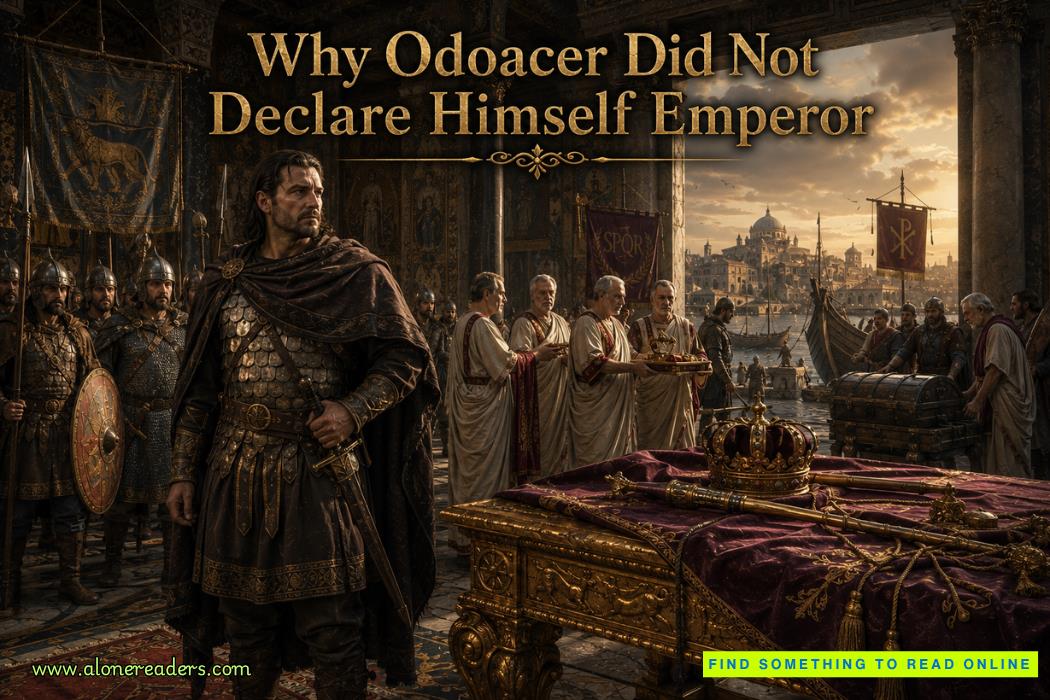
When Odoacer removed the young emperor Romulus Augustulus from the throne in 476 AD, he stood at one of history's most decisive crossroads. He possessed the army, controlled Italy, occupied the imperial capital at Ravenna, and held absolute military authority. If anyone had the opportunity to proclaim himself the next Western Roman Emperor, it was Odoacer. Yet he deliberately chose not to do so. Instead, he adopted the title King of Italy (Rex Italiae), acknowledged the authority of the Eastern Roman Emperor, and sent the imperial insignia of the Western Empire to Constantinople.
This decision has fascinated historians for centuries because it appears, at first glance, completely illogical. Most conquerors who overthrow rulers immediately seize the highest available title. Odoacer did the opposite. His refusal was not an act of humility but a carefully calculated political strategy that reflected the changing realities of the fifth-century Roman world. His decision marked not only the end of the Western Roman Empire but also the beginning of a new political order in Europe.
To understand why Odoacer refused the imperial crown, one must first appreciate the condition of the Western Roman Empire in the years leading to 476 AD. The empire was already little more than a shadow of its former greatness. Britain had been abandoned decades earlier. Spain was largely controlled by Visigoths and Suebi. North Africa, once Rome's richest province, had fallen to the Vandals. Much of Gaul was ruled by Germanic kingdoms, while imperial authority survived only in parts of Italy.
The emperors themselves had become increasingly powerless. During the fifth century, the real authority belonged to powerful military commanders known as magistri militum, who often appointed, controlled, or removed emperors whenever it suited their interests. Men such as Stilicho, Aetius, Ricimer, Gundobad, and Orestes demonstrated that military strength mattered far more than imperial titles. By the time Odoacer emerged, the office of Western Emperor had already lost much of its prestige and practical power.
Odoacer understood this political reality better than anyone. Although historians continue to debate his exact ethnic background, he was generally associated with the Germanic warrior elite serving within the Roman military. He had spent years commanding soldiers who expected rewards, land, and stable leadership rather than symbolic constitutional changes. His authority rested on military loyalty, not on Roman dynastic legitimacy.
Another important reason for his decision involved the Eastern Roman Empire, whose capital remained at Constantinople. Emperor Zeno was universally recognized as the senior Roman emperor after the death of Julius Nepos, who technically remained the legitimate Western Emperor despite having lost control of Italy. If Odoacer had proclaimed himself emperor, he would have directly challenged Zeno's authority and invited immediate political conflict.
Instead, Odoacer chose a remarkably different approach. After removing Romulus Augustulus, he allowed the boy to retire peacefully rather than executing him. More significantly, the Roman Senate informed Emperor Zeno that the Western Empire no longer required a separate emperor. They argued that a single emperor in Constantinople could govern the entire Roman world. Along with this message, they sent the imperial regalia of the Western Empire to Constantinople.
This symbolic act effectively declared that the Western imperial office should cease to exist. By supporting this proposal rather than claiming the throne himself, Odoacer transformed what might have appeared to be a rebellion into an administrative reorganization of the Roman Empire.
Zeno responded pragmatically. Officially, he instructed Odoacer to recognize Julius Nepos as the lawful Western Emperor. In practice, however, he accepted Odoacer's control over Italy by granting him the respected title of Patrician, effectively recognizing him as the emperor's representative in Italy. This arrangement benefited both men. Zeno avoided an expensive military campaign in the West, while Odoacer gained legal legitimacy without provoking Constantinople.
Equally important was the changing perception of imperial authority within Italy itself. Many Roman aristocrats had become exhausted by decades of civil wars, invasions, and rapidly changing emperors. Between the death of Valentinian III in 455 and the deposition of Romulus Augustulus in 476, the Western Empire witnessed a rapid succession of rulers, many surviving only months or a few years. The imperial title had become associated with instability rather than strength.
By avoiding the imperial crown, Odoacer presented himself as a restorer of order rather than another ambitious usurper. This distinction mattered enormously to the Roman Senate, wealthy landowners, city officials, and the Church. Instead of dismantling Roman institutions, Odoacer preserved many of them. Roman law continued to function. The Senate retained influence. Tax administration remained largely intact. Civil officials continued performing their duties under the new government.
His approach reflected an understanding that legitimacy depended not only on military victories but also on administrative continuity. Rather than replacing Roman government, Odoacer effectively positioned himself above it as its military protector.
There was also an important cultural dimension to his decision. Despite ruling Italy, Odoacer remained an outsider in the eyes of many traditional Roman elites. Becoming emperor required more than controlling armies. The emperor represented centuries of Roman political tradition, imperial ceremony, dynastic symbolism, and constitutional legitimacy. Odoacer understood that claiming this title might alienate influential Romans whose cooperation he desperately needed.
Instead, the title King accurately reflected his position among his Germanic followers while avoiding unnecessary constitutional controversy among Roman elites. It allowed him to bridge two very different political cultures. His Germanic warriors recognized him as their traditional king, while Roman administrators accepted him as the emperor's officially recognized representative.
His decision also reflected the growing transformation occurring throughout Western Europe. Across former Roman provinces, Germanic rulers increasingly governed through existing Roman administrative systems without attempting to become Roman emperors. The Visigoths, Burgundians, Franks, and Vandals all established kingdoms rather than restoring imperial institutions. Odoacer's government became one of the earliest and most influential examples of this emerging political model.
This represented a profound shift in European political history. Authority was no longer derived solely from ancient Roman constitutional traditions. Instead, new kingdoms combined Roman administration with Germanic military leadership, laying the foundations for medieval Europe.
Military considerations further reinforced Odoacer's decision. Italy remained vulnerable to external threats from the Ostrogoths, Vandals, Burgundians, and Eastern Roman ambitions. Declaring himself emperor would likely have united many of these rivals against him. Remaining technically subordinate to Emperor Zeno reduced diplomatic tensions and bought valuable time to consolidate his authority.
For nearly seventeen years, this strategy proved remarkably successful. Odoacer governed Italy efficiently, maintained internal stability, protected Roman institutions, and defended the peninsula against several external threats. His administration demonstrated that political effectiveness did not require the imperial title.
Ironically, his greatest challenge eventually came not because he refused to become emperor but because Emperor Zeno later encouraged Theodoric, leader of the Ostrogoths, to invade Italy. Zeno viewed the increasingly independent Odoacer as a potential threat despite their earlier cooperation. After a prolonged war lasting from 489 to 493 AD, Theodoric captured Ravenna. During a supposed banquet celebrating peace, Theodoric personally killed Odoacer, ending his reign.
Yet even Theodoric learned from Odoacer's example. Despite becoming master of Italy, Theodoric also refused to proclaim himself Western Roman Emperor. Instead, he ruled as King of the Ostrogoths while preserving Roman administrative structures and maintaining a formal relationship with Constantinople. This continuity demonstrates that Odoacer's political model had become the accepted formula for governing post-imperial Italy.
Modern historians increasingly view Odoacer not simply as the man who ended the Western Roman Empire but as the architect of a peaceful constitutional transition. He recognized that the imperial title had become more burdensome than beneficial. By abandoning it, he avoided unnecessary wars, secured recognition from Constantinople, reassured the Roman aristocracy, satisfied his Germanic followers, and established a stable government that lasted nearly two decades.
His actions also reveal that the traditional date of 476 AD should not be understood as the dramatic overnight collapse of Roman civilization. Roman institutions, laws, taxation, administration, cities, and even political ideals survived long after the last Western emperor disappeared. What changed was the identity of those exercising power.
In many respects, Odoacer demonstrated extraordinary political realism. Rather than chasing the fading prestige of an office whose authority had already eroded, he embraced a new model of leadership better suited to the realities of his age. His refusal to wear the imperial crown was not a rejection of power but an acknowledgment that genuine authority no longer depended upon imperial titles. The Western Roman Empire ended not because no one could claim the throne, but because Odoacer understood that history had already moved beyond the need for another Western emperor.



 The Hundred Days Offensive: How the Allies Defeated Germany in World War I
 The Second Battle of the Marne: The Turning Point of World War I in 1918
 The Spring Offensive of 1918: Germany's Final Gamble to Win World War I
 The Treaty of Brest-Litovsk: How Russia Left World War I
 The Russian Revolution and World War I: How War Brought Down the Tsar
 The Zimmermann Telegram Explained: Germany's Secret Offer to Mexico in World War I










