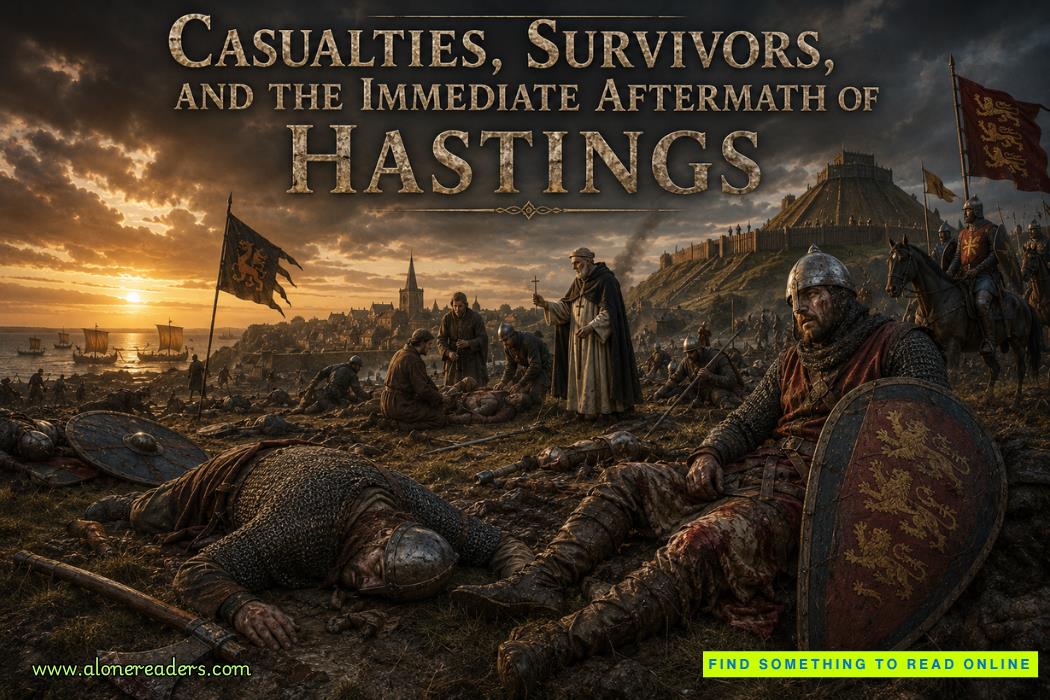
On the evening of 14 October 1066, as darkness fell over Senlac Hill, the battlefield near Hastings was less a monument to glory than a charnel landscape of broken shields, shattered spears, and the bodies of men who had fought from sunrise to sunset. The death of King Harold II and the collapse of the Anglo-Saxon army did not end the crisis of 1066; it opened a new phase in which the fate of survivors, the treatment of the dead, and the political vacuum in London would determine whether William, Duke of Normandy, could transform a tactical victory into a lasting conquest.
The human cost of the battle and its immediate aftermath shaped the early character of Norman England. Casualty figures remain uncertain, but the scale of loss among the Anglo-Saxon elite was decisive: with Harold and his brothers Gyrth and Leofwine dead, the core of the House of Godwin and much of the professional huscarl corps were destroyed. Norman losses, though lower, were still significant enough to force caution in William’s subsequent operations. In the days and weeks that followed, the treatment of prisoners, the identification of the king’s body, the survival of key nobles, and the rapid reorganization of power in London and Kent became as important as the fighting itself. This article examines the casualties and survivors of Hastings, then traces the immediate political, military, and social consequences that carried William from the ridge near Battle to his coronation in Westminster Abbey on Christmas Day 1066.
Anglo-Saxon England on the eve of 1066 was a wealthy, centralized kingdom with a strong royal administration, a network of shires, and a military system built around the fyrd (local levies) and the huscarls (professional household troops). Edward the Confessor’s long reign had seen growing Norman influence at court, but the witan—the council of leading nobles and bishops—retained the right to choose a king. When Edward died on 5 January 1066, the witan elected Harold Godwinson, earl of Wessex, who was crowned on 6 January. His claim rested on proximity to power, family ties through his sister Ealdgyth (Edith), and alleged designation by Edward. Yet the succession was immediately contested by William of Normandy, who asserted a prior promise from Edward and an oath from Harold, and by Harald Hardrada of Norway, who invoked an old agreement between Magnus the Good and Harthacnut.
The military context of Hastings cannot be separated from the Stamford Bridge campaign. On 25 September 1066, Harold defeated and killed Harald Hardrada and his own brother Tostig at Stamford Bridge, near York, inflicting heavy losses on the Viking army but also exhausting his own forces. Within days, William landed at Pevensey on 28 September, established a fortified camp, and by 29 September had occupied Hastings, building a wooden motte-and-bailey castle to secure his beachhead. Harold, informed of the landing, marched south with remarkable speed, reaching London by 6 October and then advancing to Senlac Hill by 13 October. The English army took up a strong defensive position on the ridge, flanked by woods and marsh, and formed a dense shield wall of huscarls and fyrd infantry. William’s army, a mixed force of Norman, Breton, and Flemish contingents, deployed in three divisions with archers in front, infantry behind, and cavalry in reserve.
The battle began at around nine in the morning with a volley of Norman arrows that did little damage against the elevated shield wall. Repeated infantry and cavalry assaults failed to break the English line, and at one point a rumour that William had been killed nearly caused a rout among the Bretons on the Norman left. William rode through his ranks with his visor raised to prove he was alive, rallied his men, and led a counter-attack that destroyed an English force that had pursued the retreating Normans onto lower ground. The afternoon likely saw a pause for rest and reorganization, followed by further assaults and the use of feigned retreats to draw elements of the English line out of position. These tactics probably killed many huscarls, who were then replaced by less experienced fyrd troops. Towards evening, as the English line finally began to crumble, Harold was killed—traditionally said to have been struck in the eye by an arrow and then cut down by knights—along with his brothers Gyrth and Leofwine. With their king and commanders dead, the remaining English forces broke and fled, pursued by Norman cavalry as far as a place later remembered as the Malfosse, where a last desperate stand by some English troops inflicted serious wounds on Eustace of Boulogne before being annihilated.
Casualty figures for Hastings are necessarily approximate, but the pattern is clear: the English suffered proportionally heavier losses, especially among their leadership. Modern estimates suggest around 4,000 English dead and 2,000 Normans, though some scholars argue for totals between 5,000 and 6,000 across both armies. What is certain is that roughly half of the known English participants at Hastings did not survive, including the king and his two brothers, while the Norman nobility—though better documented—also lost a significant fraction of their commanders. The huscarls, who formed the core of the English army, were particularly hard hit; many fought to the death around Harold’s body, and their destruction removed the professional backbone of Anglo-Saxon military power. For the Normans, the loss of experienced knights and officers was serious enough to constrain William’s immediate operations; he could not afford another major engagement until reinforcements arrived and his position was consolidated.
The fate of the dead and the wounded formed the first chapter of the aftermath. Norman dead were gathered and buried, likely in a common grave near the battlefield, though its exact location remains unknown. English bodies, by contrast, were left on the field for some time, a grim signal of William’s assertion of victory and a practical measure given the scale of the slaughter. Later tradition holds that Harold’s body was so badly mutilated that it could only be identified by personal marks known to his mistress, Edith Swanneck, though other accounts suggest recognition by his armour or by companions who had fought beside him. William is said to have granted the king’s body for burial without ransom, and Harold was eventually interred at Waltham Abbey, a foundation with which he had close ties. The fate of other high-ranking English dead is less clear; many were probably left where they fell or buried locally, their absence contributing to the rapid collapse of regional command structures.
Among the survivors, the picture was mixed. Some prominent English nobles escaped the battlefield and returned to London, including the standard-bearer Ansgar, who, though wounded, made his way back to the capital and would later play a role in the submission to William. Members of the House of Godwin who had not been at Hastings, such as Harold’s sons by Edith Swanneck, fled to Ireland and would later attempt invasions of the south-west. The young Edgar Ætheling, grandson of Edmund Ironside and a member of the old House of Wessex, was not present at the battle but immediately emerged as a figurehead for continued resistance. In London, the witan and leading nobles—including the archbishops Stigand and Ealdred, and the earls Edwin of Mercia and Morcar of Northumbria—initially rejected submission and proclaimed Edgar king, hoping to rally a new army. This decision reflected both dynastic loyalty and a calculation that William, with his army weakened and isolated in the south-east, could be contained or forced to negotiate.
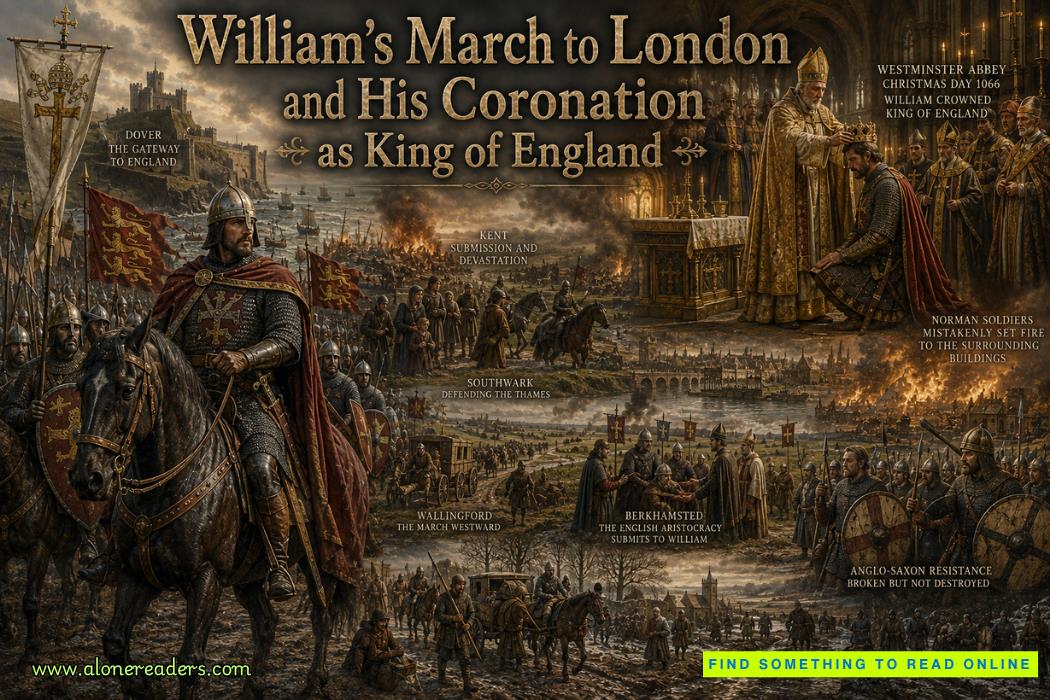
William, however, understood that his victory at Hastings would be meaningless unless he secured London and obtained formal recognition as king. He did not march directly on the city. Instead, he executed a carefully planned campaign of coercion and demonstration, moving along the coast and then inland to isolate the capital. From mid-October he advanced to Dover, which surrendered without a fight, then to Canterbury, where he received the submission of local leaders. He secured Winchester, the royal treasury and administrative centre, effectively cutting off southern resources from London. By November, he was approaching the capital from the south-west, but found the city unwilling to open its gates. Rather than risk a costly assault, William crossed the Thames at Wallingford, receiving the submission of Stigand, and then circled north of London through the Chilterns, devastating the countryside to demonstrate his power and cut off supplies. This maneuver forced the English leadership to confront the reality that no relieving army was coming and that resistance would only bring further destruction.
In early December, at Berkhamsted, the English nobility formally submitted to William. Edgar Ætheling, Edwin, Morcar, and other leading figures acknowledged William as king, effectively ending the political resistance that had coalesced around London. This submission was not merely an act of personal loyalty; it was a recognition that the institutions of the kingdom—the witan, the shire administration, the church—could continue to function only under a recognized monarch. William’s restraint in not sacking London and his willingness to accept the surrender of the old elite were calculated moves to present himself as a legitimate successor to the Anglo-Saxon kings rather than a foreign destroyer. On 25 December 1066, in Westminster Abbey, William was crowned William I, King of England, by Archbishop Ealdred, in a ceremony that combined Norman and English elements and symbolized the fusion of conquest and continuity.
The immediate consequences of Hastings were thus both military and political. Militarily, the destruction of the huscarls and the death of the Godwinsons left England without a coherent field army capable of challenging William in open battle. Politically, the submission at Berkhamsted and the coronation in Westminster gave William the legal and religious legitimacy he needed to begin the transformation of the kingdom. Yet the conquest was far from complete. Over the next five years, William would face repeated revolts—in Exeter, in the north, and in the Fens under Hereward the Wake—and would respond with brutal repression, most notoriously in the Harrying of the North in 1069–1070. The seeds of these conflicts were already present in the aftermath of Hastings: the survival of members of the House of Godwin, the presence of Edgar Ætheling as an alternative claimant, and the resentment of a displaced aristocracy.
Historians have long debated the extent to which Hastings was a decisive turning point or merely the first major step in a longer process of conquest. Some emphasize the battle’s immediate political impact: with the king and his leading supporters dead, the centralized Anglo-Saxon state was decapitated, allowing William to impose his authority with relatively little institutional resistance. Others point to the resilience of English identity and the persistence of resistance movements, arguing that the real transformation occurred gradually through castle-building, land redistribution, legal reforms, and the replacement of the English aristocracy with Norman and French lords. The Domesday Book, compiled in 1086, would later reveal the extent of this transformation, documenting a new landholding elite and a reorganized system of taxation and justice.
The legacy of Hastings and its aftermath is visible in many aspects of medieval and modern England. The Bayeux Tapestry, likely commissioned by William’s half-brother Odo of Bishop of Bayeux, presents a Norman narrative of the conquest, emphasizing Harold’s oath and the justice of William’s cause while immortalizing the battle’s key moments. Archaeological evidence from the battlefield and from early Norman castles supports the written accounts of a rapid military occupation and fortification programme. In literature and popular culture, Harold is often portrayed as a tragic hero, cut down at the moment of victory over the Vikings, while William is depicted as a ruthless but capable conqueror. The debate over the exact manner of Harold’s death—arrow to the eye, or cut down by knights—continues to attract scholarly attention, reflecting broader questions about the reliability of sources and the construction of national myths.
Ultimately, the casualties, survivors, and immediate aftermath of Hastings reveal a moment of profound rupture and equally profound continuity. The battle ended the life of the last crowned Anglo-Saxon king and destroyed the military elite that had defended England for generations. Yet the institutions of the kingdom—the shires, the church, the law—proved durable enough to be absorbed into a new Norman framework. William’s skill lay not only in winning the battle but in converting victory into governance, using the submission of the English nobility, the symbolism of coronation, and the strategic control of key towns to lay the foundations of Norman England. The human cost was immense, but the political outcome was decisive: by the end of 1066, the Norman Conquest had moved from a military campaign to a dynastic reality, reshaping the destiny of England and its place in Europe.




 The Hundred Days Offensive: How the Allies Defeated Germany in World War I
 The Second Battle of the Marne: The Turning Point of World War I in 1918
 The Spring Offensive of 1918: Germany's Final Gamble to Win World War I
 The Treaty of Brest-Litovsk: How Russia Left World War I
 The Russian Revolution and World War I: How War Brought Down the Tsar
 The Zimmermann Telegram Explained: Germany's Secret Offer to Mexico in World War I










