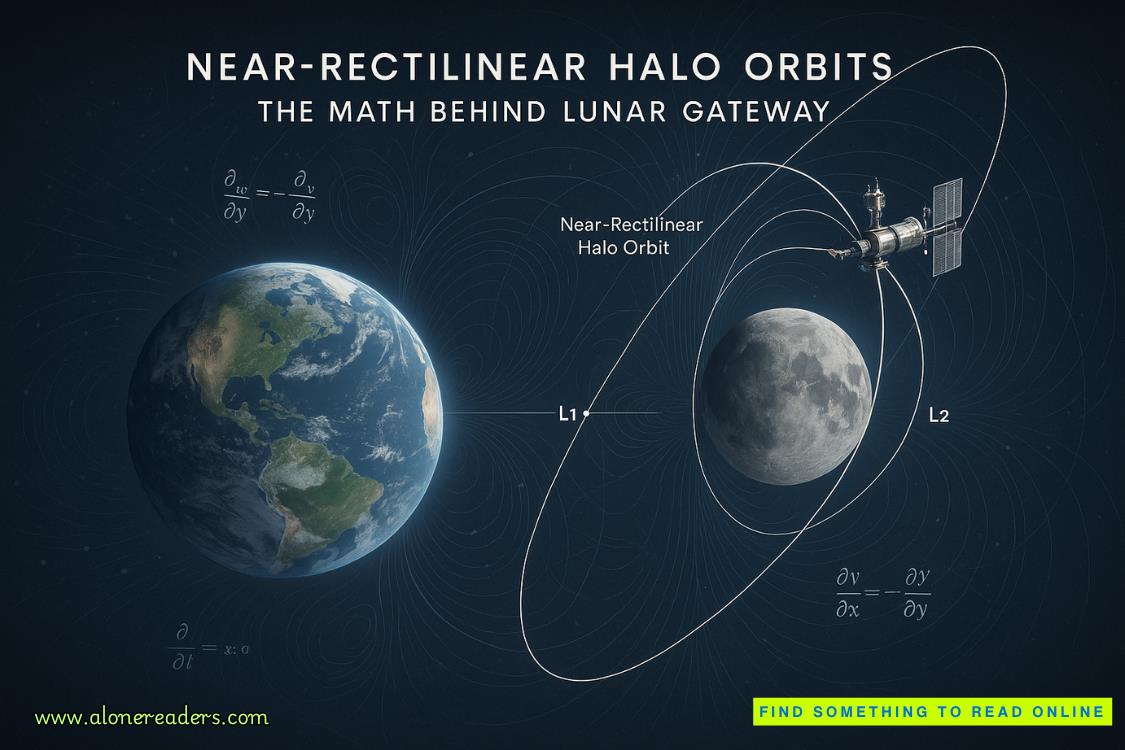
Near-Rectilinear Halo Orbits, commonly abbreviated as NRHOs, represent one of the most mathematically sophisticated orbital solutions ever used for a human-rated space infrastructure. Unlike circular or elliptical orbits familiar from traditional satellite mechanics, an NRHO is a dynamically balanced trajectory shaped by the competing gravitational forces of two massive bodies—in this case, Earth and the Moon. NASA’s decision to place the Lunar Gateway in such an orbit reflects not convenience, but an explicit reliance on advanced three-body mathematics, nonlinear dynamics, and modern computational astrodynamics.
At its core, an NRHO exists within the framework of the restricted three-body problem, a classical physics challenge that studies how a small object moves under the gravitational influence of two much larger bodies. While the problem has been studied for centuries, its equations do not admit closed-form solutions. Instead, NRHOs emerge from numerical methods that analyze stability regions in phase space rather than fixed orbital paths. This already distinguishes them fundamentally from traditional Keplerian orbits.
The Earth-Moon system possesses five equilibrium points, known as Lagrange points, where gravitational and centrifugal forces balance. Near these points, families of complex orbits arise, including halo orbits, Lyapunov orbits, and Lissajous trajectories. Near-Rectilinear Halo Orbits are a specialized subset of halo orbits, characterized by extreme eccentricity. The spacecraft swings very close to the Moon at perilune, then arcs far away toward Earth before returning in a looping, three-dimensional path. This shape is not incidental—it is mathematically tuned to exploit gravitational gradients for stability and efficiency.
What makes an NRHO “near-rectilinear” is its geometry near the Moon. At perilune, the trajectory becomes almost straight-line relative to the lunar surface, giving the orbit its name. This rectilinear segment occurs because the spacecraft’s velocity vector aligns strongly with the Earth-Moon line, a configuration that arises naturally from solutions to the three-body equations near certain invariant manifolds. These manifolds act as gravitational corridors, guiding motion with minimal propulsion.
The mathematical foundation of NRHOs relies heavily on rotating reference frames. In the synodic frame—where Earth and Moon remain fixed in space—the spacecraft’s equations of motion include Coriolis and centrifugal terms. These additional forces are not approximations; they are essential to understanding how the orbit remains bounded without constant thrust. In this rotating frame, NRHOs appear as closed loops, even though they are highly non-intuitive in inertial space.
Stability is a key reason NRHOs were selected for the Lunar Gateway, but this stability is subtle and conditional. NRHOs are not stable in the classical sense like low Earth orbit. Instead, they possess what is known as weak stability. Small deviations grow slowly, allowing infrequent correction maneuvers. This property arises from the eigenstructure of the system’s linearized equations, where unstable modes exist but evolve over long timescales. Engineers can predict and control these modes using state transition matrices derived from the system’s Jacobian.
One of the most critical mathematical advantages of NRHOs is their energy efficiency. Traditional lunar orbits require significant delta-v to maintain altitude and orientation due to the Moon’s irregular gravity field. NRHOs, by contrast, naturally avoid long exposure to mascons. Their high perilune passes are brief, minimizing gravitational perturbations, while most of the orbit occurs far from the Moon where the gravitational field is smoother. This distribution dramatically reduces station-keeping fuel requirements.
Communication geometry also plays a mathematically decisive role. NRHOs are designed so that the spacecraft maintains continuous or near-continuous line-of-sight to Earth. This is not a coincidence but the result of optimizing the orbit’s phase angle relative to Earth. By selecting specific orbital periods—typically around seven days—engineers ensure that Earth never passes behind the Moon from the Gateway’s perspective. This continuous visibility simplifies navigation, telemetry, and crew safety considerations.
Thermal stability is another outcome of orbital mathematics. The NRHO’s orientation ensures relatively stable Sun angles over time. Because the orbit’s plane and precession rates are carefully selected, the spacecraft avoids rapid transitions between sunlight and shadow. This predictability reduces thermal cycling stress on materials and simplifies power generation models, especially for solar arrays that depend on consistent illumination.
From a navigation standpoint, NRHOs demand extreme precision. Traditional orbit determination techniques must be augmented with high-fidelity dynamical models that account for third-body effects, solar radiation pressure, relativistic corrections, and non-uniform lunar gravity. The Gateway’s trajectory is maintained using continuous state estimation, where onboard and ground-based systems constantly update the spacecraft’s predicted position within a multi-dimensional state space.
The concept of invariant manifolds is central to understanding why NRHOs are viable at all. These manifolds act like invisible rails in space, channeling motion along predictable paths. By inserting the Gateway onto the correct manifold, mission planners leverage natural dynamics instead of fighting them. This approach represents a philosophical shift in spaceflight—from overpowering gravity to collaborating with it.
Another mathematical feature of NRHOs is their scalability. Once a particular NRHO solution is computed, families of related orbits can be generated by slightly adjusting energy levels or phase parameters. This flexibility allows mission designers to adapt the orbit for different payloads, mission durations, or operational constraints without re-deriving the entire solution from scratch.
The Lunar Gateway’s NRHO also serves as a staging node for deep-space missions. The orbit’s energy level makes transfers to lunar surface sites and interplanetary trajectories remarkably efficient. From a mathematical perspective, the Gateway sits at an energetic crossroads where small velocity changes can redirect spacecraft toward vastly different destinations. This property is invaluable for sustainable exploration architectures.
What makes NRHOs particularly remarkable is that they were impractical before the advent of modern computing. Their existence was known theoretically, but their precise computation requires numerical integration, continuation methods, and high-order perturbation analysis. Only with contemporary computational power could engineers model their long-term behavior with the confidence required for human missions.
In a broader sense, Near-Rectilinear Halo Orbits symbolize the maturation of astrodynamics as a discipline. They demonstrate how abstract mathematical concepts—phase space, nonlinear stability, eigenvalues, and manifolds—can directly shape real-world engineering decisions. The Lunar Gateway is not merely orbiting the Moon; it is embedded within a living mathematical system that balances forces with extraordinary precision.
As humanity pushes further into deep space, NRHOs are likely to become more common, not less. They represent a class of orbits that prioritize efficiency, adaptability, and elegance over brute force. In choosing an NRHO for the Lunar Gateway, NASA has effectively turned advanced mathematics into mission infrastructure, proving that the future of space exploration will be written as much in equations as in rocket engines.



 Château de Vincennes: France’s Forgotten Royal Fortress and Medieval Stronghold
 Château de Carcassonne: Europe’s Greatest Medieval Citadel and Fortress
 Château de Chenonceau: The Castle Built by Remarkable Women
 Château de Chambord: France’s Magnificent Renaissance Castle and Architectural Wonder
 Tehri Dam: India's Tallest Dam and the Debate Behind It
 Bhakra Nangal Dam: India's Temple of Modern Development