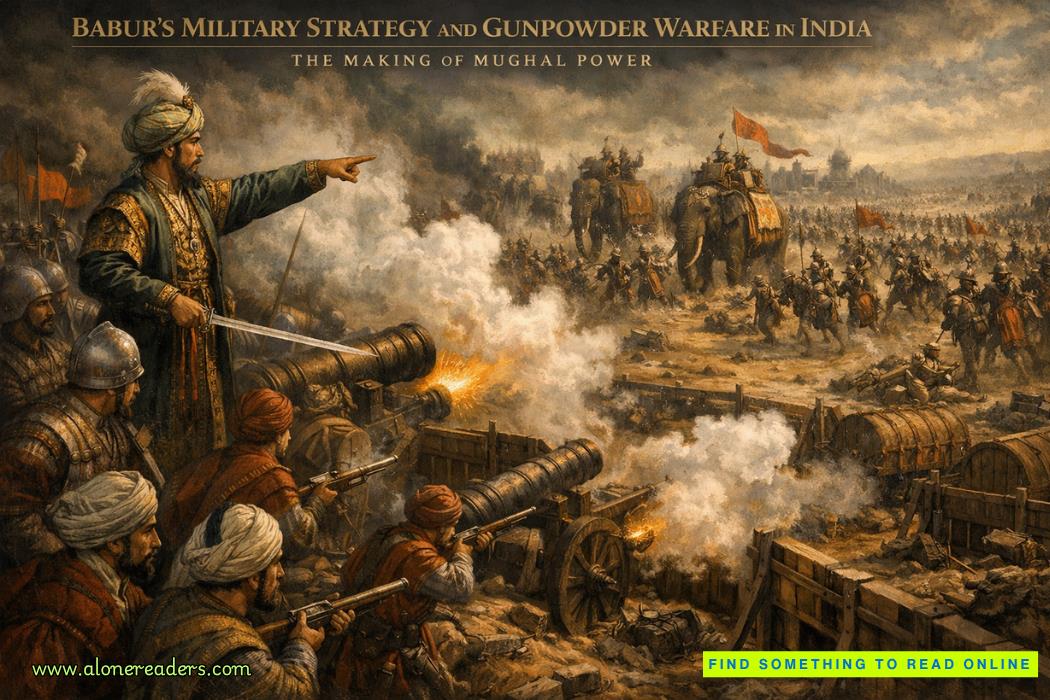
The emergence of Babur in the Indian subcontinent represents one of the most decisive turning points in South Asian military history, not merely because of conquest but due to the systematic introduction of disciplined gunpowder warfare integrated with mobile steppe tactics. Unlike earlier Central Asian invaders who relied primarily on cavalry shock and opportunistic raids, Babur approached warfare as a calculated synthesis of Turko-Mongol mobility, Persian organizational discipline, and Ottoman gunpowder technology. His campaigns in India, particularly against the forces of Ibrahim Lodi, reveal a commander who understood not only the mechanics of battle but also the psychology of warfare, terrain exploitation, and force multiplication through technology.
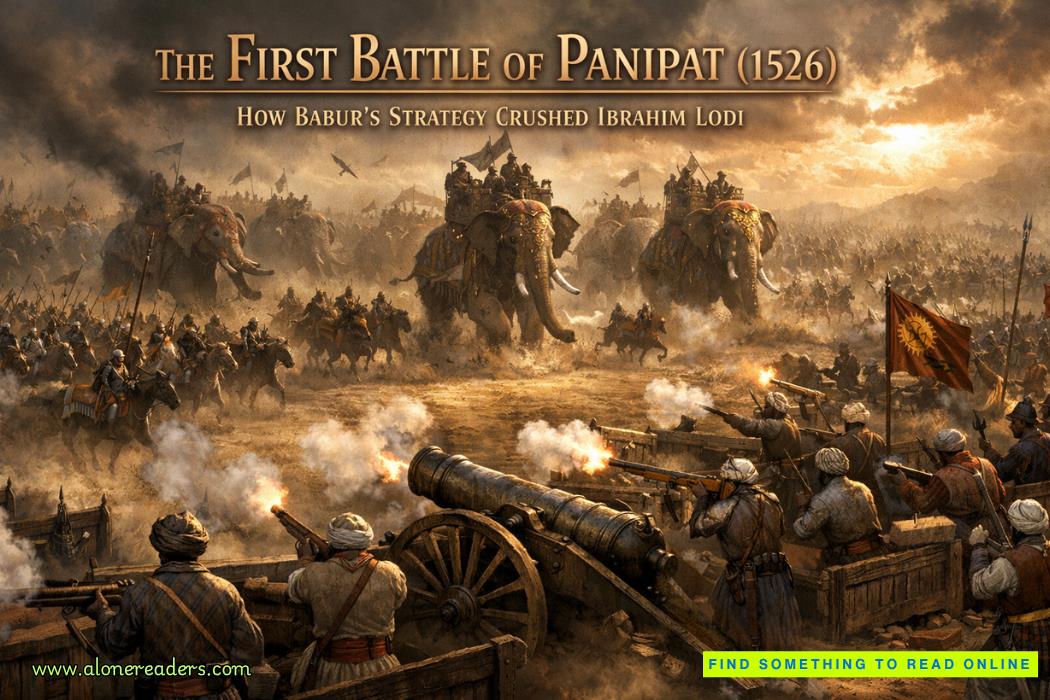
The defining moment of Babur’s military system came during the First Battle of Panipat, where he confronted an army vastly superior in numbers. Ibrahim Lodi commanded tens of thousands of troops and hundreds of war elephants, a formidable combination in traditional Indian warfare. However, Babur transformed this apparent disadvantage into an opportunity by introducing field artillery and matchlock firearms as decisive battlefield tools. His artillery, under the command of Ottoman gunners like Ustad Ali Quli and Mustafa Rumi, was not merely ornamental but tactically integrated into a defensive-offensive system that neutralized the enemy’s numerical strength.
Central to Babur’s innovation was the use of the “Ottoman-style wagon laager”, a defensive formation where carts were lashed together with rawhide ropes, forming a fortified line. Between these carts, gaps were left for matchlock men and artillery pieces to fire upon advancing enemies. This arrangement, often described as tabur or araba formation, effectively created a mobile fortress on the battlefield. The psychological impact of this setup was profound. War elephants, accustomed to charging infantry lines, were terrified by the noise, smoke, and destructive force of cannon fire, often turning back into their own ranks and causing chaos. This was not accidental but a deliberate exploitation of enemy vulnerabilities, demonstrating Babur’s acute understanding of both technology and opponent behavior.
Equally significant was Babur’s application of the tulughma tactic, a classic Central Asian maneuver adapted to Indian conditions. This involved dividing the army into multiple flanking units that could encircle the enemy once engagement began. While the center held firm behind artillery and defensive works, the wings executed rapid cavalry movements to attack the enemy from the sides and rear. This dual system of static firepower combined with dynamic cavalry encirclement was revolutionary in the Indian context, where battles often depended on frontal assaults and brute force. Babur’s forces effectively turned the battlefield into a controlled killing zone, where the enemy was first disorganized by artillery and then annihilated by cavalry strikes.
Another layer of Babur’s military sophistication lies in his logistical and organizational discipline. Unlike many contemporary rulers who relied on feudal levies, Babur maintained a more cohesive and loyal force, often bound by personal allegiance and shared campaign experience. His army was smaller but highly trained, disciplined, and responsive to command structures. This allowed him to execute complex battlefield maneuvers with precision, a critical advantage when coordinating artillery fire with cavalry movements. His ability to maintain morale during long campaigns, despite harsh conditions and uncertain prospects, reflects not only leadership but also a deep strategic vision rooted in long-term conquest rather than opportunistic plunder.
The Battle of Khanwa further illustrates the maturation of Babur’s military doctrine. Facing the Rajput confederacy led by Rana Sanga, Babur encountered an adversary that combined numerical strength with exceptional battlefield courage. Unlike Ibrahim Lodi’s forces, the Rajputs were highly motivated and tactically aggressive. Babur responded by reinforcing his reliance on gunpowder weapons and defensive formations while intensifying his use of tulughma maneuvers. The battle demonstrated that gunpowder warfare was not merely effective against disorganized forces but could also break elite warrior traditions when properly applied. The sustained use of artillery disrupted Rajput charges, while coordinated cavalry attacks fragmented their formations, leading to a decisive Mughal victory.
It is crucial to understand that Babur’s success was not solely technological. Gunpowder weapons had existed in India prior to his arrival, but they were often used in a limited or uncoordinated manner. What Babur achieved was the integration of gunpowder into a coherent military doctrine. Artillery was not an isolated component but part of a broader system that included reconnaissance, terrain selection, disciplined infantry deployment, and cavalry mobility. This holistic approach transformed warfare from a contest of numbers into a contest of systems, where coordination and innovation outweighed sheer manpower.
Babur’s strategic thinking also extended beyond the battlefield into campaign planning and geopolitical positioning. He carefully selected routes of invasion, secured supply lines, and established fortified bases to maintain operational continuity. His use of intelligence networks allowed him to assess enemy strengths and weaknesses before engagement. Moreover, his willingness to adapt, whether by adopting Ottoman artillery techniques or modifying Central Asian tactics for Indian terrain, underscores a flexibility that is often absent in traditional narratives of conquest. Babur was not bound by rigid doctrines; instead, he evolved his methods in response to changing conditions.
Another dimension of Babur’s military effectiveness was his psychological warfare. He often used displays of power, strategic communication, and symbolic acts to influence both his troops and his enemies. After key victories, he emphasized the inevitability of his success, thereby weakening resistance and encouraging defections. His memoirs reveal a leader deeply aware of morale as a decisive factor in warfare. By framing his campaigns as both a personal destiny and a broader mission, he cultivated a sense of purpose among his soldiers, which translated into resilience on the battlefield.
The long-term implications of Babur’s military innovations are profound. His victories laid the foundation for the Mughal Empire, but more importantly, they redefined the nature of warfare in the Indian subcontinent. Subsequent rulers, both Mughal and non-Mughal, were compelled to adopt gunpowder weapons and reorganize their armies along similar lines. The era of elephant-dominated warfare gradually gave way to artillery-centered combat supported by infantry and cavalry coordination. This transformation was not immediate but irreversible, marking the beginning of early modern military practices in South Asia.
Babur’s legacy in military history can therefore be understood as a convergence point between medieval and early modern warfare. He did not simply introduce new weapons; he introduced a new way of thinking about war. His campaigns demonstrate that technology alone is insufficient without tactical integration, and strategy is ineffective without adaptability. By combining mobility, firepower, discipline, and psychological insight, Babur created a military system that was both innovative and sustainable.
In evaluating Babur’s role, it is essential to move beyond the simplistic narrative of conquest and recognize the structural transformation he initiated. His use of gunpowder warfare was not an isolated phenomenon but part of a broader shift in global military practices during the sixteenth century. However, his ability to successfully implement these changes in the diverse and complex environment of India highlights his exceptional capabilities as a commander.
Ultimately, Babur’s military strategy represents a decisive break from traditional patterns of warfare in the region. Through careful planning, technological integration, and tactical innovation, he overcame numerical inferiority and established a new paradigm of power. His victories at Panipat and Khanwa were not accidents of history but the result of a deliberate and sophisticated military vision that reshaped the trajectory of the Indian subcontinent for centuries to come.



 The Hundred Days Offensive: How the Allies Defeated Germany in World War I
 The Second Battle of the Marne: The Turning Point of World War I in 1918
 The Spring Offensive of 1918: Germany's Final Gamble to Win World War I
 The Treaty of Brest-Litovsk: How Russia Left World War I
 The Russian Revolution and World War I: How War Brought Down the Tsar
 The Zimmermann Telegram Explained: Germany's Secret Offer to Mexico in World War I