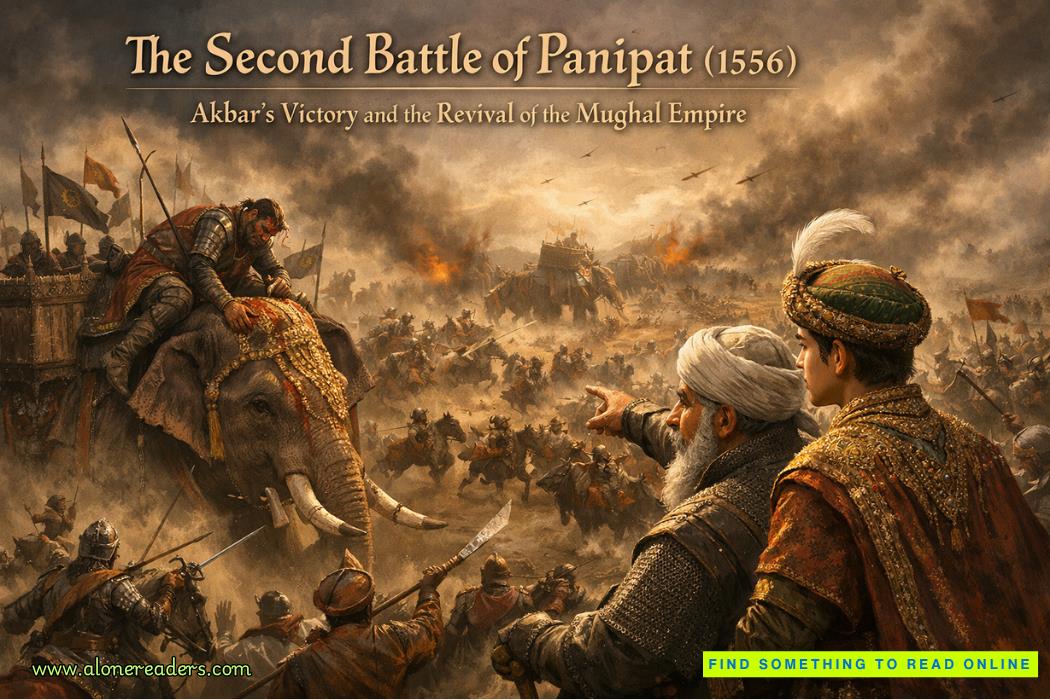
The Second Battle of Panipat, fought on November 5, 1556, stands as one of the most decisive turning points in Indian history. It was not merely a clash between two armies; it was a struggle that determined the political future of North India. At stake was the survival of the Mughal Empire, which had been weakened after the death of Humayun, and the ambitions of a rising Hindu general, Hemu, who sought to establish his own rule over Delhi. The outcome of this battle not only secured Akbar’s position as a ruler but also laid the foundation for one of the most powerful empires in the Indian subcontinent.
The political backdrop leading to this confrontation was marked by instability and uncertainty. After Babur’s victory in the First Battle of Panipat in 1526, the Mughal Empire was established in India. However, Babur’s son, Humayun, struggled to maintain control and was eventually defeated by Sher Shah Suri, leading to the temporary collapse of Mughal authority. It was only after years of exile that Humayun managed to reclaim Delhi in 1555, but his sudden death in 1556 left the empire vulnerable once again. His son, Akbar, was only thirteen years old at the time, making the situation even more precarious.
During this fragile transition, Hemu, a brilliant military commander and administrator serving under the Sur dynasty, rose rapidly to power. Known for his strategic acumen and relentless ambition, Hemu had already won several battles against rival factions. Seizing the opportunity presented by Mughal instability, he marched toward Delhi and Agra, capturing both cities with remarkable speed. Declaring himself ruler with the title of Vikramaditya, Hemu aimed to establish a new era of indigenous rule, challenging the Mughal claim to power.
At this critical juncture, Akbar was under the guardianship of his regent, Bairam Khan, an experienced and loyal statesman. Recognizing the magnitude of the threat posed by Hemu, Bairam Khan quickly mobilized the Mughal forces. The decision to confront Hemu at Panipat was both strategic and symbolic, as the same ground had witnessed Babur’s historic victory three decades earlier. The choice of battlefield reflected a desire not only to defend the empire but to reaffirm Mughal legitimacy.
The Mughal army, though relatively smaller, was highly disciplined and well-organized. It relied on a combination of cavalry, archers, and artillery, reflecting the military innovations introduced by Babur. In contrast, Hemu’s forces were numerically superior and included a formidable contingent of war elephants, which were considered powerful shock units in medieval Indian warfare. At the outset, the advantage seemed to lie with Hemu, whose army appeared unstoppable.
As the battle commenced, Hemu personally led his troops from the front, mounted on a war elephant, inspiring his soldiers with his presence. His forces launched a fierce assault on the Mughal lines, causing significant disruption. For a time, it seemed that Hemu would achieve yet another victory, potentially ending Mughal aspirations in India. The Mughal army began to falter under the pressure, and the situation grew increasingly desperate.
However, the course of the battle changed dramatically due to a single, unforeseen event. In the midst of the fighting, Hemu was struck in the eye by an arrow. Severely wounded and rendered unconscious, he collapsed within his howdah atop the elephant. This sudden loss of leadership created confusion and panic among his troops. In pre-modern warfare, the presence of a commanding leader often played a crucial role in maintaining morale and coordination. Without Hemu’s direction, his army began to lose cohesion.
Sensing the opportunity, the Mughal forces regrouped and launched a counterattack. The tide of the battle shifted rapidly. Hemu’s army, once dominant, started to retreat as uncertainty spread through its ranks. Eventually, Hemu was captured by Mughal soldiers and brought before Akbar and Bairam Khan. According to historical accounts, Bairam Khan urged the young emperor to strike the final blow, symbolizing his authority as a sovereign ruler. Although interpretations vary, this moment is often seen as a defining episode in Akbar’s early reign.
The victory at Panipat was far more than a military success; it marked the revival of the Mughal Empire. Without this triumph, the Mughal dynasty might have faded into obscurity. Instead, the battle secured Delhi and Agra, the political and economic centers of North India, providing a stable base from which Akbar could expand his rule. It also eliminated a formidable rival who had the potential to establish an alternative power structure in the region.
One of the most significant aspects of this victory was the role played by Bairam Khan. As regent, he not only guided the young Akbar but also demonstrated exceptional leadership and strategic insight. His decision-making during the campaign ensured that the Mughal forces were able to withstand initial setbacks and ultimately prevail. At the same time, the battle highlighted Akbar’s emergence as a ruler, even if he was still under guidance. It set the stage for his transformation into one of the greatest emperors in Indian history.
In the years following the battle, Akbar consolidated his power and embarked on a series of administrative and military reforms. He expanded the empire through a combination of conquest and diplomacy, incorporating diverse regions and communities into his administration. His policies of religious tolerance and inclusive governance distinguished him from many of his predecessors and contributed to the stability and prosperity of the empire. The foundations laid by the victory at Panipat allowed these developments to take root.
The battle also had broader implications for the subcontinent. It signaled the end of significant resistance from the remnants of the Sur dynasty and reaffirmed the dominance of the Mughals in North India. This consolidation of power created a relatively unified political structure, which facilitated economic growth, cultural exchange, and artistic development. The Mughal Empire would go on to become a center of architectural brilliance, literary achievement, and administrative innovation.
From a military perspective, the Second Battle of Panipat illustrates the importance of leadership, strategy, and adaptability. Despite being outnumbered, the Mughal forces were able to capitalize on a critical moment and turn the tide in their favor. The use of artillery and disciplined formations played a crucial role in offsetting the numerical advantage of Hemu’s army. At the same time, the battle underscores the vulnerability of armies that rely heavily on a single leader. Hemu’s injury demonstrates how quickly fortunes can change when leadership is compromised.
The psychological dimension of the battle is equally noteworthy. The sudden collapse of Hemu’s command structure had a profound impact on the morale of his troops. In contrast, the Mughal forces, motivated by the prospect of survival and resurgence, displayed resilience and determination. This contrast highlights the complex interplay between morale, leadership, and battlefield dynamics.
It is also important to consider the symbolic significance of the battle. By winning at Panipat, Akbar not only secured his empire but also connected his reign to that of his grandfather, Babur. The battlefield became a site of continuity, linking the founding of the Mughal Empire with its revival. This symbolic resonance reinforced the legitimacy of Mughal rule and contributed to the narrative of destiny and victory that surrounded the dynasty.
In retrospect, the Second Battle of Panipat can be seen as a moment of convergence, where multiple historical forces intersected. The decline of the Sur dynasty, the ambitions of Hemu, the vulnerability of a young emperor, and the strategic brilliance of Bairam Khan all came together in a single decisive event. The outcome shaped the course of Indian history for generations to come.
The story of this battle also offers a compelling human dimension. It is a tale of ambition, resilience, and the unpredictable nature of fate. Hemu, who rose from modest beginnings to challenge an empire, embodies the possibilities and risks of power. Akbar, who faced a grave threat at a young age, represents the potential for growth and transformation. Bairam Khan, who guided the empire through a critical period, exemplifies loyalty and leadership.
Ultimately, the Second Battle of Panipat was not just about victory or defeat; it was about the redefinition of power in the Indian subcontinent. It marked the beginning of a new chapter in which the Mughal Empire would rise to unprecedented heights. The legacy of this battle continues to be felt, not only in historical narratives but also in the cultural and political fabric of the region.
Through this decisive confrontation, Akbar secured more than a throne; he secured the future of an empire that would shape the destiny of millions. The field of Panipat, once again, proved to be the stage upon which history was rewritten, and where the foundations of Mughal greatness were firmly established.



 The Hundred Days Offensive: How the Allies Defeated Germany in World War I
 The Second Battle of the Marne: The Turning Point of World War I in 1918
 The Spring Offensive of 1918: Germany's Final Gamble to Win World War I
 The Treaty of Brest-Litovsk: How Russia Left World War I
 The Russian Revolution and World War I: How War Brought Down the Tsar
 The Zimmermann Telegram Explained: Germany's Secret Offer to Mexico in World War I










