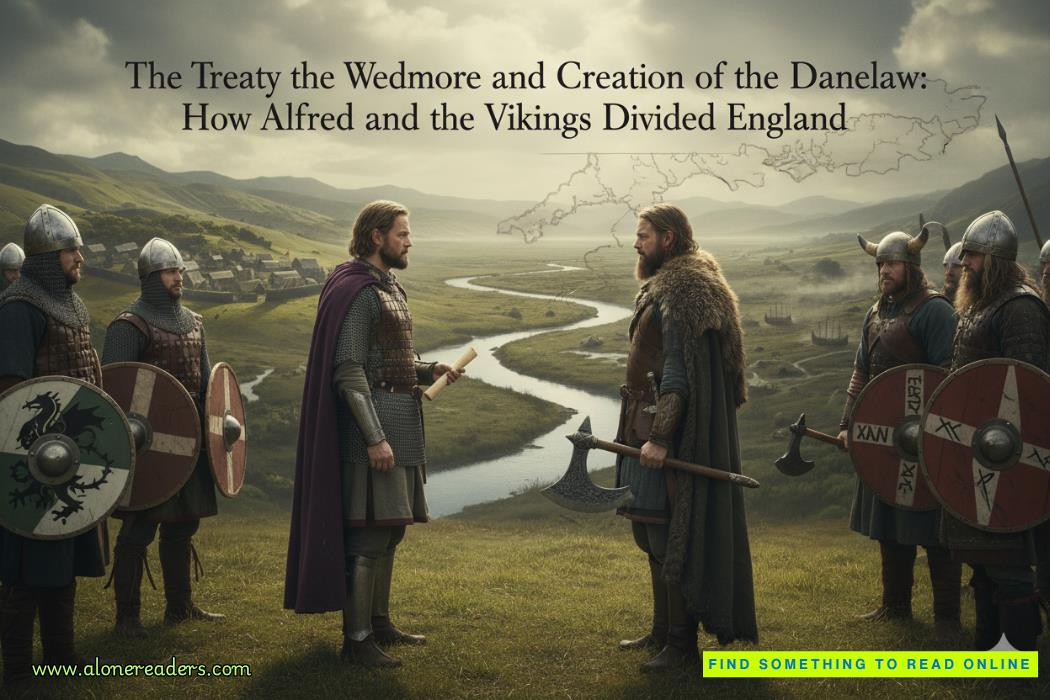
The late ninth century in England was defined by a relentless struggle between the Anglo-Saxon kingdoms and the invading Viking forces from Scandinavia. Among the many turning points of this turbulent era, the Treaty of Wedmore stands out as a decisive moment that reshaped the political and cultural map of England. It was not merely a peace agreement but a foundational event that led to the establishment of the Danelaw, a region where Viking law, customs, and governance took root alongside Anglo-Saxon traditions. This division of land and authority would leave a lasting imprint on English identity, law, and society.
To understand the significance of the Treaty of Wedmore, one must first grasp the severity of the Viking threat during the ninth century. Viking raids had begun as sporadic coastal attacks, but by the 860s, they had evolved into full-scale invasions. The so-called Great Heathen Army, composed of seasoned Norse warriors, arrived in England with the intent not just to plunder but to conquer and settle. Kingdoms such as Northumbria, East Anglia, and Mercia fell under Viking control, leaving Wessex as the last major Anglo-Saxon stronghold resisting total domination.
At the center of this resistance was King Alfred of Wessex, later known as Alfred the Great. His leadership during this period was nothing short of extraordinary. Unlike many of his contemporaries, Alfred combined military resilience with strategic foresight. He understood that defeating the Vikings outright might not be feasible, but containing them and preserving Anglo-Saxon rule was essential.
The crisis reached its peak in 878 when the Viking leader Guthrum launched a surprise attack on Alfred’s forces at Chippenham during the winter. This assault forced Alfred into hiding in the marshes of Athelney, a moment that has become legendary in English history. Yet this apparent defeat marked the beginning of a remarkable comeback. Alfred reorganized his forces, rallied local support, and launched a counteroffensive that culminated in the Battle of Edington.
The Battle of Edington was a decisive confrontation. Alfred’s army defeated Guthrum’s forces, forcing the Viking leader into a position where negotiation became inevitable. It was this victory that set the stage for what would later be known as the Treaty of Wedmore. While the exact details of the treaty remain somewhat debated among historians, its outcomes are clear and profound.
One of the most significant terms of the agreement was Guthrum’s conversion to Christianity. This was not merely a religious gesture but a powerful political act. By accepting baptism, Guthrum acknowledged Alfred’s cultural and spiritual authority, even as he retained control over certain territories. Alfred himself reportedly stood as Guthrum’s godfather, symbolizing a new relationship that blended rivalry with mutual recognition.
Equally important was the territorial division that followed. England was effectively split into two spheres of influence. The southern and western regions remained under Anglo-Saxon control, while the northern and eastern areas came under Viking rule. This Viking-controlled territory became known as the Danelaw, a term that reflects the application of Danish laws and customs.
The creation of the Danelaw was not just a political arrangement but a profound cultural transformation. Within this region, Scandinavian settlers established communities, farmed the land, and integrated aspects of their legal and social systems. Place names ending in “-by,” “-thorpe,” and “-toft” are enduring reminders of this Viking presence. These linguistic traces reveal how deeply the Norse influence penetrated everyday life.
Legal practices in the Danelaw also differed from those in Anglo-Saxon England. Viking law emphasized collective responsibility and compensation, often favoring practical resolutions over rigid hierarchical structures. This contrasted with the more centralized authority of Anglo-Saxon kingship. The coexistence of these systems created a unique legal landscape that would later influence the development of English common law.
Trade and economic activity flourished within the Danelaw. Viking settlers were not only warriors but also skilled traders and craftsmen. Towns such as York, known as Jorvik under Viking rule, became vibrant centers of commerce. Goods flowed between Scandinavia, the British Isles, and even distant regions, fostering a network of exchange that enriched both cultures.
Despite the division, the boundary between Anglo-Saxon and Viking territories was not a rigid barrier. Instead, it functioned as a zone of interaction where cultures blended and adapted. Intermarriage, trade, and shared challenges led to a gradual fusion of identities. Over time, distinctions between “Viking” and “Anglo-Saxon” became less pronounced, giving rise to a more unified English culture.
Alfred’s role in this transformation cannot be overstated. While he accepted the division of his kingdom as a practical necessity, he also used the period of relative peace to strengthen Wessex. He introduced military reforms, established fortified towns known as burhs, and encouraged education and literacy. His efforts ensured that Wessex would remain a strong and resilient power capable of eventually reclaiming lost territories.
The Treaty of Wedmore also had symbolic importance. It demonstrated that even in an age defined by warfare, diplomacy could achieve what brute force alone could not. Alfred’s willingness to negotiate, combined with his ability to secure favorable terms, reflects a sophisticated approach to leadership that balanced pragmatism with ambition.
In the decades following the treaty, the balance of power gradually shifted. Alfred’s successors continued his work, expanding Anglo-Saxon control and integrating the Danelaw into a unified England. By the early tenth century, many Viking-held territories had been reconquered or assimilated. Yet the legacy of the Danelaw endured, shaping the character of the emerging English nation.
The influence of the Danelaw is still visible today, not only in place names but also in language. Many common English words, such as “law,” “sky,” and “window,” have Old Norse origins. This linguistic blending reflects the deeper cultural integration that began with the treaty. It serves as a reminder that the history of England is not a story of isolation but of interaction and exchange.
Moreover, the treaty and the creation of the Danelaw highlight a broader theme in history: the capacity of societies to adapt in the face of external pressure. Rather than being overwhelmed by the Viking invasions, Anglo-Saxon England absorbed and transformed these influences, creating something new and enduring.
It is also important to recognize that the Treaty of Wedmore was not a single document preserved in detail but a set of agreements and understandings reconstructed from later sources. This adds an element of mystery to the event, inviting historians to piece together its implications from limited evidence. Yet its impact is undeniable, as it marked a turning point in the struggle between two powerful cultures.
The story of Alfred and Guthrum is, in many ways, a story of mutual recognition. Both leaders understood that coexistence was preferable to endless conflict. Their agreement laid the groundwork for a period of relative stability that allowed both societies to flourish in their own ways.
In examining the Treaty of Wedmore and the creation of the Danelaw, one sees not just a division of land but a convergence of worlds. It was a moment when war gave way to negotiation, when cultural boundaries became porous, and when the foundations of a future England were quietly laid. The legacy of this moment continues to echo through history, reminding us that even in times of division, the seeds of unity can take root.
Ultimately, the Treaty of Wedmore stands as a testament to the complexity of the Viking Age. It was an era not only of raids and battles but also of settlement, adaptation, and cultural exchange. Through this lens, the creation of the Danelaw emerges as one of the most significant developments of the period, shaping the trajectory of England in ways that are still felt today.
The enduring lesson of this event lies in its demonstration that history is rarely defined by simple victories or defeats. Instead, it is shaped by the choices of individuals and the interactions of cultures. In the case of Alfred and Guthrum, their decision to forge an agreement transformed a moment of crisis into an opportunity for coexistence and growth, leaving a legacy that would help define a nation.



 The Hundred Days Offensive: How the Allies Defeated Germany in World War I
 The Second Battle of the Marne: The Turning Point of World War I in 1918
 The Spring Offensive of 1918: Germany's Final Gamble to Win World War I
 The Treaty of Brest-Litovsk: How Russia Left World War I
 The Russian Revolution and World War I: How War Brought Down the Tsar
 The Zimmermann Telegram Explained: Germany's Secret Offer to Mexico in World War I