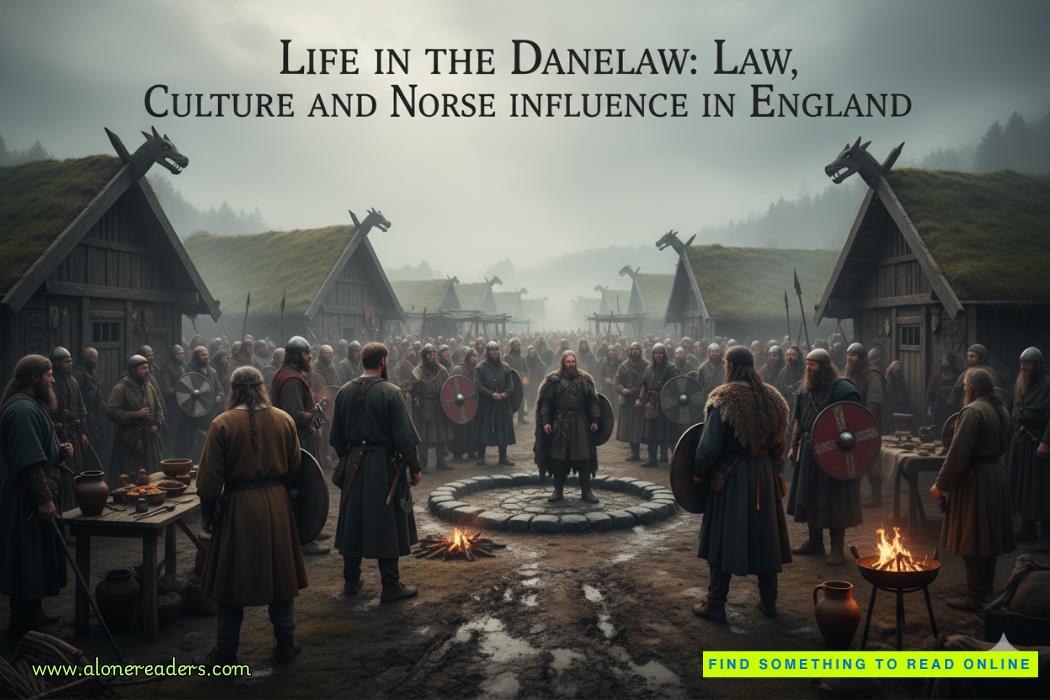
The Danelaw represents one of the most fascinating and transformative periods in early English history, when Norse settlers did not merely raid but rooted themselves deeply into the fabric of society. Stretching across much of northern and eastern England from the late ninth century, this region was governed by Scandinavian legal traditions, shaped by cultural blending, and defined by a unique coexistence between Anglo-Saxons and Vikings. Far from being a simple story of conquest, life in the Danelaw was a dynamic negotiation of identity, law, and daily survival, where old customs met new realities.
At the heart of the Danelaw was its legal system, which stood in contrast to the more centralized and hierarchical structures of Anglo-Saxon kingdoms. Norse law emphasized community-based justice, often administered through local assemblies known as things. These gatherings were not merely courts but public forums where disputes were settled, laws were recited, and decisions were made collectively. Participation in the thing was a civic duty, reflecting a society that valued consensus and communal responsibility over royal decree.
Unlike Anglo-Saxon law, which often relied on written codes issued by kings, Danelaw justice was deeply rooted in oral tradition and customary practice. Legal disputes frequently involved compensation rather than punishment. The concept of wergild, or "man price," assigned a specific value to a person's life depending on their social status, allowing feuds to be resolved through payment instead of endless cycles of revenge. This system highlights a pragmatic approach to justice, where maintaining social stability was more important than imposing rigid authority.
However, this was not a lawless or egalitarian utopia. Social hierarchy still played a crucial role, and individuals were expected to defend their honor and rights actively. The Norse emphasis on personal reputation and honor shaped interactions at every level of society. A person's standing within the community could influence legal outcomes, making reputation both a shield and a weapon.
Culturally, the Danelaw was a melting pot where Scandinavian and Anglo-Saxon traditions intertwined in complex ways. Rather than replacing the existing culture, Norse settlers adapted and integrated, creating a hybrid identity that would leave a lasting imprint on England. This blending is perhaps most visible in language. Old Norse words seeped into Old English, enriching it with terms that remain in use today. Words like sky, law, egg, window, and knife all trace their origins to Norse influence, illustrating how deeply embedded this cultural exchange became.
Place names across England still bear the unmistakable mark of the Danelaw. Settlements ending in -by (meaning village), -thorpe (secondary settlement), and -thwaite (clearing) signal areas of Scandinavian settlement. These names are not mere linguistic relics but evidence of how Norse settlers reshaped the landscape, establishing new communities and redefining old ones.
Daily life in the Danelaw was characterized by a blend of agricultural labor, trade, and craftsmanship. Norse settlers were not just warriors; they were farmers, blacksmiths, shipbuilders, and traders. The fertile lands of eastern England provided opportunities for farming, while rivers and coastlines facilitated trade networks that connected the Danelaw to the wider Viking world, including Scandinavia, Ireland, and even the Byzantine Empire.
Markets and trading hubs became vibrant centers of interaction. Goods such as wool, grain, iron tools, and imported luxury items circulated through these networks. The presence of silver hoards and coinage in archaeological finds points to a monetized economy that was both sophisticated and far-reaching. Trade was not just economic but cultural, bringing new ideas, technologies, and artistic influences into the region.
Religion in the Danelaw reflects another layer of cultural fusion. While the Norse brought with them their pagan beliefs—worshipping gods like Odin, Thor, and Freyja—many eventually converted to Christianity. This was not an abrupt transformation but a gradual process marked by syncretism, where elements of both belief systems coexisted. Archaeological evidence shows burial practices that blend Christian and pagan elements, suggesting a society in transition rather than one abruptly transformed.
Churches and monasteries, once targets of Viking raids, began to play a role in integrating Norse settlers into the Christian world. Conversion often had practical benefits, including political alliances and social acceptance. Yet traces of Norse mythology persisted in folklore and cultural memory, creating a spiritual landscape that was layered and complex.
Women in the Danelaw occupied a position that was both constrained and, in some ways, more flexible than in other medieval societies. Norse traditions allowed women certain rights in property ownership and divorce, giving them a degree of agency that could surpass that of their Anglo-Saxon counterparts. While still operating within a patriarchal framework, women could manage households, engage in trade, and influence family decisions, particularly in the absence of men who were traveling or engaged in warfare.
The material culture of the Danelaw reveals a society that valued both function and artistry. Artifacts such as intricately designed brooches, weapons, and tools demonstrate a distinctive Norse aesthetic, characterized by interwoven patterns and symbolic motifs. These items were not only practical but also expressions of identity and status. The blending of artistic styles further underscores the cultural integration that defined the region.
Conflict, of course, remained an ever-present aspect of life. The Danelaw was born out of conquest, and tensions between Norse settlers and Anglo-Saxon kingdoms did not simply vanish. Periodic conflicts, shifting alliances, and power struggles shaped the political landscape. Yet over time, coexistence became more common than conflict, as both groups found ways to live, trade, and govern together.
One of the most significant outcomes of the Danelaw was its influence on the development of English governance. The concept of local assemblies and community-based decision-making would echo in later English institutions. Even as the Danelaw was gradually reabsorbed into a unified English kingdom under rulers like Alfred the Great and his successors, its legacy persisted in legal practices, administrative divisions, and cultural norms.
The impact of the Danelaw extended beyond its geographic boundaries. It played a crucial role in shaping the identity of England as a whole, contributing to a more diverse and resilient society. The blending of Norse and Anglo-Saxon elements created a cultural richness that would influence everything from language to governance.
Perhaps what makes life in the Danelaw so compelling is its human dimension. It was a world of adaptation and negotiation, where individuals and communities had to navigate a rapidly changing landscape. Farmers learned new techniques, traders expanded their horizons, and families forged new identities that combined elements of different traditions. It was not always harmonious, but it was undeniably transformative.
The legacy of the Danelaw is still visible today, not only in place names and language but in the broader cultural and institutional frameworks of England. It serves as a reminder that history is not simply a series of conquests and victories but a complex process of interaction and change. The Norse influence on England was not imposed from above but woven into the daily lives of its people, shaping their world in ways that continue to resonate.
In examining life in the Danelaw, we gain insight into a society that was both rooted in tradition and open to change. It challenges simplistic narratives of the Viking Age as merely a time of violence and disruption, revealing instead a period of cultural exchange, legal innovation, and social evolution. The Danelaw stands as a testament to the enduring power of human adaptability and the rich possibilities that emerge when cultures meet and intertwine.



 The Hundred Days Offensive: How the Allies Defeated Germany in World War I
 The Second Battle of the Marne: The Turning Point of World War I in 1918
 The Spring Offensive of 1918: Germany's Final Gamble to Win World War I
 The Treaty of Brest-Litovsk: How Russia Left World War I
 The Russian Revolution and World War I: How War Brought Down the Tsar
 The Zimmermann Telegram Explained: Germany's Secret Offer to Mexico in World War I