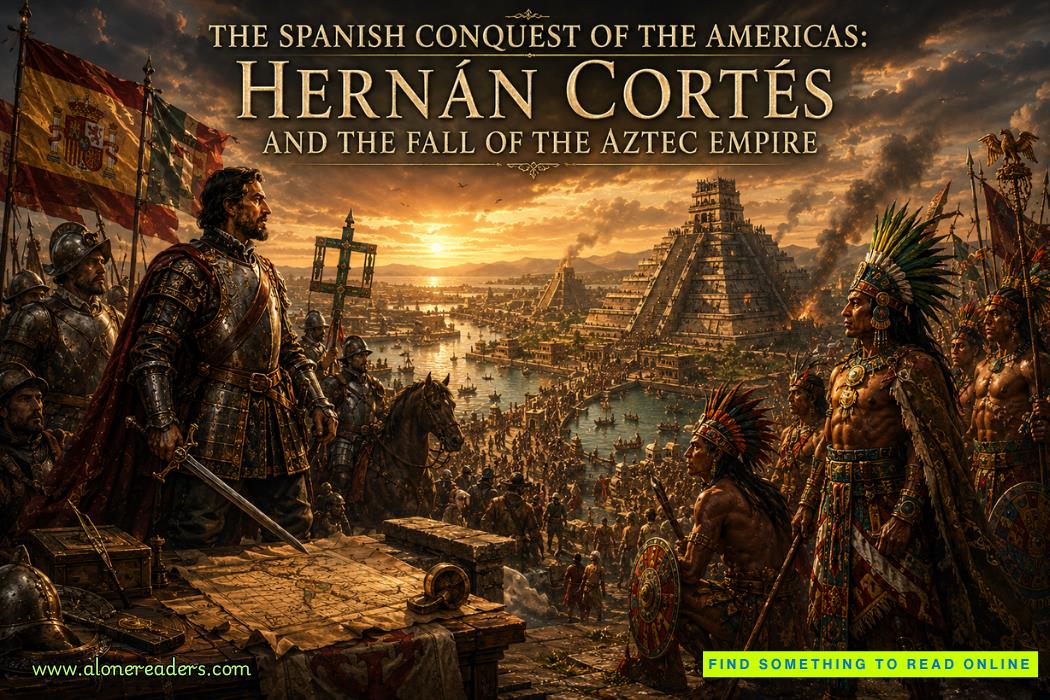
The Spanish conquest of the Americas stands as one of the most transformative and controversial episodes in world history, and at its center lies the dramatic encounter between Hernán Cortés and the powerful Aztec Empire. This story is not simply one of conquest and defeat; it is a complex narrative shaped by ambition, misunderstanding, alliances, and the collision of entirely different worlds. The fall of the Aztec Empire in the early sixteenth century marked the beginning of a new era in the Americas, one defined by European dominance and profound cultural change.
When Hernán Cortés set sail from Cuba in 1519, he was not merely embarking on an expedition—he was pursuing glory, wealth, and recognition. Like many conquistadors of his time, Cortés was driven by a desire to elevate his social standing and secure a legacy. However, his journey would exceed even the boldest expectations. Landing on the eastern coast of present-day Mexico, Cortés quickly realized that he had entered a region far more complex and politically sophisticated than the Caribbean islands previously encountered by the Spanish.
The Aztec Empire, centered in the magnificent city of Tenochtitlan, was one of the most advanced civilizations in the Americas. Built on an island in Lake Texcoco, Tenochtitlan was a marvel of engineering and urban planning, with canals, causeways, temples, and bustling marketplaces. At its height, it rivaled the great cities of Europe in size and organization. The empire was ruled by Emperor Moctezuma II, a leader who commanded immense authority but also governed a vast and sometimes fragile network of tributary states.
Cortés quickly understood that military strength alone would not guarantee victory. Instead, he relied on a combination of diplomacy, manipulation, and strategic alliances. One of his most significant advantages came from the deep resentment many indigenous groups felt toward Aztec rule. The Aztecs demanded tribute and conducted ritual sacrifices, practices that bred hostility among neighboring peoples. Cortés exploited these tensions masterfully, forming alliances with groups such as the Tlaxcalans, who would become crucial partners in his campaign.
Another key factor in Cortés’s success was his use of cultural interpretation and communication. His encounter with Malintzin, also known as La Malinche, proved invaluable. She served as both translator and advisor, enabling Cortés to navigate the complex political landscape of central Mexico. Through her, he gained insight into Aztec customs, internal divisions, and potential opportunities for negotiation or deception. Without this bridge between cultures, the conquest might have taken a very different course.
As Cortés advanced toward Tenochtitlan, he maintained a careful balance between diplomacy and intimidation. When he finally entered the city in November 1519, he was greeted by Moctezuma II with a mixture of caution and ceremonial respect. Some historical interpretations suggest that Moctezuma may have believed Cortés to be a divine or semi-divine figure, possibly linked to the returning god Quetzalcoatl. Whether or not this belief truly influenced his actions, it is clear that hesitation and uncertainty played a critical role in the early stages of the encounter.
Cortés seized the opportunity to assert control from within. In a bold and calculated move, he took Moctezuma hostage, effectively ruling the empire through its own leader. This strategy allowed the Spanish to maintain a fragile hold over Tenochtitlan, but it also heightened tensions among the Aztec population. The presence of foreign soldiers, combined with growing unrest, created a volatile situation that would soon erupt into violence.
The turning point came in 1520 during an event often referred to as the Massacre at the Great Temple. While Cortés was temporarily away, his lieutenant Pedro de Alvarado ordered an attack on unarmed Aztec nobles during a religious festival. This act of brutality shattered any remaining trust and triggered a full-scale uprising. When Cortés returned, he found the city in chaos and the Spanish forces under siege.
What followed was a desperate and bloody retreat known as La Noche Triste, or the Night of Sorrows. Attempting to escape the city under cover of darkness, the Spanish and their allies suffered heavy losses as they were attacked by Aztec warriors. Many drowned in the lake while carrying stolen gold, and the retreat marked one of the lowest points in Cortés’s अभियान. Yet, even in defeat, he demonstrated resilience and strategic thinking.
Rather than abandoning his ambitions, Cortés regrouped and prepared for a final assault. He strengthened alliances, reorganized his forces, and adopted new tactics to counter the strengths of the Aztec military. One of his most decisive moves was the construction of brigantines—small ships that allowed the Spanish to control the waters of Lake Texcoco. This innovation enabled them to cut off supplies and isolate Tenochtitlan, turning the city’s geography from an advantage into a vulnerability.
At the same time, another devastating factor entered the conflict: disease. The arrival of smallpox, introduced by the Europeans, had catastrophic effects on the indigenous population. Lacking immunity, the Aztecs suffered massive casualties, including the death of key leaders. This invisible enemy weakened the empire far more than any weapon, undermining its ability to resist the Spanish advance.
The final siege of Tenochtitlan in 1521 was brutal and prolonged. The city was gradually starved and bombarded, its infrastructure destroyed, and its population pushed to the brink of collapse. Despite fierce resistance, the Aztecs were ultimately overwhelmed by the combined forces of the Spanish and their indigenous allies. When the city fell in August 1521, it marked the end of the Aztec Empire and the beginning of Spanish colonial rule in Mexico.
The consequences of this conquest were profound and far-reaching. The fall of Tenochtitlan led to the establishment of New Spain, a vast colonial territory that would become a cornerstone of the Spanish Empire. Indigenous cultures were reshaped through forced conversion to Christianity, the imposition of European social structures, and the exploitation of labor through systems such as encomienda. At the same time, elements of Aztec culture persisted, blending with Spanish influences to create a new, hybrid identity that continues to shape Mexico today.
Hernán Cortés remains a deeply controversial figure. To some, he is a brilliant strategist and a symbol of European exploration and expansion. To others, he represents violence, exploitation, and cultural destruction. His legacy cannot be understood in simple terms; it reflects the broader complexities of the Age of Discovery, an era defined by both remarkable achievements and devastating consequences.
The story of the Spanish conquest of the Americas is not solely about conquest—it is about encounter, adaptation, and transformation. It reveals how power can shift rapidly when technology, alliances, and circumstance align. It also serves as a reminder of the human cost of empire-building and the resilience of cultures in the face of overwhelming change.
By examining the fall of the Aztec Empire, we gain insight into a pivotal moment in global history, one that reshaped continents and connected worlds in ways that continue to influence our present. The legacy of this encounter endures, not only in historical records but in the cultural and social fabric of the modern Americas.



 The Hundred Days Offensive: How the Allies Defeated Germany in World War I
 The Second Battle of the Marne: The Turning Point of World War I in 1918
 The Spring Offensive of 1918: Germany's Final Gamble to Win World War I
 The Treaty of Brest-Litovsk: How Russia Left World War I
 The Russian Revolution and World War I: How War Brought Down the Tsar
 The Zimmermann Telegram Explained: Germany's Secret Offer to Mexico in World War I