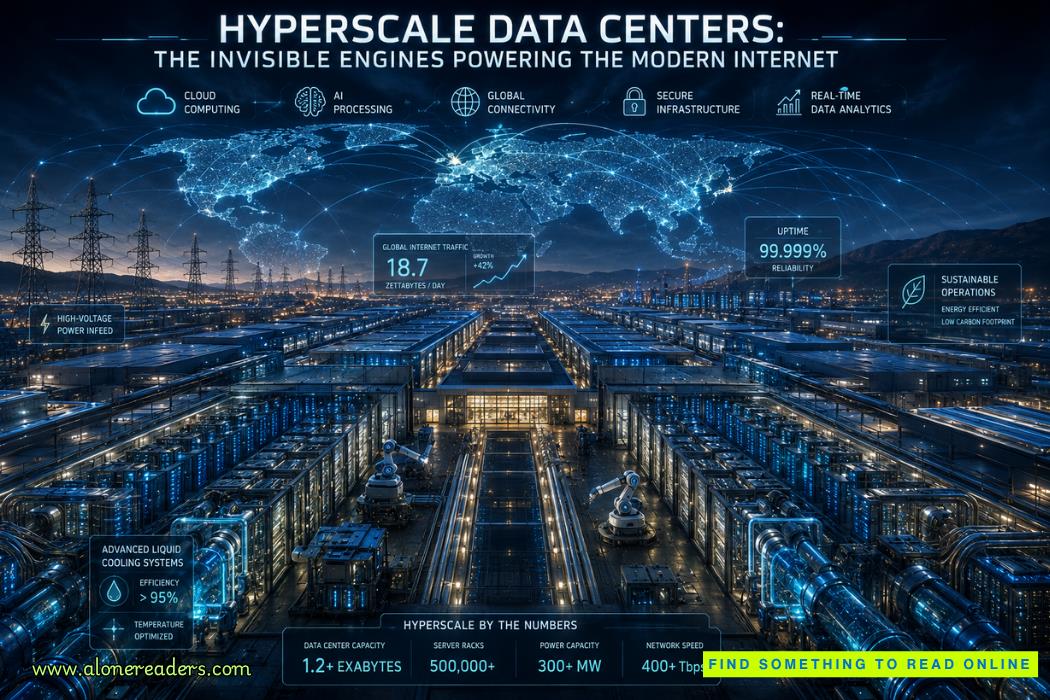
Hyperscale data centers are the silent backbone of the digital age, supporting everything from social media interactions and streaming platforms to artificial intelligence workloads and global financial systems. Unlike traditional enterprise data centers, hyperscale facilities are designed to operate at enormous scale, often containing hundreds of thousands of servers distributed across vast physical campuses. These infrastructures are engineered not just for size, but for efficiency, resilience, and rapid scalability, enabling companies like Amazon, Google, Microsoft, and Meta to serve billions of users simultaneously with near-instant responsiveness.
The defining characteristic of a hyperscale data center is its ability to scale horizontally with minimal friction. Instead of relying on monolithic hardware upgrades, these facilities add capacity by deploying standardized server units in modular clusters. This architectural approach allows operators to expand compute, storage, and networking capabilities incrementally, reducing downtime and optimizing capital expenditure. The concept mirrors cloud computing itself, where resources are abstracted and delivered dynamically, but hyperscale data centers represent the physical layer that makes this abstraction possible.
At the core of hyperscale infrastructure lies a sophisticated orchestration of compute resources. Servers are typically commodity hardware, stripped down to essential components and optimized for specific workloads such as machine learning, content delivery, or database management. These machines are interconnected through high-bandwidth, low-latency networks that rely on advanced switching architectures like spine-leaf topology. This design ensures that any server can communicate with another with predictable latency, a crucial requirement for distributed applications and real-time services.
Energy consumption is one of the most critical challenges in hyperscale data center design. A single facility can consume as much electricity as a small city, making power efficiency a top priority. Operators employ a variety of strategies to minimize energy waste, including custom power distribution units, high-efficiency transformers, and direct current power delivery systems. The effectiveness of these measures is often measured using Power Usage Effectiveness (PUE), a metric that compares total facility energy consumption to the energy used by computing equipment. Leading hyperscale operators consistently achieve PUE values close to 1.1, indicating highly optimized energy utilization.
Cooling systems represent another major area of innovation. Traditional air cooling methods are increasingly insufficient for modern high-density workloads, particularly those involving artificial intelligence and high-performance computing. As a result, hyperscale data centers are rapidly adopting liquid cooling technologies. Direct-to-chip liquid cooling and immersion cooling systems allow heat to be removed more efficiently, enabling higher server densities while reducing energy consumption. Some facilities even use ambient environmental conditions, such as cold climates or seawater, to further enhance cooling efficiency.
Network infrastructure within hyperscale data centers is engineered for extreme throughput and reliability. Fiber optic connections form the backbone of internal and external communication, supporting data transfer rates measured in terabits per second. Internally, software-defined networking (SDN) enables dynamic traffic routing, allowing operators to optimize performance and avoid congestion in real time. Externally, these data centers are connected through global backbone networks, forming a distributed system that ensures data can be routed efficiently across continents with minimal latency.
Reliability and redundancy are foundational principles in hyperscale design. These facilities are built with multiple layers of fault tolerance, including redundant power supplies, backup generators, and geographically distributed replication. Data is often stored across multiple locations simultaneously, ensuring that even catastrophic failures do not result in data loss or service disruption. This level of resilience is essential for mission-critical applications such as financial transactions, healthcare systems, and cloud-based enterprise services.
Automation plays a central role in managing the complexity of hyperscale environments. Manual intervention is minimized through the use of advanced monitoring systems, machine learning algorithms, and robotic process automation. These systems can detect anomalies, predict hardware failures, and optimize resource allocation in real time. For example, predictive maintenance algorithms analyze telemetry data from servers and cooling systems to identify potential issues before they escalate, reducing downtime and maintenance costs.
The rise of artificial intelligence has further accelerated the evolution of hyperscale data centers. AI workloads require specialized hardware such as GPUs, TPUs, and custom accelerators, which introduce new challenges in terms of power density and thermal management. Hyperscale operators are redesigning their facilities to accommodate these requirements, often creating dedicated AI clusters with enhanced cooling and power infrastructure. This shift is transforming data centers from general-purpose compute environments into highly specialized processing hubs tailored for specific workloads.
Sustainability has become a defining priority for hyperscale data center operators. The environmental impact of these facilities is significant, prompting companies to invest heavily in renewable energy and carbon reduction initiatives. Many hyperscale providers now power their operations with solar, wind, or hydroelectric energy, and some have committed to achieving carbon neutrality or even carbon negativity. In addition to renewable energy sourcing, innovations such as waste heat recovery and water-efficient cooling systems are helping to reduce the overall environmental footprint.
Geographic location is a strategic consideration in hyperscale deployment. Factors such as climate, energy availability, connectivity, and regulatory environment all influence site selection. For example, colder regions offer natural cooling advantages, while proximity to major population centers reduces latency for end users. However, balancing these factors requires careful planning, as hyperscale data centers must also comply with local regulations and ensure data sovereignty where required.
Security in hyperscale data centers operates on multiple layers, encompassing physical, network, and application-level protections. Physical security includes biometric access controls, surveillance systems, and perimeter defenses, while network security relies on encryption, firewalls, and intrusion detection systems. At the application level, data is protected through encryption at rest and in transit, along with strict access controls and identity management systems. This multi-layered approach ensures that sensitive information remains secure even in a highly distributed environment.
The economic impact of hyperscale data centers extends beyond the technology sector. These facilities drive job creation, stimulate local economies, and support the growth of digital ecosystems. They enable startups to scale rapidly without investing in their own infrastructure, democratizing access to advanced computing resources. At the same time, they create new dependencies, as businesses increasingly rely on a small number of hyperscale providers for critical services.
Looking ahead, the evolution of hyperscale data centers will be shaped by emerging technologies such as edge computing, quantum computing, and next-generation networking. Edge data centers, which are smaller and located closer to end users, will complement hyperscale facilities by reducing latency for applications like autonomous vehicles and augmented reality. Meanwhile, advances in quantum computing may introduce entirely new paradigms for data processing, requiring further innovation in data center design.
In essence, hyperscale data centers are not just large buildings filled with servers; they are highly sophisticated ecosystems that integrate hardware, software, and infrastructure at unprecedented scale. They enable the seamless digital experiences that modern society depends on, from instant communication to real-time analytics and AI-driven insights. As the demand for data and computing power continues to grow, these invisible engines will remain at the forefront of technological progress, continuously evolving to meet the needs of an increasingly connected world.



 Château de Vincennes: France’s Forgotten Royal Fortress and Medieval Stronghold
 Château de Carcassonne: Europe’s Greatest Medieval Citadel and Fortress
 Château de Chenonceau: The Castle Built by Remarkable Women
 Château de Chambord: France’s Magnificent Renaissance Castle and Architectural Wonder
 Tehri Dam: India's Tallest Dam and the Debate Behind It
 Bhakra Nangal Dam: India's Temple of Modern Development










