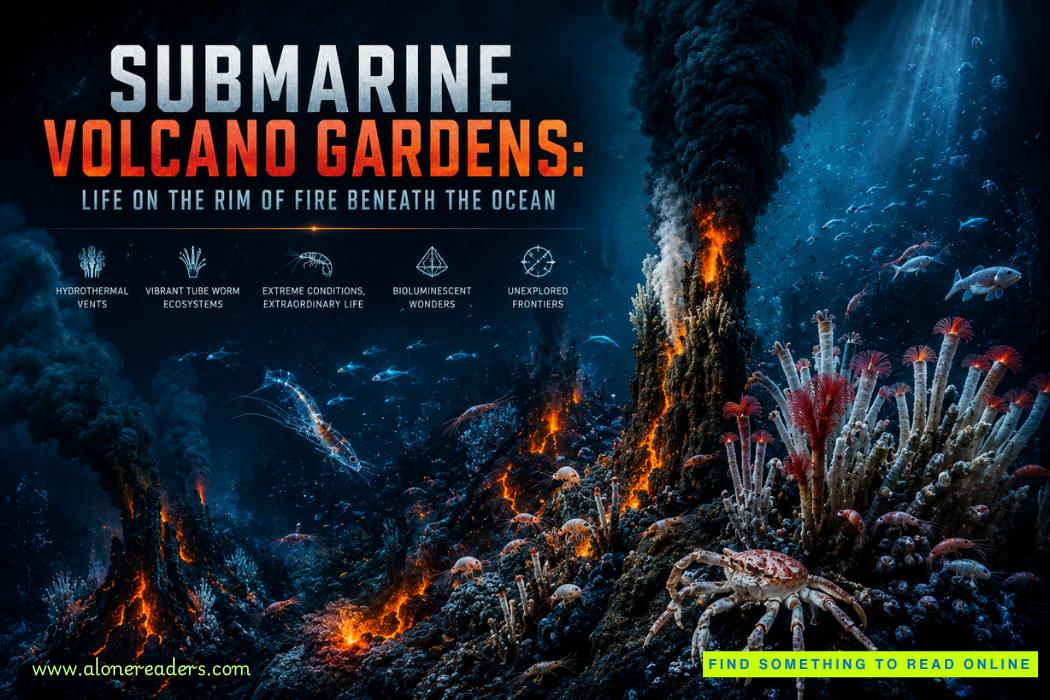
Far below the ocean’s surface, beyond the reach of sunlight and far from human eyes, lies one of the most extraordinary ecosystems on Earth. These environments, known as submarine volcano gardens, form along tectonic plate boundaries where magma pushes upward through the seafloor. Often located along the Pacific “Ring of Fire,” these deep-sea regions are defined by extreme heat, crushing pressure, and complete darkness—conditions once thought to be incompatible with life. Yet, paradoxically, they host some of the most diverse and specialized biological communities on the planet.
Unlike surface ecosystems that depend on sunlight for photosynthesis, life in submarine volcano gardens is built on an entirely different energy system. At the heart of these environments are hydrothermal vents—cracks in the ocean floor where superheated, mineral-rich water erupts into the surrounding sea. These vents act as the foundation of a unique biological network driven by chemosynthesis, a process in which microorganisms convert chemicals like hydrogen sulfide into energy. This process replaces sunlight as the primary energy source and supports an entire food web.
The geological formation of these submarine gardens begins with tectonic activity. When oceanic plates diverge or converge, magma from the Earth's mantle rises and cools rapidly upon contact with cold seawater, forming new crust. In these zones, seawater seeps into fissures in the crust, becomes superheated by underlying magma, and re-emerges as hydrothermal fluid. This fluid carries dissolved metals such as iron, copper, and zinc, which precipitate upon contact with cold seawater, forming chimney-like structures known as “black smokers” or “white smokers,” depending on their mineral composition.
These vent structures are not static; they grow, collapse, and reform over time, creating a constantly shifting landscape. Temperatures around hydrothermal vents can exceed 400 degrees Celsius, yet the surrounding seawater remains near freezing. This creates sharp thermal gradients within just a few centimeters, allowing a variety of organisms to occupy specific microhabitats tailored to their tolerance levels.
One of the most iconic inhabitants of these submarine gardens is the giant tube worm, Riftia pachyptila. These organisms can grow over two meters long and have no mouth or digestive system. Instead, they rely entirely on symbiotic bacteria housed within their tissues. These bacteria perform chemosynthesis, converting hydrogen sulfide from vent emissions into organic molecules that nourish the worm. The worm, in turn, provides the bacteria with a stable environment and access to necessary chemicals, forming a highly specialized mutualistic relationship.
Alongside tube worms, a wide array of organisms populate these extreme environments. Blind shrimp with heat-sensitive organs cluster around vent openings, detecting temperature gradients rather than relying on vision. Vent crabs scavenge organic matter and prey on smaller organisms, while certain species of fish hover at the edges of vent fields, exploiting the abundance of food without exposing themselves to lethal temperatures. Even microbial mats blanket the seafloor, forming the base layer of this unique ecosystem.
What makes submarine volcano gardens particularly fascinating is their isolation. These ecosystems are often separated by vast stretches of barren seafloor, meaning species must adapt not only to extreme conditions but also to limited opportunities for dispersal. Larvae of vent organisms drift through ocean currents, sometimes traveling hundreds of kilometers before finding a new vent to colonize. This has led to high levels of endemism, with species evolving unique traits specific to individual vent systems.
The chemical environment of hydrothermal vents also plays a crucial role in shaping these communities. Fluids emitted from vents can vary significantly in composition, influencing which organisms can survive there. Some vents are rich in methane, supporting communities of methane-oxidizing bacteria, while others are dominated by sulfur compounds. This chemical diversity creates a mosaic of microhabitats, each with its own specialized inhabitants.
In addition to hydrothermal vents, submarine volcano gardens may also include cold seeps—areas where hydrocarbons like methane and hydrogen sulfide leak from the seafloor at lower temperatures. Although less visually dramatic than vents, cold seeps support similarly complex ecosystems. Organisms such as clams and mussels host symbiotic bacteria that process these chemicals, demonstrating another variation of life independent of sunlight.
These deep-sea ecosystems are not only biologically significant but also hold clues to the origins of life on Earth. Many scientists believe that life may have first emerged in environments similar to hydrothermal vents, where chemical gradients and mineral surfaces could have facilitated the formation of early organic molecules. The ability of organisms to thrive in such extreme conditions has also expanded the search for extraterrestrial life, particularly on ocean worlds like Jupiter’s moon Europa or Saturn’s moon Enceladus.
Despite their remoteness, submarine volcano gardens are increasingly threatened by human activity. Deep-sea mining, driven by the demand for rare metals used in electronics and renewable technologies, poses a significant risk to these fragile ecosystems. The mineral deposits formed around hydrothermal vents are rich in valuable elements, making them attractive targets for extraction. However, mining operations can destroy vent structures, disrupt biological communities, and generate sediment plumes that smother nearby habitats.
Climate change also indirectly affects these ecosystems. Alterations in ocean chemistry, temperature, and circulation patterns can influence the distribution of vent species and the stability of their habitats. Although deep-sea environments are somewhat buffered from surface changes, they are not entirely immune to global shifts.
Scientific exploration of submarine volcano gardens has advanced significantly with the development of remotely operated vehicles (ROVs) and autonomous underwater vehicles (AUVs). These technologies allow researchers to map vent fields, collect samples, and observe organisms in their natural habitat without the need for human divers. High-definition imaging and in situ experiments have revealed behaviors and interactions that were previously unknown, shedding light on the complexity of these ecosystems.
For example, researchers have observed intricate reproductive strategies among vent species, including synchronized spawning events triggered by environmental cues. Some organisms exhibit remarkable resilience, quickly colonizing new vents formed by volcanic eruptions. These findings highlight the dynamic nature of submarine volcano gardens and their ability to adapt to a constantly changing environment.
The study of these ecosystems also has practical applications. Enzymes derived from vent organisms, known as extremozymes, are highly stable under extreme conditions and have been used in industrial processes, including biotechnology and pharmaceuticals. Understanding how these organisms function at a molecular level could lead to innovations in medicine, energy production, and materials science.
Submarine volcano gardens challenge our understanding of life and its limits. They demonstrate that life can flourish in environments once considered inhospitable, driven not by sunlight but by the Earth’s internal heat. These ecosystems are a testament to the adaptability of life and the interconnectedness of geological and biological processes.
As exploration continues, each new discovery adds another layer of complexity to our understanding of these hidden worlds. From towering mineral chimneys to vibrant biological communities, submarine volcano gardens represent one of the last great frontiers on Earth. Protecting them requires a balance between scientific curiosity, economic interests, and environmental stewardship.
In the silent depths of the ocean, where darkness and pressure dominate, life persists in forms both strange and beautiful. These underwater gardens, forged by fire and sustained by chemistry, remind us that the boundaries of life are far broader than we once imagined. They are not merely isolated anomalies but integral components of Earth’s biosphere, deserving of both study and protection as we continue to explore the mysteries of our planet.



 Château de Vincennes: France’s Forgotten Royal Fortress and Medieval Stronghold
 Château de Carcassonne: Europe’s Greatest Medieval Citadel and Fortress
 Château de Chenonceau: The Castle Built by Remarkable Women
 Château de Chambord: France’s Magnificent Renaissance Castle and Architectural Wonder
 Tehri Dam: India's Tallest Dam and the Debate Behind It
 Bhakra Nangal Dam: India's Temple of Modern Development










