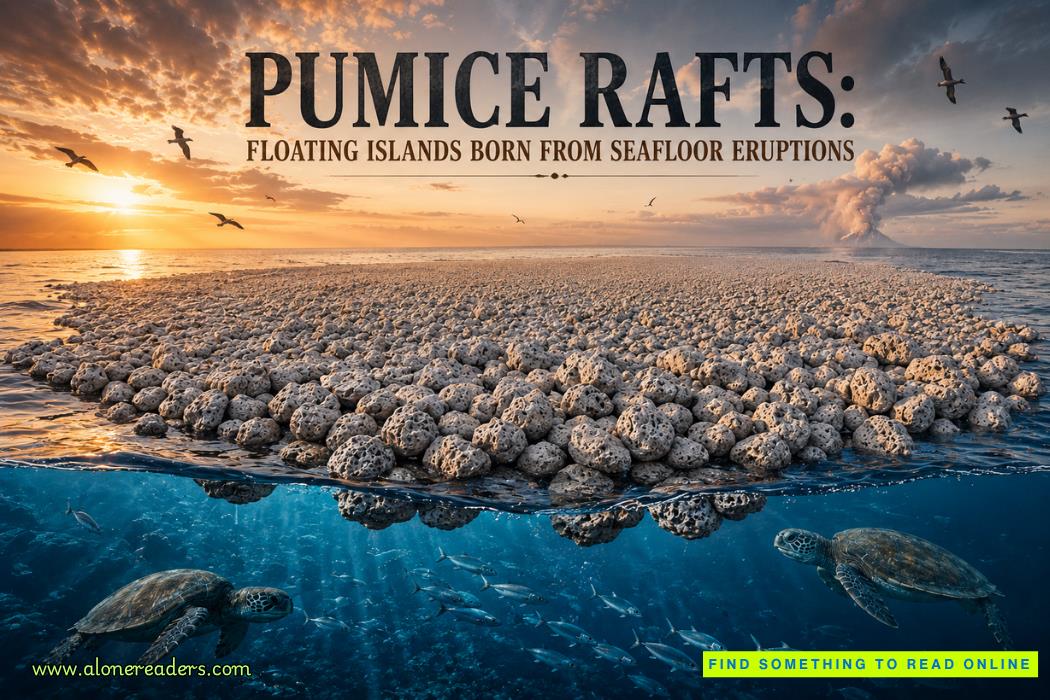
Pumice rafts are among the most fascinating and underappreciated phenomena in oceanography, representing a rare intersection of volcanic violence and delicate ecological opportunity. These floating islands, composed of lightweight volcanic rock, form during explosive underwater eruptions and can drift across entire ocean basins. Though they may appear as temporary curiosities, pumice rafts play a profound role in marine dispersal systems, geological cycles, and even climate interactions. Their existence challenges the traditional notion that volcanic activity is purely destructive, revealing instead a dynamic process that can foster new life across vast distances.
The origin of a pumice raft begins deep beneath the ocean floor, where tectonic forces create pressure chambers filled with magma rich in dissolved gases. When this magma is suddenly released during a submarine eruption, the rapid drop in pressure causes the gases to expand violently, forming a frothy, foam-like volcanic rock known as pumice. Unlike most rocks, pumice contains countless microscopic air bubbles, making it buoyant enough to float on water. When large quantities of pumice are ejected simultaneously, they accumulate on the ocean surface, forming dense, contiguous rafts that can span hundreds or even thousands of square kilometers.
One of the most remarkable aspects of pumice rafts is their scale. Satellite imagery has documented rafts large enough to rival small countries in surface area. For example, a significant eruption in the South Pacific in recent decades produced a pumice raft that covered an area exceeding 400 square kilometers. These floating masses can persist for months or even years, gradually dispersing due to ocean currents, wind, and wave action. During this time, they become dynamic platforms that interact continuously with the marine environment.
The texture and structure of pumice make it uniquely suited for long-distance travel. Each piece is highly porous, allowing it to remain buoyant even after prolonged exposure to seawater. However, over time, water gradually infiltrates the pores, increasing the density of the rock until it eventually sinks. This process can take months, providing a long window during which pumice rafts can traverse entire ocean basins. Ocean currents such as the South Equatorial Current or the East Australian Current can carry these rafts thousands of kilometers from their origin, sometimes delivering them to distant coastlines.
Perhaps the most scientifically significant role of pumice rafts lies in their function as biological transport systems. As the pumice floats, it becomes colonized by a wide variety of marine organisms. Algae, barnacles, mollusks, corals, and even microorganisms attach themselves to the rough, porous surfaces of the rocks. Over time, each piece of pumice transforms into a miniature ecosystem, supporting life that would otherwise struggle to disperse across vast stretches of open ocean. This process, known as rafting, is a critical mechanism for species distribution, particularly in isolated regions such as island chains and coral reef systems.
The ecological implications of this natural transport system are profound. Pumice rafts can facilitate the spread of coral species to damaged reef areas, aiding in ecosystem recovery after bleaching events or storm destruction. In some cases, entire communities of organisms have been observed traveling together across oceans, effectively seeding new habitats upon arrival. This makes pumice rafts an important factor in understanding how marine biodiversity is maintained and replenished on a global scale.
However, the ecological impact of pumice rafts is not universally positive. While they can support the spread of beneficial species, they can also act as vectors for invasive organisms. Species that attach to pumice in one region may be transported to entirely new environments where they lack natural predators. This can disrupt local ecosystems, outcompete native species, and alter ecological balances. As global shipping and climate change already contribute to the spread of invasive species, pumice rafting adds another layer of complexity to marine biosecurity challenges.
From a geological perspective, pumice rafts provide valuable insights into underwater volcanic activity, which is otherwise difficult to observe directly. Because most submarine eruptions occur far below the ocean surface, they often go unnoticed until secondary effects—such as pumice rafts—become visible. By analyzing the composition, distribution, and movement of pumice, scientists can infer details about the eruption’s location, intensity, and magma chemistry. This makes pumice rafts an important tool for monitoring volcanic activity in remote ocean regions.
Technological advancements have significantly improved the study of pumice rafts. Satellite imagery allows researchers to track the movement of these floating islands in near real-time, providing data on ocean currents and dispersal patterns. Autonomous ocean sensors and drones can sample pumice directly, analyzing its chemical composition and the organisms attached to it. These tools have transformed pumice rafts from obscure geological curiosities into valuable sources of scientific data.
In addition to their ecological and geological significance, pumice rafts can also have practical implications for human activity. Large rafts can pose hazards to maritime navigation, as dense concentrations of floating rock can interfere with ship movement and damage propellers. In some cases, vessels have reported difficulty navigating through thick pumice fields, which can resemble slushy ice rather than solid rock. Ports and coastal infrastructure may also be affected if large quantities of pumice wash ashore.
Despite these challenges, pumice itself has numerous beneficial uses once it reaches land. It is widely used in construction, water filtration, and horticulture due to its lightweight and porous nature. In agriculture, pumice is valued for its ability to retain moisture while providing excellent drainage, making it an ideal soil additive. In industry, it is used as an abrasive material in polishing and cleaning products. Thus, the same properties that allow pumice to float across oceans also make it highly useful in various human applications.
The study of pumice rafts also intersects with climate science. While they do not directly influence global climate systems on a large scale, their formation is linked to volcanic activity, which can release gases and particles into the atmosphere. Additionally, the dispersal of marine organisms via pumice rafting can influence carbon cycling in ocean ecosystems. For instance, the spread of coral and algae communities can affect how carbon is absorbed and stored in marine environments.
One particularly intriguing aspect of pumice rafts is their role in the history of life on Earth. Some scientists hypothesize that similar rafting mechanisms may have contributed to the dispersal of early life forms across ancient oceans. Before the existence of complex ecosystems, floating substrates like pumice could have provided essential habitats for primitive organisms, enabling them to colonize new regions. While this idea remains a topic of ongoing research, it highlights the broader significance of pumice rafting as a natural process that extends beyond modern ecosystems.
The unpredictable nature of submarine eruptions means that pumice rafts can appear suddenly and without warning. This makes them both scientifically exciting and logistically challenging to study. When a new raft is detected, researchers often mobilize quickly to gather data before it disperses. Each event provides a unique opportunity to observe the early stages of ecological colonization and track the movement of marine species in real time.
In recent years, increased awareness of pumice rafts has led to greater public interest in ocean geology and marine ecology. Images of vast floating islands captured by satellites and passing ships have sparked curiosity and highlighted the dynamic nature of Earth’s oceans. These events serve as a reminder that even in the most remote parts of the planet, powerful natural processes are constantly shaping the environment.
Pumice rafts represent a striking example of how destructive forces can give rise to new opportunities for life. Born from the explosive energy of seafloor eruptions, these floating islands transform into traveling ecosystems that connect distant parts of the ocean. Their journey across the seas illustrates the intricate interplay between geology and biology, revealing a world where even volcanic debris can become a vessel for life. As research continues, pumice rafts will undoubtedly provide further insights into the hidden processes that govern our planet’s oceans.



 Château de Vincennes: France’s Forgotten Royal Fortress and Medieval Stronghold
 Château de Carcassonne: Europe’s Greatest Medieval Citadel and Fortress
 Château de Chenonceau: The Castle Built by Remarkable Women
 Château de Chambord: France’s Magnificent Renaissance Castle and Architectural Wonder
 Tehri Dam: India's Tallest Dam and the Debate Behind It
 Bhakra Nangal Dam: India's Temple of Modern Development