The ocean floor is one of the last true frontiers on Earth—and sometimes, it stares back.
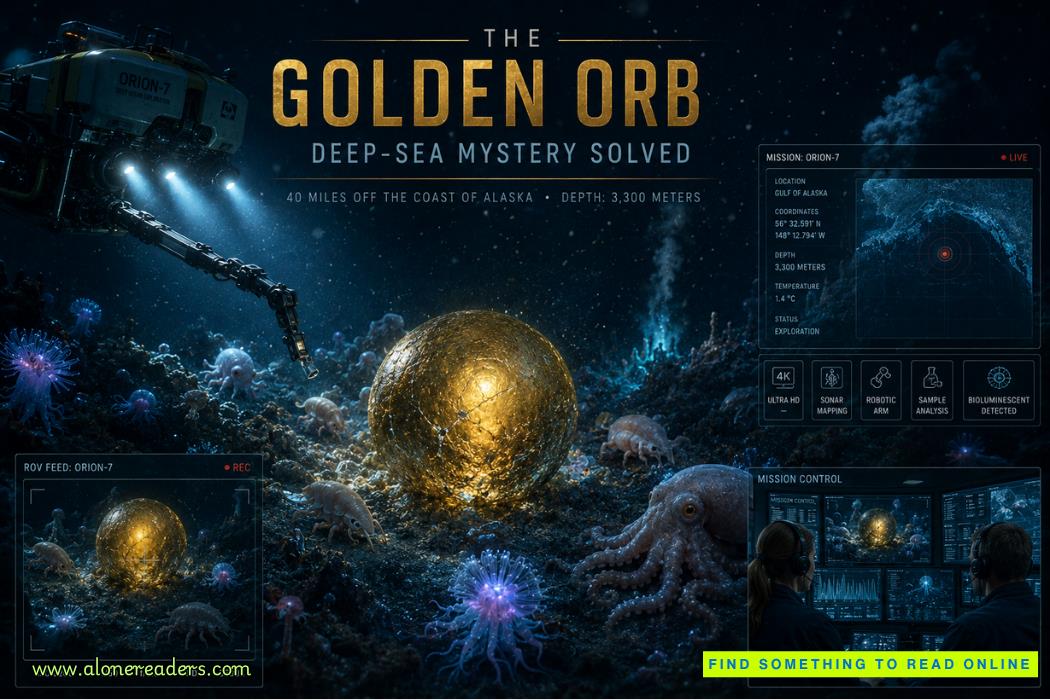
When scientists first spotted the golden orb deep sea object resting silently on the dark seafloor off Alaska, it didn’t look like anything familiar. It wasn’t rock. It wasn’t coral. It wasn’t debris. It shimmered faintly under artificial light, smooth and almost perfectly formed, like something placed there deliberately.
For a moment, even seasoned researchers hesitated. Because when something in the deep ocean looks unfamiliar, it often means one thing: we’re looking at life we don’t yet understand
Key Takeaways
The object was discovered during a remotely operated vehicle (ROV) dive in the Gulf of Alaska. At depths where sunlight never reaches, the seafloor is typically a landscape of mud, scattered organisms, and geological formations shaped over millennia.
Then came something different.
A smooth, golden dome-like structure, about the size of a small grapefruit, attached to a rock. It had a small opening or tear on one side, which made it even more puzzling. It didn’t resemble known eggs, sponges, or coral formations.
Why it stood out:
At first glance, it triggered multiple hypotheses—from a deep sea golden egg to a sponge species, or even a previously unknown organism.
But none of these explanations fully fit.
Deep-sea biology operates under extreme conditions—high pressure, near-freezing temperatures, and total darkness. These factors produce organisms that look radically different from anything on land or even in shallow waters.
Three key reasons for the uncertainty:
1. Lack of Reference Points
Most marine species cataloged by science come from accessible depths. The deeper you go, the less comparative data exists. This means even basic identification becomes difficult.
2. Convergent Evolution in the Deep Sea
Different species can evolve similar shapes or textures to survive. A spherical structure, for instance, could belong to:
3. Decomposition and Transformation
In deep water, biological material often changes appearance over time. Without sunlight and with slower decay processes, tissues can develop unusual textures or colors, including metallic-like finishes.
This made the mysterious sea creature—or object—hard to classify without direct sampling.
Once the specimen was carefully collected and analyzed, scientists reached a more grounded conclusion.
The golden orb was most likely a biological egg case or tissue structure, possibly from a cephalopod (like an octopus) or a previously undocumented marine organism.
Key indicators supporting this:
While the exact species remains uncertain, the classification shifted from “unknown object” to biological origin, solving the immediate mystery.
This is what makes the “ocean mystery solved” narrative both satisfying and incomplete—the object is identified in category, but not fully understood in origin.
The golden orb deep sea discovery reinforces a critical idea: the deep ocean is not just unexplored—it’s fundamentally unfamiliar.
Biological Adaptation Beyond Imagination
Creatures in the deep sea evolve under constraints that push biology into unusual territory:
The golden orb likely represents one such strategy—an organism depositing or protecting its offspring in a way rarely observed.
Low-Energy Ecosystems Drive Unique Behavior
Unlike surface ecosystems fueled by sunlight, deep-sea life relies on:
This scarcity leads to highly efficient, often bizarre biological structures designed to maximize survival.
There’s a reason deep-sea footage often feels like science fiction.
It’s not exaggeration—it’s biology operating under different rules.
1. Extreme Pressure Shapes Form
At depths exceeding 3,000 meters, pressure can exceed 300 times that at sea level. Organisms evolve without rigid structures, leading to soft, flowing, or inflated forms.
2. Total Darkness Eliminates Visual Camouflage
Without light, traditional camouflage becomes irrelevant. Instead, organisms rely on:
3. Isolation Drives Evolutionary Divergence
Deep-sea habitats are often isolated, meaning species evolve independently for millions of years. This results in forms that appear completely alien to us.
Example:
The blobfish, once voted “ugliest animal,” looks drastically different in its natural high-pressure environment. Its distorted surface appearance is a result of decompression—not its true form.
Similarly, the golden orb may look unnatural to us simply because we’re seeing it outside its ecological context.
“Strange means extraterrestrial.”
Unusual appearance doesn’t imply non-Earth origin. Deep-sea ecosystems naturally produce unfamiliar forms.
“We’ve already explored most of the ocean.”
In reality, over 80% of the ocean remains unmapped and unexplored in detail.
“If we can’t identify it immediately, it must be new.”
Sometimes organisms are known but rarely observed in certain life stages—like eggs or larval forms.
The Alaska ocean mystery is just one of many cases where something bizarre turned out to have a logical biological explanation.
1. The “Bloop” Sound
Once thought to be a massive unknown creature, it was later identified as ice cracking and shifting in Antarctica.
2. Giant Squid Sightings
Long considered myth, giant squids were eventually filmed alive in their natural habitat, confirming centuries-old sailor stories.
3. Deep-Sea “Snowfall”
Initially mistaken for unusual sediment, it was revealed to be organic material—dead plankton, feces, and debris—feeding deep ecosystems.
4. Underwater Crop Circles
Perfectly symmetrical sand patterns discovered in Japan were traced back to small pufferfish creating them to attract mates.
5. Glowing Ocean Waves
Bioluminescent plankton create glowing shorelines, once mistaken for chemical pollution or supernatural phenomena.
Each case follows a similar pattern: confusion, speculation, investigation, and eventually, understanding.
The golden orb deep sea object wasn’t just a curiosity—it was a reminder of how science progresses.
Mystery drives exploration. Exploration leads to discovery. And discovery reshapes what we think we know.
Even when answers are partial, they expand the boundaries of knowledge.
The deep ocean isn’t hiding secrets out of reach—it’s offering them slowly, one strange discovery at a time.
The story of the golden orb deep sea discovery is less about a single object and more about perspective.
What looked like an alien artifact turned out to be a natural product of Earth’s most extreme ecosystem. Yet, its strangeness still challenges our assumptions about life, evolution, and the limits of biology.
And that’s the real takeaway: the ocean doesn’t need to be fictional to feel otherworldly.
It already is.
What was the golden orb found in the deep sea?
It was identified as a biological structure, likely an egg casing or tissue from a previously unknown or rarely observed marine organism.
Where was the golden orb discovered?
It was found on the seafloor off the coast of Alaska during a deep-sea exploration mission.
Why did scientists find it mysterious?
Its metallic appearance, smooth texture, and unusual placement didn’t match known marine organisms or geological formations.
What does the discovery teach us?
It highlights how little we know about deep-sea ecosystems and how many species remain undocumented.
Are such ocean mysteries common?
Yes, deep-sea exploration frequently uncovers strange and previously unseen biological forms.



 Château de Vincennes: France’s Forgotten Royal Fortress and Medieval Stronghold
 Château de Carcassonne: Europe’s Greatest Medieval Citadel and Fortress
 Château de Chenonceau: The Castle Built by Remarkable Women
 Château de Chambord: France’s Magnificent Renaissance Castle and Architectural Wonder
 Tehri Dam: India's Tallest Dam and the Debate Behind It
 Bhakra Nangal Dam: India's Temple of Modern Development