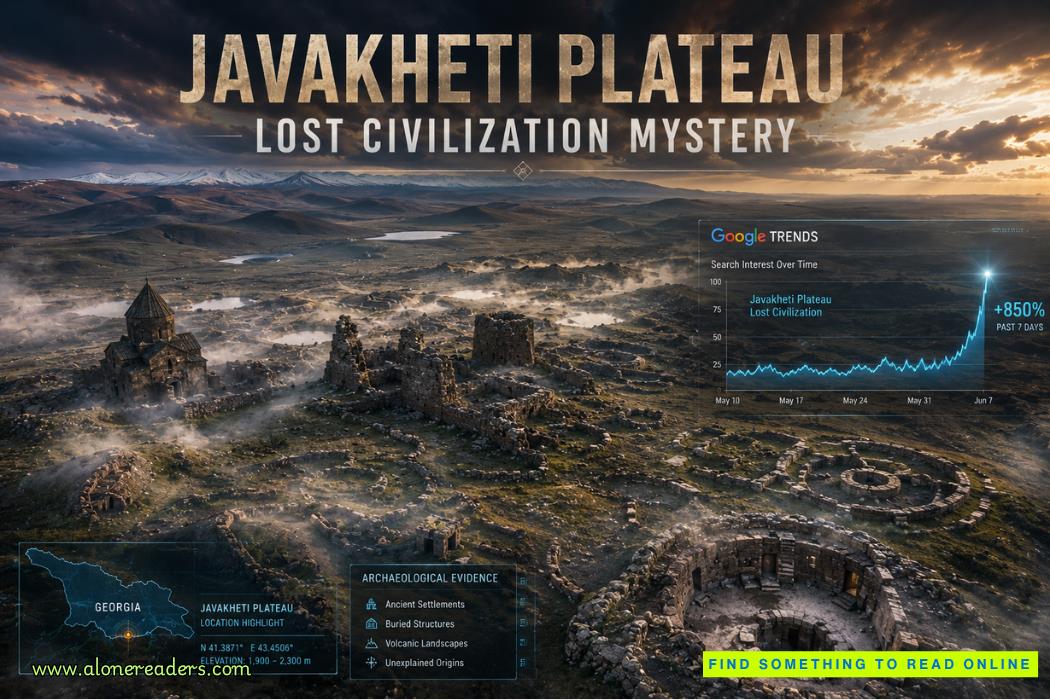
Within days, the phrase “Javakheti Plateau lost civilization” surged across Google Trends, pulling an obscure highland region in southern Georgia into global curiosity. It wasn’t driven by a major archaeological announcement or a new excavation report. Instead, it followed a familiar pattern: scattered social posts, speculative videos, and algorithm-fueled intrigue turning a little-known landscape into a viral mystery.
But behind the sudden attention lies a deeper question—one that’s more interesting than any conspiracy: what is the Javakheti Plateau really, and why does it so easily become a canvas for lost civilization narratives?
Key Takeaways
A remote highland in the Caucasus
The Javakheti Plateau sits in southern Georgia, near the borders with Armenia and Turkey. It’s part of the Lesser Caucasus mountain system, characterized by volcanic formations, high-altitude grasslands, and a network of lakes formed by ancient lava flows.
Unlike the lush valleys often associated with Georgia, Javakheti feels stark and expansive. Elevations range from roughly 1,500 to over 3,000 meters, creating a harsh climate with long winters and limited agricultural potential. This relative isolation has shaped both its historical development and its modern obscurity.
Why geography matters
Remote landscapes like Javakheti often become fertile ground for “lost civilization” theories for three reasons:
In other words, the less people know about a place, the easier it is to imagine something extraordinary hidden within it.
Early human presence and settlement patterns
The Javakheti Plateau history is far from empty. Archaeological evidence shows that the region has been inhabited since prehistoric times, particularly during the Bronze Age. Excavations across the broader Caucasus reveal interconnected networks of pastoral and agricultural communities rather than isolated or advanced civilizations.
These early inhabitants adapted to the plateau’s environment through seasonal migration, livestock herding, and localized farming.
Megalithic structures and stone features
One of the main drivers of the Georgia archaeology mystery narrative is the presence of stone constructions scattered across the plateau. These include:
To an untrained eye, these can look enigmatic or even technologically advanced. In reality, they align closely with known construction techniques from the Bronze and Iron Ages across the Caucasus.
Cultural crossroads, not isolation
Rather than hosting a lost civilization, Javakheti was more likely part of a broader cultural corridor connecting Anatolia, the Armenian Highlands, and the wider Caucasus region.
Artifacts and settlement styles suggest interaction rather than isolation—trade routes, shared technologies, and gradual cultural evolution.
How speculation fills knowledge gaps
The phrase “lost civilization trend” isn’t new. Similar patterns have emerged around places like Göbekli Tepe, the Richat Structure, and even parts of the Amazon.
Javakheti fits the same template:
This combination invites reinterpretation. A fortress becomes a “mysterious ruin.” A burial mound becomes “evidence of a forgotten culture.”
The algorithm effect
What accelerates these narratives today isn’t just curiosity—it’s digital amplification.
When a few pieces of content begin performing well, algorithms push them further, often prioritizing engagement over accuracy. A speculative claim framed as a question—“Was this a lost civilization?”—spreads faster than a measured explanation.
Within days, the topic evolves from curiosity to perceived mystery.
Visual storytelling over factual depth
Short-form video platforms play a key role here. Aerial footage of the Javakheti Plateau—its misty lakes, abandoned stone structures, and vast emptiness—creates an atmosphere that invites interpretation.
When paired with dramatic narration, even ordinary archaeological features can feel extraordinary.
“There are unexplored ruins proving advanced technology”
There is no credible evidence suggesting advanced or unknown technology in the region. The structures align with known historical building methods.
“The area was suddenly discovered”
Javakheti has been studied for decades. It’s not newly discovered—it’s newly viral.
“Mainstream archaeology is ignoring it”
In reality, the region has been documented, though not heavily publicized. Its findings simply don’t support sensational claims.
“Isolation means uniqueness”
Isolation often leads to preservation, not mystery. What survives in Javakheti is consistent with broader Caucasus ancient settlements.
The psychology of hidden worlds
Humans are wired to be drawn to the unknown. A remote plateau with visible ruins triggers a powerful combination:
This emotional pull often outweighs factual analysis.
Digital-era exploration
In the past, exploration required physical travel. Today, it happens through screens. Satellite imagery, drone footage, and user-generated content make remote regions feel accessible—and open to reinterpretation.
Javakheti becomes less a physical place and more a digital artifact shaped by narrative.
The pattern repeats
The same cycle has appeared repeatedly:
By the time factual explanations catch up, the idea of a “lost civilization” has already taken hold.
The most compelling mystery isn’t buried in the ground—it’s happening online.
Why do certain places suddenly capture global attention while others, equally significant, remain ignored?
The answer lies in a mix of timing, visual appeal, and narrative potential. Javakheti offers all three:
In this sense, the plateau becomes a mirror reflecting how we engage with the past in a digital age.
We’re no longer just uncovering history—we’re actively reshaping how it’s perceived.
The Javakheti Plateau lost civilization narrative reveals far more about modern curiosity than ancient reality.
Yes, the region holds genuine historical value. Its landscapes preserve traces of early human life, regional interaction, and adaptive survival in a challenging environment. But those traces fit within known patterns of Caucasus ancient settlements, not evidence of a forgotten advanced civilization.
What transformed Javakheti into a global talking point wasn’t a groundbreaking discovery—it was attention itself.
And that may be the most important takeaway: in the age of algorithms, even the quietest corners of the world can suddenly become the center of a mystery, not because they’ve changed, but because we’ve started looking at them differently.
What is the Javakheti Plateau known for?
The Javakheti Plateau is known for its volcanic landscape, ancient settlements, and archaeological remains in southern Georgia.
Is there evidence of a lost civilization in Javakheti?
There is no confirmed evidence of a lost advanced civilization, but the region does have ancient human settlements and archaeological sites.
Why is the Javakheti Plateau trending online?
A spike in interest is likely driven by social media speculation, algorithmic amplification, and fascination with unexplored regions.
What ancient cultures lived in the Caucasus region?
Various groups, including early pastoral communities and Bronze Age societies, inhabited the Caucasus.
Are there unexplored ruins in Javakheti?
Yes, some areas remain under-researched, but most findings align with known historical patterns rather than mysterious advanced civilizations.



 Château de Vincennes: France’s Forgotten Royal Fortress and Medieval Stronghold
 Château de Carcassonne: Europe’s Greatest Medieval Citadel and Fortress
 Château de Chenonceau: The Castle Built by Remarkable Women
 Château de Chambord: France’s Magnificent Renaissance Castle and Architectural Wonder
 Tehri Dam: India's Tallest Dam and the Debate Behind It
 Bhakra Nangal Dam: India's Temple of Modern Development










