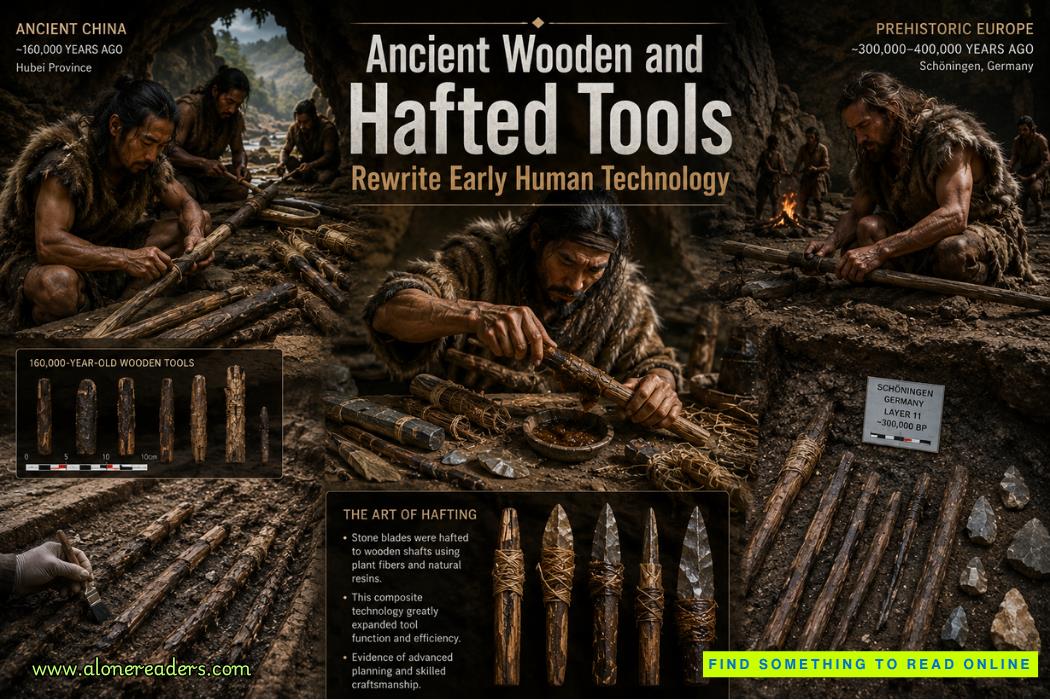
The story of early human innovation has long been told through stone. Hard, durable, and abundant, stone tools have dominated archaeological narratives for over a century. But that narrative is incomplete. The real revolution in ancient wooden tools lies in what we don’t see—because wood almost never survives.
In the rare cases where it does, it rewrites assumptions about early human capability, revealing a world of sophisticated craftsmanship, material science, and cognitive foresight that stone alone cannot capture.
Key Takeaways
Why wood rarely survives
Organic materials like wood decompose rapidly under normal conditions. Microorganisms, oxygen, moisture, and temperature fluctuations break down cellulose and lignin—the core components of wood. Unless buried in oxygen-poor environments like waterlogged sediments, frozen ground, or arid deserts, wooden tools vanish within centuries, not millennia.
This creates a massive archaeological bias. Stone survives. Wood does not.
Imagine judging modern civilization only by what’s made of stone—ignoring plastics, metals, and composites. That’s essentially what has happened with early human technology.
What this means for archaeology
Because of this preservation gap, archaeologists have historically underestimated:
When rare wooden artifacts are discovered, they often force a complete reevaluation of timelines and capabilities.
What is hafting?
Hafting is the process of attaching a stone tool to a handle, typically made of wood, bone, or antler. This transforms a simple object into a compound machine.
A sharp stone alone can cut. But attach it to a handle, and it becomes:
This seemingly simple innovation marks a profound leap in early human technology.
Why hafting was revolutionary
Hafting required multiple layers of understanding:
This is not improvisation. It is engineering.
Creating hafted tools means early humans could conceptualize multi-part systems—thinking beyond immediate use toward optimized performance.
160000 year old tools China
Discoveries in China have revealed 160000 year old tools that suggest early use of hafting and complex tool systems. These tools show wear patterns and residues indicating they were likely mounted on handles.
What makes this remarkable is the timeline. It pushes back the emergence of advanced tool-making by tens of thousands of years.
These tools also demonstrate:
This challenges the assumption that sophisticated tool systems emerged only with later Homo sapiens populations.
Greek wooden-tool evidence
In contrast, European findings—particularly in regions like Greece—have yielded rare preserved wooden tools due to unique environmental conditions.
These include:
Unlike stone tools, these artifacts reveal the full tool, not just the cutting edge. They show how tools were used, held, and integrated into daily life.
Together, Chinese stone-based evidence and European wooden finds create a more complete picture of prehistoric innovation.
The presence of ancient wooden tools is not just about materials—it’s about mindset.
Planning and foresight
Creating a hafted tool requires thinking in stages:
This sequence demonstrates long-term planning, not immediate problem-solving.
Abstract thinking
Early humans had to imagine a final product before it existed. That ability—mental simulation—is a cornerstone of modern cognition.
Knowledge transmission
These techniques were not one-off discoveries. They were taught, shared, and refined across generations.
This implies:
Tools used to shape tools
Ironically, stone tools were often used to create wooden ones. Through scraping, carving, and controlled burning, early humans could shape wood into precise forms.
Common prehistoric woodworking techniques likely included:
Why woodworking matters
Wood is versatile. It can be:
This makes it ideal for tools that require both strength and adaptability.
Without recognizing prehistoric woodworking, we miss a huge portion of human innovation.
“Stone tools define early technology”
Stone tools are just the surviving fraction. The full toolkit was likely far more diverse.
“Early humans were primitive thinkers”
The complexity of hafted tools suggests advanced reasoning, planning, and problem-solving.
“Innovation was slow and linear”
Evidence from different regions shows bursts of innovation occurring independently and earlier than expected.
What we’ve uncovered so far may only represent a fraction of early human ingenuity.
Consider this:
This raises a provocative possibility: early humans may have been far more technologically advanced than the archaeological record suggests.
Not in the sense of modern machines—but in their ability to manipulate materials, solve problems, and adapt to environments with remarkable efficiency.
The discovery of ancient wooden tools, combined with evidence of hafted tools and finds like the 160000 year old tools China, forces a shift in perspective.
Early humans were not merely tool users—they were system builders. They combined materials, optimized designs, and passed knowledge across generations.
What we see in stone is only the skeleton. Wood, fiber, and organic materials were the living tissue of early technology—and most of it is gone.
That absence doesn’t diminish their achievements. It magnifies them.
Because what survives is impressive. But what’s missing might be extraordinary.
Why are ancient wooden tools so rare?
Wood decays quickly due to moisture, microbes, and oxygen, so only exceptional environments preserve it.
What are hafted tools?
Hafted tools are implements where a stone or blade is attached to a handle, improving grip, force, and precision.
What is significant about 160000 year old tools China?
They show early humans used complex tool systems, including hafting, far earlier than previously believed.
How do wooden tools change our understanding of early humans?
They reveal advanced planning, material knowledge, and cognitive abilities often underestimated in prehistoric societies.
Did prehistoric humans practice woodworking?
Yes, prehistoric woodworking included shaping handles, spears, and digging tools using stone tools and controlled fire.



 Château de Vincennes: France’s Forgotten Royal Fortress and Medieval Stronghold
 Château de Carcassonne: Europe’s Greatest Medieval Citadel and Fortress
 Château de Chenonceau: The Castle Built by Remarkable Women
 Château de Chambord: France’s Magnificent Renaissance Castle and Architectural Wonder
 Tehri Dam: India's Tallest Dam and the Debate Behind It
 Bhakra Nangal Dam: India's Temple of Modern Development










