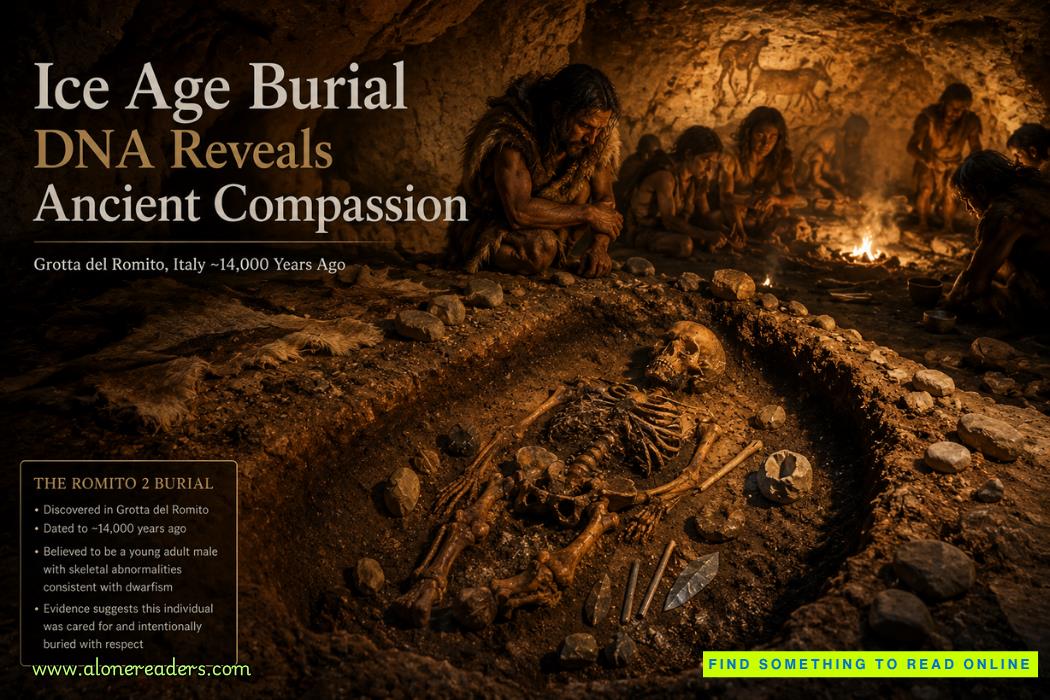
The skeleton lay carefully arranged in the dim light of a prehistoric cave, its bones telling a story that defied assumptions about Ice Age survival. For decades, the Grotta del Romito burial puzzled archaeologists: how had this individual, marked by severe physical limitations, lived long enough to be buried with such care?
The answer began to emerge through Ice Age burial DNA, unlocking a paleogenomics mystery that reshaped how we understand early human societies—not as purely survival-driven, but as deeply social and compassionate.
Key Takeaways
A Carefully Placed Life
The Grotta del Romito burial in southern Italy dates back roughly 10,000–12,000 years. At first glance, it appears similar to other Upper Paleolithic burials—intentional placement, associated artifacts, and signs of ritual.
But one detail stood out: the skeleton displayed unusually short limbs and abnormal bone structure.
For years, researchers debated whether this was simply variation or evidence of disease. Without genetic data, the conclusions remained speculative.
The Puzzle of Survival
In Ice Age environments, survival depended heavily on mobility, hunting ability, and resilience. Individuals with severe physical impairments would face immense challenges:
Yet this individual did not just survive infancy—they reached adolescence or adulthood.
That fact alone hinted at something profound: they were not surviving alone.
Ice Age Burial DNA and the NPR2 Gene
Advances in paleogenomics allowed scientists to extract and analyze ancient DNA from the remains. The results identified mutations in the NPR2 gene, a key regulator of bone growth.
Understanding NPR2 Function
The NPR2 gene encodes a receptor involved in skeletal development. It influences how cartilage turns into bone, particularly in long bones like the arms and legs.
When functioning normally, it supports proportional growth. When mutated:
This condition is associated with a form of ancient rare disease—a type of skeletal dysplasia.
Not Just Short Stature
This wasn’t simply a case of being shorter than average. The mutation likely caused:
In a prehistoric context, these limitations would dramatically affect daily survival.
The Role of Community Support
The most striking implication of this discovery is not the disease itself—but survival despite it.
For someone with this condition to live beyond early childhood, their community must have provided:
This suggests prehistoric compassion was not incidental—it was sustained and structured.
A Realistic Scenario
Imagine a small Ice Age group migrating through harsh terrain. Every member contributes to survival. Yet one individual cannot hunt or travel efficiently.
Instead of being abandoned, they are:
This requires not just empathy, but coordination and collective decision-making.
Other Cases of Compassion
The Grotta del Romito burial is not an isolated example. Across prehistoric sites, similar patterns emerge:
Each case adds weight to the idea that early humans practiced deliberate care.
What Makes This Case Unique
What sets this burial apart is the clarity provided by DNA evidence.
Instead of inferring disability from bone shape alone, researchers could:
This transforms the narrative from speculation to biological certainty.
Beyond One Individual
This discovery raises broader questions within the field of paleogenomics mystery:
The answers are still unfolding, but one pattern is becoming clear: survival was not purely individual—it was collective.
Evolutionary Implications
Compassion may have played a critical role in human evolution. Groups that supported vulnerable members could:
In this sense, care was not just moral—it was adaptive.
“Prehistoric Life Was Brutal and Unforgiving”
While conditions were harsh, evidence shows that early humans were not purely survival-driven. Social bonds and care were integral.
“Only the Strong Survived”
The survival of individuals with disabilities directly contradicts this idea. Strength alone did not define survival—community did.
“Compassion Is a Modern Trait”
This burial demonstrates that empathy and support existed tens of thousands of years ago, deeply embedded in human behavior.
What makes the Grotta del Romito burial so compelling is not just the genetic discovery—it’s the human story it reveals.
A child born with a rare condition grew up in a world that could have easily rejected them. Instead, they were supported, protected, and ultimately buried with care.
That burial is more than an archaeological find. It is evidence of recognition—of value assigned to a life that required more than it could physically give back.
And that changes how we see the past.
Ice Age burial DNA does more than solve a scientific puzzle—it reshapes a narrative.
It tells us that compassion is not a recent cultural development or a byproduct of modern society. It is ancient, rooted deep in human history, present even in the harshest environments.
The Grotta del Romito individual was not an exception to survival—they were proof of something greater: that humans have long chosen to care.
And that choice may be one of the oldest traits we carry.
What did Ice Age burial DNA reveal?
It revealed a rare genetic mutation in the NPR2 gene, indicating a form of dwarfism and providing insight into prehistoric health and care.
What is the Grotta del Romito burial?
It is a prehistoric burial site in southern Italy where remains showed evidence of disability and long-term survival.
Why is this discovery significant?
It suggests that prehistoric communities cared for individuals with disabilities, demonstrating early human compassion.
What is the NPR2 gene?
The NPR2 gene plays a role in bone growth; mutations can lead to skeletal abnormalities and short stature.
What does this tell us about prehistoric humans?
It shows they likely had social systems that supported vulnerable individuals, challenging assumptions about early human survival.



 Château de Vincennes: France’s Forgotten Royal Fortress and Medieval Stronghold
 Château de Carcassonne: Europe’s Greatest Medieval Citadel and Fortress
 Château de Chenonceau: The Castle Built by Remarkable Women
 Château de Chambord: France’s Magnificent Renaissance Castle and Architectural Wonder
 Tehri Dam: India's Tallest Dam and the Debate Behind It
 Bhakra Nangal Dam: India's Temple of Modern Development










