
The final decades of the Western Roman Empire were marked not by the authority of emperors but by the growing dominance of military commanders whose armies determined the fate of the state. Among these figures, Orestes occupies a unique place. Although he never claimed the imperial title for himself, he effectively ruled the Western Empire by controlling the military and placing his own son, Romulus Augustulus, on the throne. His brief but influential career perfectly illustrates a dramatic transformation in Roman politics, where the sword had become more powerful than the imperial crown. The rise of Orestes represented the culmination of a long process in which military strongmen overshadowed emperors, manipulated imperial institutions, and ultimately contributed to the collapse of Roman authority in the West.
To understand Orestes' significance, it is essential to recognize that the Roman Empire had been moving toward military dominance for generations. During the early Empire, emperors generally maintained authority by balancing military command with civilian administration and senatorial cooperation. By the fifth century, however, this balance had disappeared. Continuous invasions, economic decline, civil wars, and shrinking tax revenues weakened imperial institutions. As emperors became increasingly dependent upon their generals for survival, the commanders of armies gradually became the real rulers of the Empire.
This transformation was accelerated by the changing composition of the Roman military. Earlier Roman armies had largely consisted of Roman citizens loyal to the state. By the fifth century, however, manpower shortages forced the Empire to recruit increasing numbers of Germanic federates and mercenaries. These soldiers served under their own tribal leaders while remaining nominally loyal to Rome. Many of these commanders gained immense military prestige and political leverage, allowing them to dictate imperial policy.
Before Orestes emerged, several military leaders had already demonstrated how generals could dominate emperors without formally becoming emperors themselves. Figures such as Stilicho, Constantius III, Aetius, and Ricimer exercised extraordinary influence over imperial governments. Ricimer, in particular, established a dangerous precedent by appointing and removing multiple emperors while refusing the imperial title because his Germanic heritage made acceptance politically difficult. The emperor increasingly became a ceremonial figure, while the general behind the throne exercised genuine authority.
Orestes entered this unstable political environment with considerable experience. Born into a Roman family from Pannonia, he possessed strong administrative and military abilities. Earlier in his career, he had served the famous Hunnic ruler Attila as a secretary and diplomat. This unusual position exposed him to both Roman and barbarian political traditions, giving him valuable insight into military leadership beyond the borders of the Empire. After Attila's empire collapsed, Orestes returned to Roman service, where his experience made him an important military commander.
During the reign of Emperor Julius Nepos, Orestes rose rapidly through the military hierarchy and became Magister Militum, the highest military office in the Western Empire. In theory, Julius Nepos remained the legitimate emperor, but the reality was that military commanders possessed increasing independence. Orestes soon demonstrated that his loyalty lay not with the emperor but with his own ambitions.
In 475 AD, Orestes led his troops in rebellion against Julius Nepos. The emperor found himself unable to resist because the army itself had shifted its allegiance to the general. Rather than fighting a hopeless battle, Julius Nepos fled across the Adriatic Sea to Dalmatia, where he continued claiming the imperial title. Although he remained the lawful emperor according to the Eastern Roman Empire, his authority in Italy effectively disappeared.
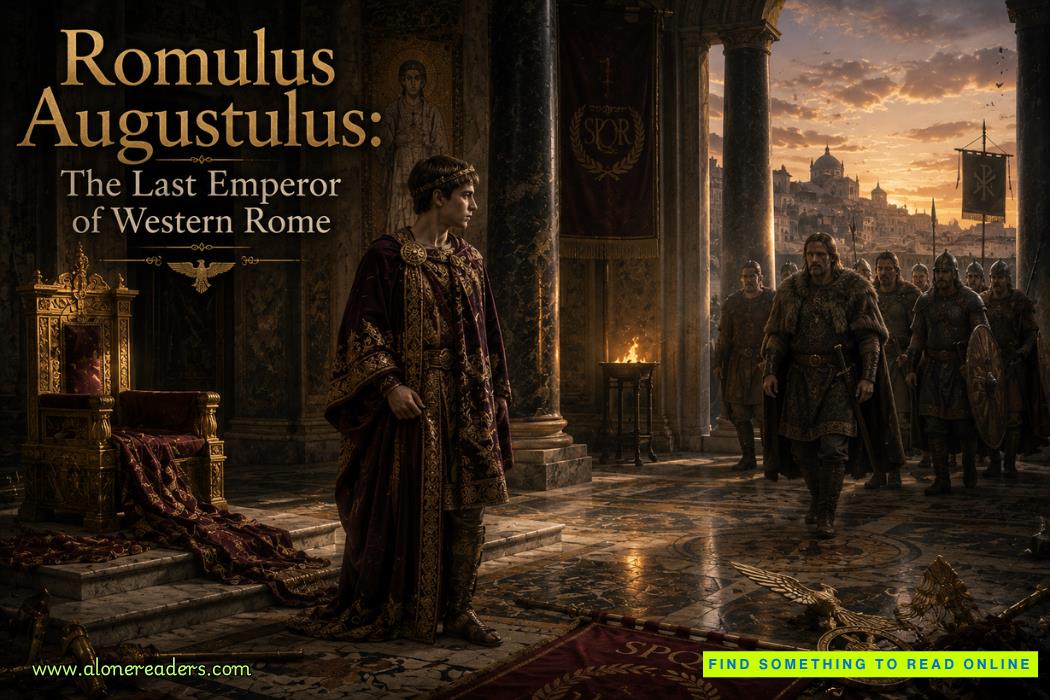
Orestes now controlled Italy, yet he made an unusual political decision. Instead of declaring himself emperor, he elevated his young son Romulus Augustulus to the throne. Historians continue to debate his motivations. Perhaps he believed that ruling through his son would preserve the appearance of constitutional legitimacy. Perhaps he feared opposition if he openly seized imperial authority. Whatever his reasoning, Orestes became the true ruler while the emperor was merely a child serving as a political symbol.
Romulus Augustulus was probably no more than fourteen years old when proclaimed emperor. His youth made him entirely dependent upon his father. Every significant political, military, and administrative decision rested with Orestes. Foreign diplomacy, military campaigns, financial administration, and appointments all reflected the general's authority rather than the emperor's personal judgment. This arrangement clearly demonstrated how completely military power had replaced traditional imperial leadership.
Yet Orestes' authority rested upon fragile foundations. His army consisted largely of Germanic federate troops who had fought for Rome in exchange for promises of land and compensation. These warriors expected generous rewards after helping Orestes seize power. Instead, he refused their demands for land distribution in Italy. The refusal proved catastrophic.
Among the dissatisfied officers stood Odoacer, himself a capable military commander with considerable support among the federate troops. Odoacer understood that Orestes' authority depended entirely upon military loyalty. Once the soldiers transferred their allegiance, the government would collapse almost immediately. The crisis demonstrated another defining characteristic of the age: political legitimacy no longer depended upon Roman law but upon military support.
In 476 AD, Odoacer led a revolt against Orestes. The campaign moved rapidly because many soldiers abandoned their former commander. Orestes attempted to defend northern Italy but was defeated near Pavia. Captured shortly afterward, he was executed. Within days, Odoacer's forces advanced toward Ravenna, the imperial capital.
The young Romulus Augustulus offered little resistance. Unlike many earlier emperors, he possessed neither an independent army nor experienced political supporters. Odoacer deposed him peacefully, allowing the boy to retire into comfortable exile rather than ordering his execution. This remarkably restrained treatment reflected the fact that Romulus himself had never exercised real political power.
The deposition of Romulus Augustulus traditionally marks the fall of the Western Roman Empire, but the event was fundamentally the consequence of military politics rather than foreign conquest alone. The Empire did not simply collapse because barbarians invaded; it collapsed because military commanders had become stronger than the institutions they were supposed to defend. Orestes' rise and fall perfectly illustrate this reality.
Following his victory, Odoacer chose not to appoint another Western emperor. Instead, he sent the imperial insignia to the Eastern Emperor Zeno and governed Italy as king while formally recognizing Eastern imperial supremacy. This decision effectively ended the separate Western imperial office that had existed for nearly a century.
Orestes' career also reveals the increasingly blurred distinction between Roman and barbarian political culture. Although he remained ethnically Roman, he relied heavily upon barbarian soldiers, had served under Attila the Hun, and employed methods of military rule similar to those used by Germanic leaders. The Roman state had become deeply intertwined with the very military forces that had once threatened its frontiers.
His story furthermore highlights the structural weaknesses that had accumulated over decades. Economic decline reduced the government's ability to pay soldiers. Population losses limited recruitment. Provincial territories disappeared under barbarian control, shrinking tax income even further. Civil wars repeatedly weakened central authority while ambitious generals competed for power. Under these conditions, the loyalty of the army became more valuable than constitutional legitimacy or hereditary succession.
The rise of military strongmen also transformed Roman political culture. Senators, administrators, and provincial elites increasingly recognized that success depended upon maintaining good relations with powerful generals rather than with emperors. Civil government survived largely because military leaders permitted it to function. Imperial institutions remained outwardly intact, but their practical authority steadily diminished.
Although Orestes ruled for only a short period, his government represented the final stage of a political evolution that had unfolded across generations. Earlier military leaders had manipulated emperors while preserving the illusion of imperial supremacy. Orestes reduced that illusion almost completely by openly governing through his own son. When Odoacer overthrew both father and emperor, virtually no institutional resistance remained because the Empire itself had become dependent upon whichever commander controlled the army.
The broader significance of Orestes extends beyond the dramatic events of 476 AD. His career symbolizes the transformation of the Western Roman Empire from a centralized imperial state into a fragmented political system where military leaders exercised personal authority through armed followers rather than established institutions. The emperor ceased to be the master of the army, and the army became the master of the emperor. Once this reversal occurred, the survival of the Western Empire became increasingly unlikely.
In the end, Orestes neither intended nor desired to destroy the Roman Empire. Like many military leaders before him, he sought to preserve order while securing his own position. Yet his methods revealed how profoundly Roman government had changed. By elevating military authority above constitutional rule, relying upon mercenary armies, and reducing the emperor to a powerless figurehead, Orestes embodied the final political transformation of the Western Empire. His rise, brief dominance, and rapid downfall stand as one of history's clearest demonstrations that when military power eclipses legitimate civil authority, even the greatest empires can quickly lose the foundations upon which they were built.




 The Hundred Days Offensive: How the Allies Defeated Germany in World War I
 The Second Battle of the Marne: The Turning Point of World War I in 1918
 The Spring Offensive of 1918: Germany's Final Gamble to Win World War I
 The Treaty of Brest-Litovsk: How Russia Left World War I
 The Russian Revolution and World War I: How War Brought Down the Tsar
 The Zimmermann Telegram Explained: Germany's Secret Offer to Mexico in World War I










