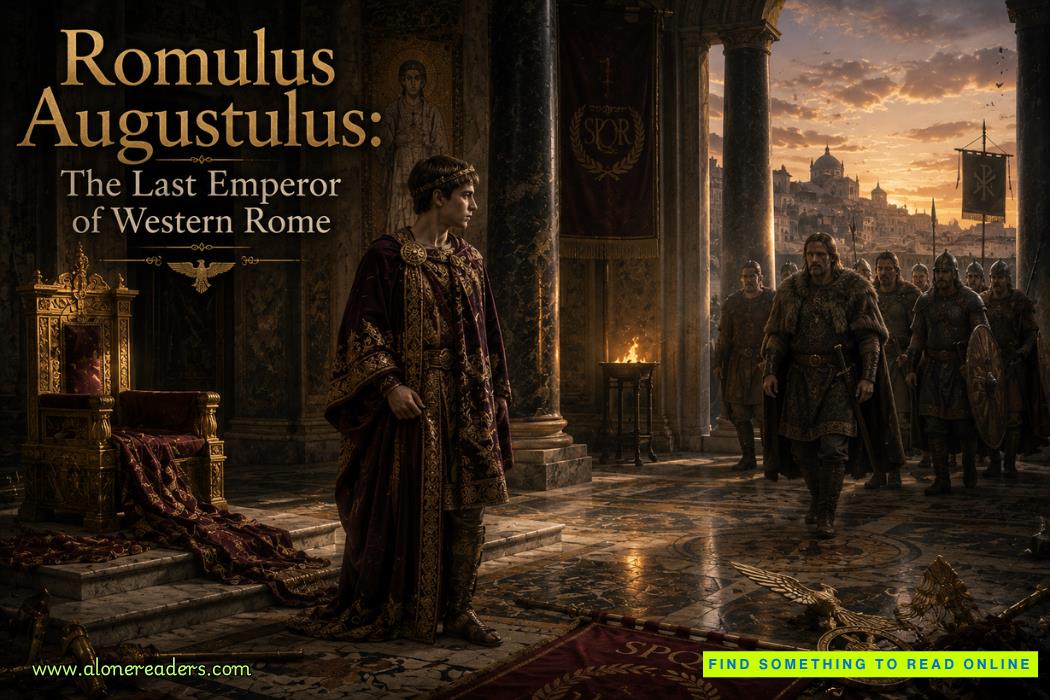
The story of Romulus Augustulus is one of the greatest historical ironies in world history. Although his name appears at the end of every list of Western Roman Emperors, he was never a powerful ruler, a brilliant general, or a respected statesman. Instead, he was a teenage boy placed upon a collapsing throne by an ambitious father who hoped to rule through him. Yet this insignificant emperor became one of the most famous figures in history because his deposition in 476 AD has long been regarded as the symbolic end of the Western Roman Empire. While Rome's decline had unfolded over centuries through political instability, economic hardship, military weakness, and repeated invasions, it was the removal of Romulus Augustulus that provided historians with a clear moment marking the conclusion of ancient Rome in the West.
The origins of Romulus Augustulus reflected the instability that had become normal within the empire during the fifth century. He was born around 461 or 463 AD, probably into an aristocratic Roman family with military connections. His father, Orestes, had served as an experienced military commander and administrator. Interestingly, Orestes had once worked under Attila the Hun before returning to Roman service, illustrating the increasingly blurred boundaries between Roman and barbarian political worlds. By the time Romulus was born, the Western Roman Empire had become heavily dependent upon military leaders rather than effective emperors. Real authority often rested in the hands of generals who controlled armies instead of imperial officials in Rome or Ravenna.
The young emperor's unusual name carried deep symbolic meaning. He was named Romulus, after the legendary founder of Rome, and Augustus, recalling the first Roman emperor who had established the imperial system nearly five centuries earlier. Historians later mockingly referred to him as "Augustulus," meaning "Little Augustus." The nickname reflected both his youth and the fact that he possessed very little genuine authority. It also unintentionally emphasized history's remarkable symmetry: the Roman Empire in the West began with Augustus and ended with Augustulus.
When Romulus was elevated to the throne in 475 AD, he was probably no older than fifteen years old. His accession was not the result of popular support or constitutional succession. Instead, his father Orestes led a military revolt against the reigning emperor Julius Nepos, forcing Nepos to flee across the Adriatic Sea to Dalmatia. Although Julius Nepos remained legally recognized by the Eastern Roman Emperor, Orestes refused to claim the imperial title for himself. Instead, he placed his young son upon the throne while exercising actual power behind the scenes.
This arrangement reflected the broader political realities of the late Western Empire. Emperors had increasingly become ceremonial figures whose survival depended entirely upon military commanders. During the fifth century, numerous emperors had risen and fallen within remarkably short periods. Some ruled only months before being assassinated or overthrown. Imperial authority had become little more than a political symbol while military leaders determined the empire's fate.
The capital of the Western Roman Empire was no longer Rome itself but Ravenna, a city protected by marshes that provided excellent defensive advantages against invading armies. From Ravenna, Romulus Augustulus occupied magnificent imperial palaces while possessing virtually no independent authority. Every important political and military decision rested with Orestes.
However, Orestes faced an enormous problem almost immediately after seizing power. The Western Roman army depended heavily upon Germanic federate troops who had been promised land in Italy as payment for their military service. These soldiers had fought for Rome for years, defending the empire against numerous invasions. When they demanded fulfillment of these promises, Orestes refused to distribute Italian land among them.
His refusal proved catastrophic. The dissatisfied federate soldiers united under the leadership of Odoacer, a capable Germanic military commander whose background likely included Scirian, Rugian, or Herulian ancestry. Odoacer organized a rebellion that rapidly gained momentum as more soldiers abandoned imperial loyalty.
In 476 AD, Odoacer marched into Italy with relatively little resistance. The imperial government lacked sufficient loyal forces to stop him, demonstrating just how weak central authority had become. Orestes attempted to organize a defense but was captured near Piacenza and executed shortly afterward. His brother Paulus also died while resisting Odoacer's advance.
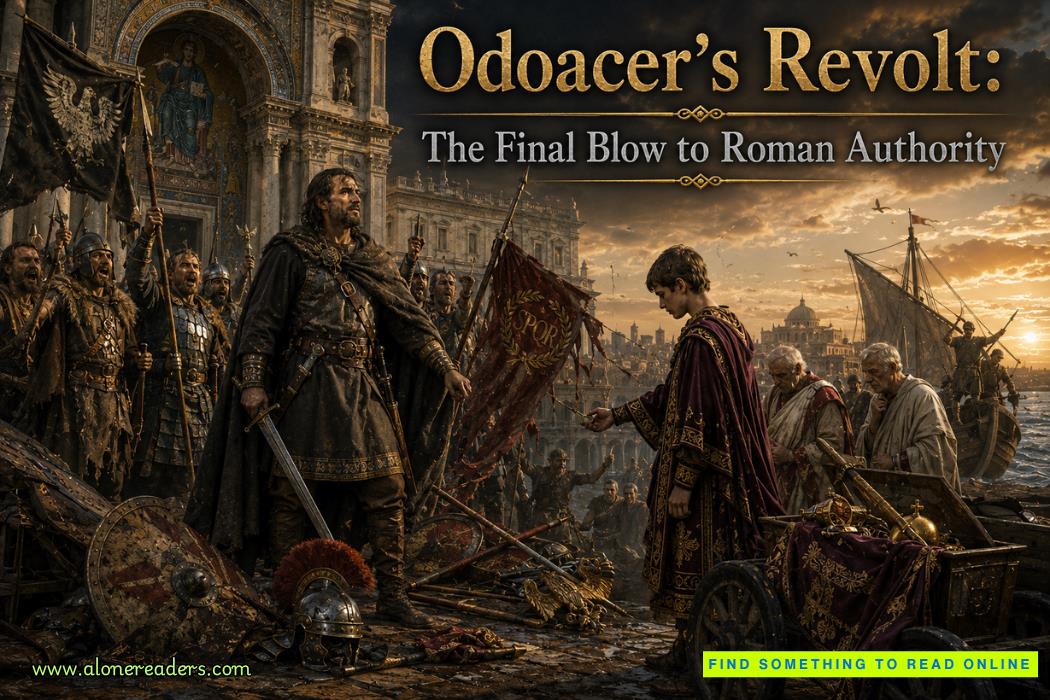
The fall of Orestes left the teenage Romulus Augustulus completely defenseless. Odoacer entered Ravenna and confronted the young emperor. Rather than executing him, as had happened to many previous Roman rulers, Odoacer chose an unexpectedly merciful course of action. Recognizing that Romulus was merely a child and had never exercised genuine authority, he simply forced the emperor to abdicate.
According to historical accounts, Romulus surrendered the imperial insignia without significant resistance. This peaceful abdication marked one of history's most important political transitions. Unlike many previous imperial changes involving civil wars, massacres, or prolonged conflicts, the final disappearance of the Western imperial office occurred with surprising simplicity.
After his deposition, Romulus Augustulus was granted a generous annual pension reportedly amounting to 6,000 solidi, an enormous sum that allowed him to live comfortably. Odoacer permitted the former emperor to retire to the luxurious Villa Lucullana near Naples, a magnificent estate that had once belonged to the famous Roman general Lucullus. Some later sources suggest Romulus may have lived there for decades, perhaps even surviving into the early sixth century, although the exact details of his later life remain uncertain.
Odoacer then made a decision that permanently altered European history. Rather than appointing another Western Roman Emperor, he sent the imperial regalia to the Eastern Roman Emperor Zeno in Constantinople. He declared that the Roman world no longer required two emperors and requested recognition as King of Italy while acknowledging the theoretical supremacy of the Eastern Emperor.
This act symbolized the disappearance of the Western imperial office itself. Although Julius Nepos technically remained the legitimate Western Emperor in exile until his assassination in 480 AD, no new emperor was ever appointed after Romulus Augustulus. The imperial throne of the West simply ceased to exist.
Modern historians often debate whether 476 AD truly represents the "fall" of the Western Roman Empire. In many respects, Roman institutions continued functioning after Romulus' deposition. The Roman Senate remained active in Italy for several decades. Roman law continued governing everyday life. Tax collection, local administration, infrastructure maintenance, and much of the civil bureaucracy survived under Odoacer and later under the Ostrogothic king Theodoric the Great. Latin remained the dominant administrative language, and many Roman aristocrats continued occupying influential positions.
Therefore, the end of the Western Roman Empire was more a political transformation than an immediate civilizational collapse. The Roman world evolved gradually into the medieval kingdoms that would dominate Europe for centuries. The people living in Italy did not wake up one morning believing that ancient civilization had ended overnight. Instead, they experienced a slow transition in which Germanic rulers increasingly governed Roman populations while preserving many Roman traditions.
Nevertheless, the deposition of Romulus Augustulus carried enormous symbolic importance. For nearly five hundred years, the office of Western Roman Emperor had represented continuity with the legacy of Augustus, Trajan, Hadrian, Constantine, and countless other rulers. Once that office disappeared, no political authority in Western Europe could legitimately claim uninterrupted succession from ancient imperial Rome.
The Eastern Roman Empire, known today as the Byzantine Empire, continued to flourish for almost another thousand years. From Constantinople, Eastern emperors regarded themselves as the legitimate Roman rulers and never accepted that the Roman Empire had truly ended. Indeed, Emperor Justinian I would later attempt to reconquer Italy and restore imperial authority in the West during the sixth century. Although his armies temporarily regained much territory, the Western imperial office itself was never permanently revived.
Romulus Augustulus occupies a unique place in historical memory because his personal achievements were virtually nonexistent, yet his historical significance is immense. He commanded no famous military victories, enacted no major reforms, and left behind no important legislation. Instead, his importance lies entirely in what his removal represented rather than what he accomplished. He became the living symbol of an empire whose political foundations had been steadily eroding for generations.
His reign also demonstrates the dangers of political systems that become dependent upon individual military strongmen rather than stable institutions. By the fifth century, emperors no longer controlled armies; armies controlled emperors. Once military loyalty disappeared, imperial authority collapsed almost instantly. Romulus himself was less the cause of Rome's fall than its final witness.
The life of Romulus Augustulus reminds us that history is often shaped by ordinary individuals placed within extraordinary circumstances. He neither created the empire's problems nor possessed the ability to solve them. Instead, he inherited centuries of accumulated political corruption, economic decline, military fragmentation, and territorial loss. His brief reign represented the final chapter of a story that had begun long before his birth.
Today, historians continue to view Romulus Augustulus as the final face of the Western Roman Empire. His deposition in 476 AD remains one of the most recognizable turning points in world history because it marks the traditional boundary between Classical Antiquity and the European Middle Ages. Although Rome's legacy survived through law, language, architecture, religion, and culture, the imperial institution that had governed Western Europe for centuries disappeared forever. The quiet abdication of a teenage emperor became one of history's greatest symbols, representing not merely the end of a dynasty but the conclusion of an entire civilization's political era.




 The Hundred Days Offensive: How the Allies Defeated Germany in World War I
 The Second Battle of the Marne: The Turning Point of World War I in 1918
 The Spring Offensive of 1918: Germany's Final Gamble to Win World War I
 The Treaty of Brest-Litovsk: How Russia Left World War I
 The Russian Revolution and World War I: How War Brought Down the Tsar
 The Zimmermann Telegram Explained: Germany's Secret Offer to Mexico in World War I










