
Few empires in African history reached the extraordinary heights achieved by the Songhai Empire, a civilization that transformed the western Sahel into one of the richest and most influential regions of the medieval world. Stretching across vast territories along the Niger River, Songhai controlled flourishing cities, immense trade networks, renowned centers of learning, and one of the strongest armies in Africa. For more than a century, its rulers expanded their authority over deserts, grasslands, and river valleys, creating an empire whose wealth became legendary far beyond the African continent.
Yet the empire that had defeated powerful rivals, managed countless ethnic groups, and accumulated enormous riches ultimately collapsed with astonishing speed. Its downfall was not simply the result of poor leadership or internal rebellion. Instead, a relatively small Moroccan expedition equipped with firearms shattered one of Africa's greatest empires at the Battle of Tondibi in 1591, forever changing the balance of power across West Africa.
The rise and fall of the Songhai Empire illustrates how geography, commerce, military innovation, political ambition, and technological change can combine to create—and destroy—a great civilization.
Long before Songhai became an empire, the region around Gao, situated on the eastern bend of the Niger River, had already emerged as an important commercial center. Merchants traveling between North Africa and the forests of West Africa found Gao to be an ideal meeting place where valuable goods changed hands. Salt from the Sahara, gold from the southern forests, ivory, copper, textiles, kola nuts, leather, and enslaved people moved through its bustling markets.
The Niger River served as the empire's lifeline. Unlike the deserts that surrounded much of the region, the river provided transportation, fertile farmland, fishing, and communication. Whoever controlled this waterway could dominate trade and sustain large populations. This geographical advantage became the foundation upon which Songhai's future power would be built.
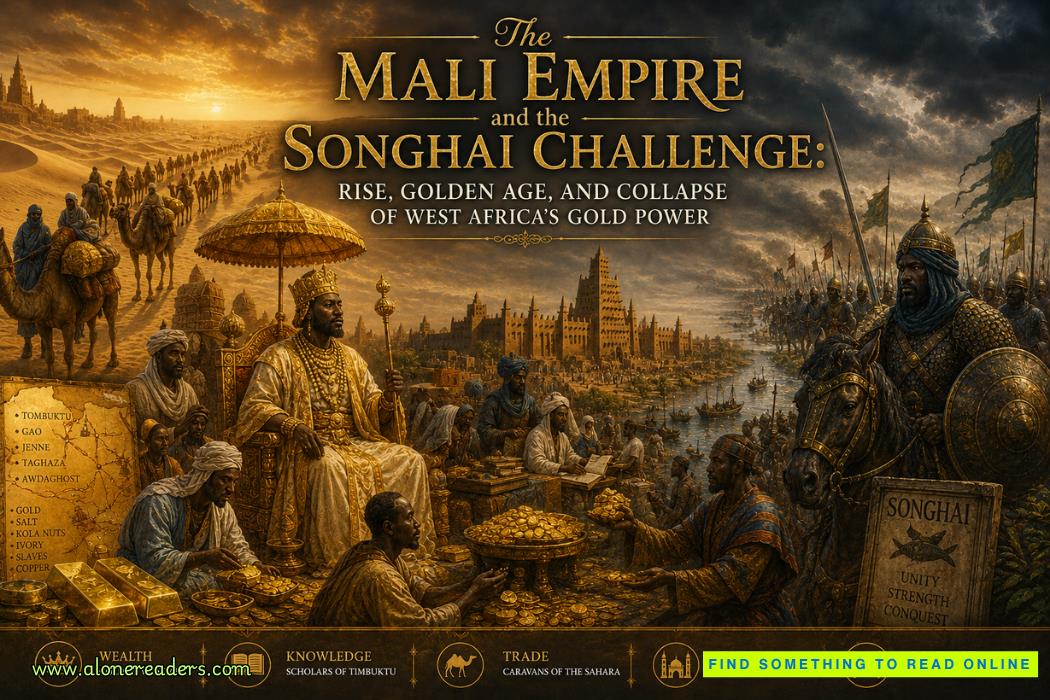
Initially, Songhai existed under the shadow of the Mali Empire, whose rulers controlled much of West Africa during the thirteenth and fourteenth centuries. As Mali gradually weakened because of succession disputes, provincial rebellions, and declining authority over distant territories, ambitious leaders in Gao recognized an opportunity.
Rather than remaining subordinate, Songhai rulers steadily increased their independence, strengthened their military, and expanded their political influence. The weakening of one great empire created the perfect conditions for another to emerge.
The true architect of Songhai's transformation was Sunni Ali, who came to power in the second half of the fifteenth century. Often regarded as one of Africa's greatest military commanders, Sunni Ali combined political vision with relentless military campaigns that fundamentally altered West African history.
Unlike many earlier rulers who focused primarily on defending existing territories, Sunni Ali pursued aggressive expansion. He understood that controlling trade routes required controlling strategic cities, river crossings, and agricultural regions.
His army became one of the largest and best-organized forces in West Africa. It consisted of infantry, cavalry, and an impressive river navy that patrolled the Niger. Horses provided speed across open terrain, while war canoes enabled rapid movement along waterways.
One of his greatest achievements was the capture of Timbuktu, a city famous throughout the Islamic world for its scholars, libraries, and prosperous merchants. Controlling Timbuktu gave Songhai not only economic wealth but also immense prestige.
Soon afterward, Sunni Ali conquered Djenné, another thriving commercial center that had resisted numerous sieges. With Gao, Timbuktu, and Djenné under one ruler, Songhai controlled nearly every major commercial hub along the middle Niger.
These victories transformed Songhai from a regional kingdom into the dominant political and economic force in West Africa.
Following Sunni Ali's death, Askia Muhammad, also known as Askia the Great, assumed power after a period of political struggle. If Sunni Ali built the empire through conquest, Askia Muhammad perfected it through administration.
He reorganized the empire into provinces governed by trusted officials responsible to the central government. Tax collection became more systematic, military commanders received clearer responsibilities, and provincial governors were regularly supervised.
Rather than relying solely on military strength, Askia recognized the importance of efficient governance. This administrative structure allowed the empire to control territories extending thousands of miles without collapsing under its own size.
His reign marked the beginning of the empire's true Golden Age.
Askia Muhammad was also deeply committed to Islamic scholarship. His pilgrimage to Mecca established diplomatic ties with rulers across North Africa and the Middle East, enhancing Songhai's international reputation.
During his reign, Timbuktu flourished as one of the world's greatest centers of education. Thousands of students traveled from across Africa to study law, mathematics, astronomy, medicine, philosophy, and theology.
Its famous universities and libraries housed enormous collections of handwritten manuscripts. Scholars debated complex legal questions, copied scientific works, and produced original research that attracted international recognition.
This remarkable intellectual environment disproves the outdated misconception that medieval Africa lacked advanced educational institutions. At its height, Timbuktu rivaled many celebrated centers of learning elsewhere in the world.
Economic prosperity fueled every aspect of Songhai's expansion.
The empire occupied one of the most valuable positions in the trans-Saharan trading system. Caravans carrying hundreds or even thousands of camels crossed the Sahara, linking West Africa with Morocco, Egypt, and the Mediterranean.
Among all commodities, gold remained Songhai's greatest source of wealth. Goldfields located farther south supplied enormous quantities of precious metal that eventually reached European and Middle Eastern markets.
Equally important was salt. While gold symbolized wealth, salt preserved food and sustained life in tropical climates. Massive salt blocks mined in the Sahara often carried values nearly equal to gold in certain regions.
By taxing merchants, regulating caravan routes, protecting trade, and maintaining secure markets, Songhai generated substantial government revenue without excessively burdening its population.
Agriculture also prospered along the fertile floodplains of the Niger. Rice, millet, sorghum, and other crops provided reliable food supplies, while fishing supported river communities.
This combination of commerce and agriculture created one of the strongest economies in medieval Africa.
At its greatest extent, the Songhai Empire stretched across much of modern-day Mali, Niger, Burkina Faso, Senegal, Guinea, Nigeria, and neighboring regions.
Maintaining such an enormous territory required careful organization. Communication relied upon rivers, mounted messengers, and caravan routes. Local rulers often retained limited authority while acknowledging imperial sovereignty and paying tribute.
The empire also embraced remarkable cultural diversity. Numerous ethnic groups, languages, and religious traditions coexisted within its borders. While Islam dominated urban centers and government administration, many rural communities preserved older spiritual traditions.
This flexibility helped maintain stability across a vast multicultural empire.
Despite its impressive achievements, Songhai contained weaknesses that gradually became more serious.
One recurring problem involved succession disputes. Like many hereditary monarchies, the transfer of power rarely occurred smoothly. Rival claimants often competed for the throne, encouraging military intervention and weakening central authority.
Large empires also faced logistical challenges. Provincial governors possessed significant military resources and occasionally acted independently. Maintaining loyalty across distant territories required constant oversight.
As generations passed, some rulers lacked the exceptional leadership qualities demonstrated by Sunni Ali and Askia Muhammad. Administrative efficiency slowly declined, corruption increased, and regional leaders became more autonomous.
Although these issues did not immediately threaten the empire, they steadily reduced its resilience.
While Songhai struggled internally, a new threat emerged far to the north.
Morocco, ruled by the ambitious Sultan Ahmad al-Mansur, faced severe financial pressures. His government required new sources of wealth to sustain military campaigns and ambitious building projects.
Reports describing the immense riches of Songhai—especially its access to gold—captured the sultan's attention.
However, invading the Sahel required crossing one of the harshest environments on Earth. The Sahara Desert posed extraordinary logistical difficulties involving water, food, navigation, and transportation.
Nevertheless, Ahmad al-Mansur believed the potential rewards justified the risks.
Perhaps even more importantly, Morocco possessed a decisive technological advantage.
Its army had access to arquebuses, muskets, cannons, and experienced soldiers trained in gunpowder warfare. While firearms had already transformed battlefields across Europe, North Africa, and the Ottoman world, most West African armies continued relying primarily on traditional weapons.
The technological gap would soon prove catastrophic.
In 1590, a Moroccan expedition commanded by Judar Pasha departed across the Sahara.
Despite numbering only a few thousand soldiers, the expedition included experienced infantry, artillery specialists, engineers, cavalry, and large quantities of gunpowder.
Crossing the Sahara itself represented an extraordinary achievement. Soldiers endured extreme temperatures, scarce water supplies, sandstorms, and immense distances before finally reaching Songhai territory.
Many observers believed the small invading force would be overwhelmed once it encountered the massive Songhai army.
They underestimated the revolutionary impact of firearms.
The decisive confrontation occurred near Tondibi in March 1591.
The Songhai army reportedly numbered tens of thousands of infantry and cavalry, vastly outnumbering the Moroccans. On paper, victory appeared almost certain.
Yet battlefield success depends on far more than numbers alone.
As the armies prepared for combat, Songhai commanders attempted an unusual tactic. They drove large herds of cattle toward the Moroccan lines, hoping to break enemy formations before launching their main assault.
Initially, the strategy seemed promising.
Then Moroccan soldiers opened fire.
The thunderous explosions of muskets and cannons terrified the cattle. Instead of charging into Moroccan ranks, the frightened animals turned and stampeded directly back into the advancing Songhai army.
Chaos spread almost instantly.
At the same time, disciplined volleys of arquebus fire cut through advancing infantry and cavalry. Warriors armed with spears, swords, and bows found themselves facing enemies capable of killing from distances they could scarcely answer.
Repeated gunfire shattered formations that had once dominated traditional African warfare.
Although many Songhai soldiers fought with extraordinary courage, bravery alone could not overcome overwhelming technological disadvantage.
The Battle of Tondibi demonstrated one of history's most dramatic examples of military technology transforming the outcome of war.
Following the defeat, the Songhai government rapidly lost control.
Moroccan forces advanced into Gao, Timbuktu, and Djenné, capturing the empire's most important cities.
Although Morocco successfully occupied these urban centers, governing such distant territories proved extremely difficult. The Sahara remained an enormous obstacle separating the conquered lands from Marrakech.
As a result, Morocco never established complete control over the former empire.
Instead, the centralized Songhai state simply disintegrated.
Provincial leaders declared independence, local kingdoms re-emerged, rival warlords competed for territory, and former imperial institutions collapsed.
Rather than replacing one great empire with another, the invasion fragmented political authority throughout the region.
The consequences extended far beyond military defeat.
Trade routes became increasingly insecure as centralized protection disappeared. Merchants faced greater risks from raids and political instability.
Timbuktu's scholarly institutions suffered severe disruption. Many scholars fled, manuscripts disappeared, and intellectual life gradually declined.
Agricultural production became less reliable in regions affected by warfare and political fragmentation.
Communities that had once benefited from imperial stability now faced uncertain futures under competing local rulers.
Although commerce never disappeared entirely, the integrated economic system that had supported Songhai's prosperity largely collapsed.
Historians continue debating why Songhai fell so quickly.
Some emphasize the decisive impact of firearms, arguing that gunpowder fundamentally altered military balance.
Others point to internal political instability, suggesting that succession disputes and administrative decline had already weakened the empire before Morocco invaded.
Economic factors also played important roles. Changes in global trade patterns gradually reduced the relative importance of trans-Saharan commerce as European maritime routes expanded along the Atlantic coast.
The most convincing explanation combines these factors rather than treating any single cause as decisive.
Songhai did not collapse solely because Morocco possessed guns. Rather, firearms delivered the final blow to an empire already weakened by political divisions, administrative challenges, and changing economic realities.
The Battle of Tondibi therefore represents more than a military defeat.
It marks the beginning of a new era in African history, one increasingly shaped by global technological competition, shifting trade networks, and expanding foreign intervention.
The legacy of the Songhai Empire remains remarkable despite its dramatic end.
Its rulers demonstrated that sophisticated states flourished in West Africa long before European colonial expansion. Their governments managed vast territories, encouraged scholarship, promoted international trade, and built institutions admired across the Islamic world.
The libraries and manuscripts of Timbuktu continue to provide invaluable evidence of Africa's rich intellectual traditions. Modern historians increasingly recognize these collections as among humanity's greatest documentary treasures.
The empire also left lasting cultural influences throughout West Africa. Administrative traditions, commercial practices, educational institutions, religious scholarship, and artistic achievements continued shaping regional societies long after the imperial government disappeared.
Today, the story of Songhai serves as both an inspiration and a warning.
It demonstrates how visionary leadership, economic innovation, strategic geography, and educational excellence can elevate a regional kingdom into one of history's greatest empires. At the same time, it reminds us that no civilization remains invincible. Political fragmentation, technological complacency, and external ambition can combine to destroy even the most powerful states.
The Battle of Tondibi stands as one of Africa's most consequential turning points—a moment when centuries of accumulated wealth, learning, and political authority collided with the revolutionary power of gunpowder. The defeat did not erase Songhai's extraordinary accomplishments, but it permanently altered the course of West African history. Even after its fall, the empire's achievements continue to testify to the sophistication, resilience, and global significance of one of Africa's greatest civilizations.
At a Glance
| Topic | Summary |
|---|---|
| Empire | Songhai Empire |
| Region | West Africa along the Niger River |
| Capital | Gao |
| Rise to Power | Expanded after the decline of the Mali Empire under Sunni Ali |
| Golden Age | Reign of Askia Muhammad, marked by administrative reforms, trade, and scholarship |
| Major Cities | Gao, Timbuktu, Djenné |
| Main Sources of Wealth | Gold trade, salt trade, trans-Saharan commerce, agriculture |
| Military Strength | Large infantry, cavalry, river navy |
| Greatest Achievement | Creation of West Africa's largest empire and the flourishing of Timbuktu as a global center of learning |
| Beginning of Decline | Succession disputes, administrative weakening, regional autonomy |
| Decisive Event | Battle of Tondibi (1591) |
| Main Opponent | Moroccan army under Judar Pasha, sent by Sultan Ahmad al-Mansur |
| Key Reason for Defeat | Moroccan firearms and artillery overwhelmed the traditionally armed Songhai army |
| Aftermath | Collapse of centralized rule, fragmentation into smaller states, decline of trans-Saharan dominance |
| Historical Legacy | One of Africa's greatest empires, remembered for its wealth, scholarship, trade, and lasting cultural influence. |




 The Hundred Days Offensive: How the Allies Defeated Germany in World War I
 The Second Battle of the Marne: The Turning Point of World War I in 1918
 The Spring Offensive of 1918: Germany's Final Gamble to Win World War I
 The Treaty of Brest-Litovsk: How Russia Left World War I
 The Russian Revolution and World War I: How War Brought Down the Tsar
 The Zimmermann Telegram Explained: Germany's Secret Offer to Mexico in World War I










