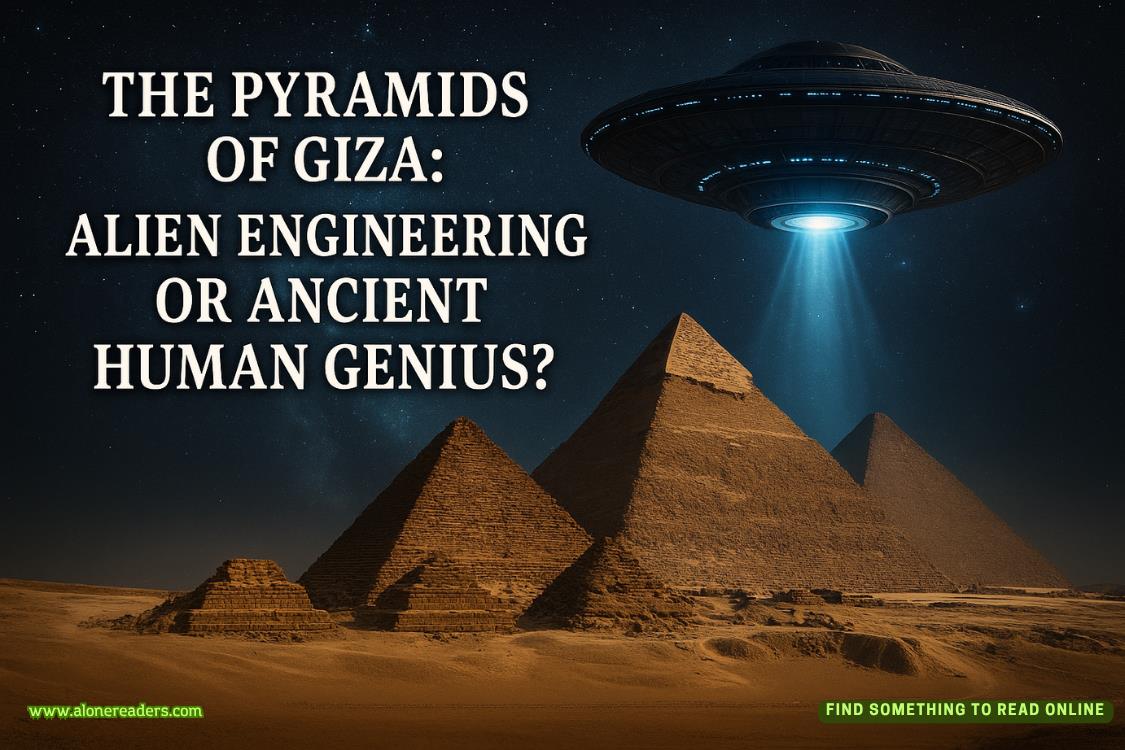
Few monuments in human history have inspired as much wonder, speculation, and mystery as the Pyramids of Giza. Standing tall for over four thousand years, these colossal structures on Egypt’s Giza Plateau continue to defy simple explanation. While mainstream archaeology attributes their construction to the ingenuity of the ancient Egyptians, alternative theories have long claimed that their precision and scale are evidence of extraterrestrial involvement. This enduring debate—alien engineering versus human genius—touches the very core of our understanding of civilization’s capabilities and the boundaries of ancient technology.
The Great Pyramid of Khufu, the largest of the three, stands as the most enigmatic of them all. Rising approximately 146 meters when first built, it remained the tallest man-made structure on Earth for nearly four millennia. Its base covers more than thirteen acres, composed of over two million limestone and granite blocks, some weighing up to eighty tons. The sheer size and precision of this monument are almost incomprehensible, even by modern standards. The pyramid’s sides are aligned almost perfectly to the cardinal directions, and the accuracy of its geometry—down to fractions of a degree—has led many to question whether humans of the Bronze Age could truly have achieved such feats without advanced tools or external help.
Supporters of the alien-engineering hypothesis argue that the pyramids exhibit characteristics that go far beyond the capabilities of the civilization that supposedly built them. They point to the extreme precision of the stone cutting, the exact placement of massive blocks, and the alignment of the structures with celestial bodies such as Orion’s Belt. According to this theory, ancient Egyptians may have received assistance—or even direct intervention—from extraterrestrial visitors possessing superior knowledge of mathematics, astronomy, and engineering. Proponents highlight ancient texts and depictions of “sky gods” descending to Earth as potential evidence of such contact. To them, the pyramids serve not merely as tombs but as technological beacons or energy transmitters, constructed through methods beyond human comprehension at that time.
On the other side of the debate, mainstream Egyptologists and scientists argue that there is ample evidence supporting the view that the pyramids were the product of human skill, organization, and innovation. The ancient Egyptians possessed an advanced understanding of geometry, astronomy, and engineering principles. Archaeological discoveries, such as workers’ villages near Giza, detailed hieroglyphs, and quarrying tools, demonstrate a sophisticated and well-coordinated workforce. Scholars explain the pyramid’s precision through systematic planning and an organized labor force rather than alien technology. Far from being slaves, these workers were well-fed, skilled craftsmen who lived in nearby settlements built to accommodate thousands. This perspective portrays the pyramids as a triumph of human civilization—a testament to discipline, faith, and ambition rather than divine or extraterrestrial intervention.
Still, the mathematical precision of the pyramids continues to astonish. The Great Pyramid’s base is nearly a perfect square, with each side measuring roughly 230 meters and deviating by mere centimeters. When viewed from above, it aligns almost flawlessly with the Earth’s true north—a level of precision that modern architects still find remarkable. Furthermore, the ratio of the pyramid’s perimeter to its height is strikingly similar to 2π, a mathematical constant. While some claim this proves advanced scientific knowledge possibly imparted by aliens, others argue it merely reflects the Egyptians’ exceptional understanding of practical geometry acquired through centuries of observation and experimentation.
Another layer of intrigue arises from the astronomical alignment of the pyramids. The three structures on the Giza Plateau are arranged in a pattern that closely mirrors the three stars of Orion’s Belt. Ancient Egyptians associated Orion with Osiris, the god of the afterlife, suggesting that this alignment had deep religious and symbolic meaning. This celestial correspondence fuels the alien theory, which contends that the builders possessed advanced astronomical knowledge—possibly guided by beings from beyond Earth. However, scholars counter that ancient civilizations worldwide were keen observers of the night sky and integrated astronomical phenomena into their architecture and spiritual beliefs without extraterrestrial assistance.
A major point of contention is the question of construction methods. How did a civilization over four thousand years ago transport and position such massive stones with only copper tools and wooden sledges? Alien theorists claim that advanced levitation or energy-based technology must have been involved, while archaeologists have reconstructed plausible methods using ramps, levers, and sheer human power. Recent experiments in Egypt and other countries have demonstrated that large teams could indeed move multi-ton blocks using wet sand to reduce friction or spiral ramps built around the pyramid’s exterior. These practical techniques, combined with decades of organization and labor, could have made the construction possible—though still incredibly demanding.
The symbolic and spiritual dimension of the pyramids also reinforces the argument for human brilliance rather than alien intervention. Ancient Egyptian religion revolved around the concept of the afterlife and the divine journey of the pharaoh’s soul. The pyramid’s shape—rising toward the heavens—was a metaphor for spiritual ascent, linking the mortal realm with the eternal. The inner chambers and passageways were designed with meticulous precision to align with specific stars, reflecting a worldview that blended science, spirituality, and cosmology. To the Egyptians, building the pyramid was not just a feat of architecture but a sacred act connecting humanity with the cosmos.
Despite the overwhelming archaeological evidence supporting human construction, the allure of the alien theory persists, fueled by popular culture, pseudoarchaeological documentaries, and the human tendency to seek extraordinary explanations for extraordinary achievements. The notion that ancient people could not possibly have created something so magnificent without help from the stars reflects both admiration and underestimation. It romanticizes the pyramids as mysteries beyond comprehension while overlooking the ingenuity of the civilization that built them. Yet this fascination also underscores the timeless impact of these monuments—they challenge our imagination, inviting us to ponder humanity’s place in the universe.
Interestingly, modern scientific tools have only deepened the mystery. Advanced scans and ground-penetrating radar have revealed hidden voids and anomalies within the Great Pyramid, including unexplored chambers. While these discoveries hint at secrets yet to be uncovered, they also reinforce the complexity of human design. The pyramid remains a puzzle not because aliens built it, but because it embodies a level of precision and durability rarely matched even today. The use of simple tools, geometry, and astronomical observation, combined with relentless labor and religious devotion, produced a monument capable of surviving earthquakes, erosion, and time itself.
The alien-engineering narrative, while captivating, may reveal more about modern humanity than ancient Egypt. It reflects our struggle to reconcile the idea that an ancient people—without digital tools, cranes, or computers—could accomplish something so immense. Belief in alien builders serves as a metaphor for disbelief in our own ancestors’ intelligence. Yet archaeological evidence consistently proves that the Egyptians were far from primitive; they were mathematicians, astronomers, artists, and engineers who laid the foundations for future civilizations.
Ultimately, the Pyramids of Giza stand as enduring symbols of human potential. Whether viewed as tombs, cosmic symbols, or architectural marvels, they represent a fusion of intellect, faith, and determination. Their creators may not have possessed interstellar knowledge, but they harnessed something equally powerful—the capacity of human beings to dream, organize, and create on a monumental scale. The mystery surrounding their construction remains, but it is a mystery born of admiration rather than impossibility.
In the end, attributing the pyramids to aliens diminishes one of humanity’s greatest accomplishments. The true wonder lies not in extraterrestrial technology, but in ancient human genius. The people of ancient Egypt achieved what no other civilization had before: the ability to turn stone, labor, and vision into a monument that defied time. The pyramids are a celebration of what humans can achieve through unity of purpose and mastery of knowledge. Their story, whether shrouded in mystery or illuminated by archaeology, continues to remind us that the boundaries of human creativity and ambition are far greater than we often imagine.





 The Hundred Days Offensive: How the Allies Defeated Germany in World War I
 The Second Battle of the Marne: The Turning Point of World War I in 1918
 The Spring Offensive of 1918: Germany's Final Gamble to Win World War I
 The Treaty of Brest-Litovsk: How Russia Left World War I
 The Russian Revolution and World War I: How War Brought Down the Tsar
 The Zimmermann Telegram Explained: Germany's Secret Offer to Mexico in World War I










