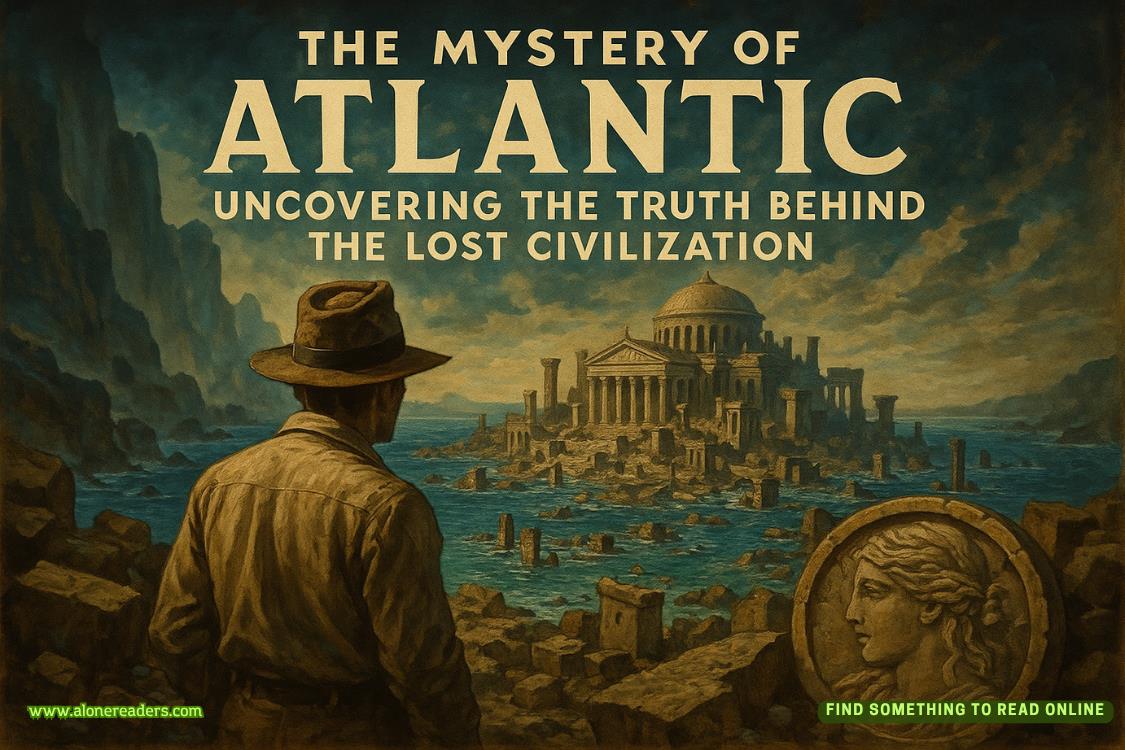
For centuries, the legend of Atlantis has captivated the imagination of historians, philosophers, and dreamers. Described as a powerful island civilization that vanished beneath the waves in a single day and night of misfortune, Atlantis stands as one of history’s most enduring enigmas. Whether viewed as an allegory of human hubris or as evidence of a forgotten age of enlightenment, the story continues to fascinate those who seek to uncover the truth behind the myth. Was Atlantis merely a moral parable invented by Plato, or did it represent a real, highly advanced civilization that once thrived before recorded history began?
The earliest mention of Atlantis comes from the writings of the Greek philosopher Plato, around 360 BCE, in his dialogues Timaeus and Critias. In these texts, Plato describes Atlantis as a grand maritime empire situated beyond the “Pillars of Hercules,” generally believed to be the Strait of Gibraltar. According to his account, Atlantis was a utopian society blessed with immense wealth, technological prowess, and moral virtue. However, over time, its inhabitants became corrupt and power-hungry, prompting the gods to punish them by submerging the entire island beneath the ocean. Plato’s tale has been interpreted by many as a cautionary story about the dangers of arrogance and moral decay. Yet others have speculated that his vivid description might have been based on ancient oral traditions or real events from a forgotten era.
Throughout history, explorers and scholars have sought to locate the lost city. Various theories have placed Atlantis in the Mediterranean, the Caribbean, the Sahara Desert, and even Antarctica. Each hypothesis brings its own interpretation of Plato’s text, connecting geological or archaeological evidence to the fabled island. Some argue that the story may have been inspired by the destruction of Thera (modern Santorini), a powerful Minoan civilization wiped out by a massive volcanic eruption around 1600 BCE. The similarities between the downfall of the Minoans and Plato’s description of Atlantis’ sudden demise have led many historians to believe that Atlantis was a retelling of this historical catastrophe, magnified through centuries of storytelling.
Nevertheless, the allure of Atlantis extends far beyond the boundaries of rational scholarship. Many enthusiasts and pseudo-historians claim that Atlantis was a technologically advanced society far ahead of its time—perhaps even more sophisticated than modern civilizations. Some believe the Atlanteans possessed knowledge of flight, renewable energy, and crystal-based power sources. These ideas, while lacking scientific support, have contributed to the rich tapestry of Atlantean mythology. During the 19th and early 20th centuries, authors such as Ignatius Donnelly popularized the notion that Atlantis was the cradle of all ancient civilizations, suggesting that survivors of the catastrophe spread their knowledge to Egypt, Mesopotamia, and the Americas. This theory implies that the great pyramids, temples, and megalithic monuments across the globe were remnants of a single mother civilization—Atlantis.
In more recent times, proponents of alternative archaeology have pointed to underwater formations like the Bimini Road in the Bahamas or submerged structures near Yonaguni, Japan, as possible evidence of lost civilizations. These formations, often interpreted by mainstream scientists as natural rock formations, are viewed by Atlantis theorists as remnants of ancient architecture. The discovery of such sites has reignited debates about whether the Earth once hosted advanced cultures now forgotten by history. The argument rests on the idea that rising sea levels following the last Ice Age may have submerged coastal cities, erasing tangible evidence of these societies.
One of the most compelling aspects of the Atlantis legend lies in its symbolism. Atlantis embodies humanity’s eternal struggle between progress and morality. The civilization’s downfall mirrors the dangers of unchecked power, materialism, and environmental disregard. This moral dimension gives the story timeless relevance, as modern societies grapple with similar challenges—climate change, technological dependence, and global inequality. Plato’s narrative, therefore, continues to resonate, offering both a warning and a reflection of human ambition.
However, skeptics maintain that the entire tale was a philosophical allegory rather than a historical record. They argue that Plato used Atlantis to illustrate his ideal state—a society governed by reason and virtue, contrasted with its eventual decay through greed and moral failure. There are no other ancient records of Atlantis before Plato’s writings, and despite centuries of exploration, no archaeological evidence conclusively supports its existence. The absence of proof leads most historians to regard Atlantis as fiction rather than fact. Yet, the persistence of the myth suggests that it fulfills a psychological or cultural need—an enduring symbol of lost perfection and the desire to rediscover humanity’s forgotten origins.
Still, the mystery of Atlantis has inspired countless expeditions, from Renaissance scholars to modern oceanographers. The search itself has become part of the legend. Satellite imagery, sonar scans, and deep-sea exploration have revealed sunken cities and geological anomalies, fueling speculation. For instance, researchers have discovered submerged ruins off the coasts of India, Cuba, and the Mediterranean, showing that advanced settlements did indeed exist before the sea claimed them. While none of these have been definitively linked to Atlantis, they demonstrate that parts of human civilization have indeed been lost to time and water. This reality keeps the possibility of Atlantis tantalizingly open, blurring the line between myth and history.
Another fascinating aspect of the Atlantis debate concerns its supposed spiritual and extraterrestrial connections. Some modern theorists and New Age movements suggest that Atlanteans were either in contact with beings from other worlds or possessed metaphysical abilities that modern science cannot explain. This narrative portrays Atlantis as a utopian society that achieved a harmonious balance between science and spirituality, only to be destroyed when it misused its knowledge. These interpretations, though far removed from academic credibility, highlight how deeply the Atlantis myth has intertwined with human imagination and the quest for meaning beyond the material world.
The legend’s influence has also seeped into popular culture. From novels and films to video games and documentaries, Atlantis has become a universal metaphor for lost knowledge and hidden truths. The enduring fascination with this myth reveals humanity’s inherent longing to connect with something greater—a golden age where wisdom and technology coexisted in perfect harmony. It speaks to the collective hope that, somewhere beneath the oceans or within the depths of forgotten history, lies a key to understanding where humanity came from and where it might be headed.
If one looks beyond the literal interpretation, Atlantis may represent not a single place, but a recurring cycle in human history—a pattern of rise, triumph, and collapse. Civilizations have risen and fallen across time, leaving behind ruins that whisper of forgotten greatness. In that sense, Atlantis is every civilization that has ever succumbed to its own excesses. The lost city becomes a mirror, reflecting both our potential for greatness and our capacity for destruction.
Whether or not Atlantis ever existed in a physical sense, its power as an idea remains undeniable. The myth continues to inspire scientific curiosity, philosophical reflection, and creative imagination. It reminds us of how fragile human achievement can be—and how easily a great civilization can vanish, leaving behind only stories and speculation. Perhaps the true lesson of Atlantis lies not in discovering its ruins beneath the sea, but in understanding the timeless truth it conveys: that no society, no matter how advanced, is immune to the consequences of its own choices.
In the end, the mystery of Atlantis endures because it speaks to something universal within us—the desire to uncover hidden truths, to rediscover lost wisdom, and to believe that humanity has lived many lives before. Whether a real lost empire or a symbol of human pride and downfall, Atlantis remains a powerful legend that refuses to sink into oblivion. It stands as a reminder that history, like the ocean, hides its deepest secrets well, waiting for those brave enough to seek them.



 The Hundred Days Offensive: How the Allies Defeated Germany in World War I
 The Second Battle of the Marne: The Turning Point of World War I in 1918
 The Spring Offensive of 1918: Germany's Final Gamble to Win World War I
 The Treaty of Brest-Litovsk: How Russia Left World War I
 The Russian Revolution and World War I: How War Brought Down the Tsar
 The Zimmermann Telegram Explained: Germany's Secret Offer to Mexico in World War I










