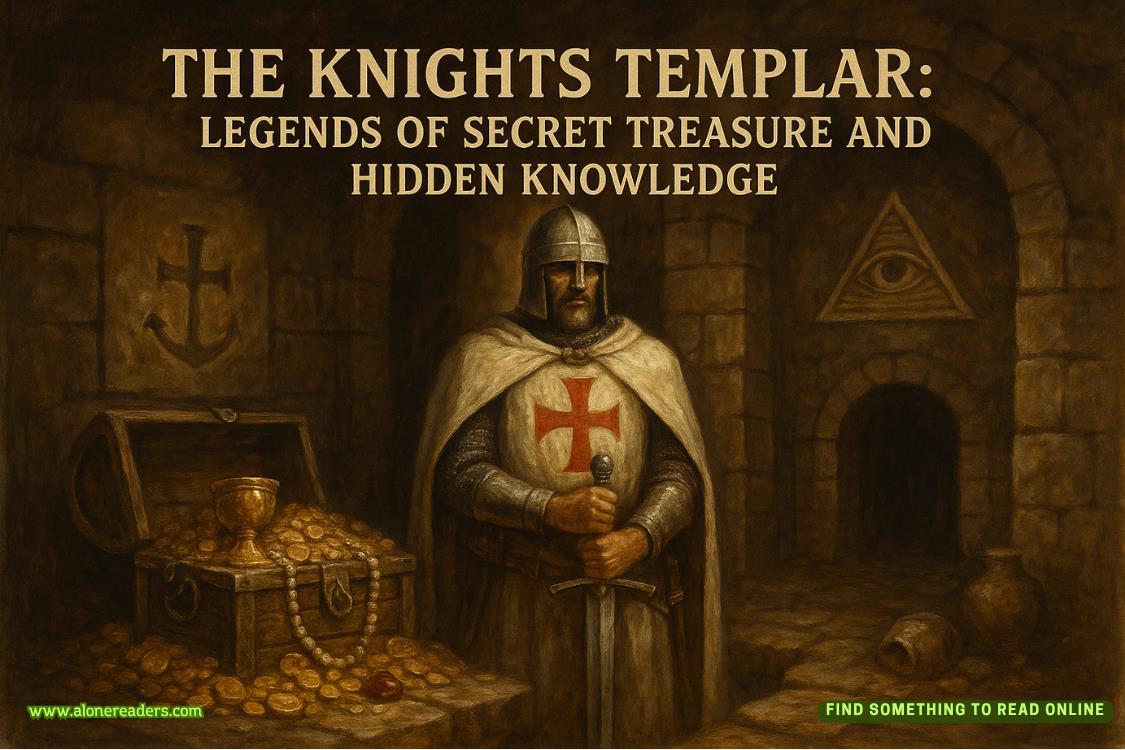
Few medieval orders have captured the world’s imagination as deeply as the Knights Templar, the warrior monks whose rise and fall still echo through the corridors of history. Founded in the early twelfth century to protect Christian pilgrims in the Holy Land, the Templars became a powerful religious and military force—amassing vast wealth, political influence, and a mystique that endured long after their dramatic downfall. Yet what truly fuels fascination today are the mysteries that surround their secret treasure and supposed hidden knowledge, subjects that have inspired countless theories, books, and legends.
The origins of the Templars were humble. In 1119, nine knights led by Hugues de Payens pledged themselves to defend pilgrims traveling to Jerusalem. With the blessing of King Baldwin II of Jerusalem, they established their headquarters on the Temple Mount—believed to be the site of Solomon’s Temple. This location would later become a cornerstone of the legends surrounding them. Their proximity to the ruins of the ancient temple stirred speculation that they had discovered sacred relics or hidden archives, perhaps remnants of Solomon’s wisdom, ancient texts, or even the Ark of the Covenant. Though historical records offer no proof, the allure of this possibility has endured for centuries.
Over time, the Templars grew from a modest band of knights into one of the most formidable institutions in medieval Europe. Their network spanned from the Holy Land to England, France, Spain, and Portugal. They developed early forms of banking—allowing pilgrims to deposit funds in one country and withdraw them in another—earning both the gratitude and suspicion of kings and popes. As their wealth increased, so too did rumors of secret rites, hidden chambers, and vast treasure vaults buried beneath their strongholds. Their symbols—the red cross, the white mantle, and the mysterious seals depicting two riders on one horse—added to their aura of secrecy and mysticism.
The supposed Templar treasure has been one of the most enduring legends in Western history. When the order was destroyed in the early fourteenth century by King Philip IV of France, who accused them of heresy and seized their assets, the royal treasurers found far less gold than expected. This discrepancy gave rise to tales that the Templars had spirited away their immense fortune before the arrests. Some stories claim that fleets of Templar ships slipped away from the French port of La Rochelle, vanishing into the Atlantic with their riches. Others suggest the treasure was hidden in remote castles, catacombs, or secret tunnels, awaiting rediscovery. The idea that a vast cache of gold, sacred relics, or forbidden knowledge remains buried somewhere in Europe still captivates treasure hunters and historians alike.
Linked to the treasure are the many conspiracy theories about what the Templars might have known or preserved. Some believe they discovered ancient scrolls beneath Solomon’s Temple, containing mystical or scientific wisdom lost since antiquity. These alleged texts, according to speculation, could have contained insights into alchemy, astronomy, or divine power—knowledge that might challenge the Church’s authority. Others connect the Templars to the Holy Grail, asserting that they guarded the chalice of Christ or the bloodline of Jesus himself. This theory, made popular by modern novels and pseudo-historical works, portrays the order as secret keepers of sacred truth—protecting it from religious persecution or political greed.
Another dimension to the Templar mystery involves the Freemasons, a fraternal organization that emerged centuries after the Templars’ suppression. Many believe that when the order was disbanded, surviving knights went underground and later re-emerged as the early Freemasons, passing down esoteric rituals, symbols, and hidden knowledge through coded traditions. The shared use of architectural symbols, secret initiations, and reverence for Solomon’s Temple strengthened the supposed link between these two organizations. While historians generally view this connection as speculative, the symbolic continuity between the Templar myth and Masonic lore remains an irresistible topic for those who seek secret lineages of wisdom.
The Templars’ downfall itself feeds the sense of conspiracy. By the early 1300s, the order had become immensely powerful—wealthy enough to lend money to monarchs, and independent enough to make them nervous. King Philip IV of France, deeply in debt to the Templars, saw an opportunity to eliminate his creditors and seize their resources. On Friday, October 13, 1307, hundreds of Templars were arrested on charges of heresy, blasphemy, and idolatry. They were accused of denying Christ, worshiping mysterious idols like the Baphomet, and engaging in secret rites. Most historians agree these charges were fabricated under torture, yet the details—the secret oaths, the alleged idol, the ritual spitting on the cross—have continued to haunt the Templar legend. The date itself, Friday the 13th, is still considered unlucky by many, a lingering echo of their tragic fate.
When Jacques de Molay, the last Grand Master of the Templars, was burned at the stake in 1314, he reportedly cursed both the king and the pope who condemned him, predicting their deaths within the year—a prophecy that seemingly came true. His defiance and dignity in death elevated him to a near-mythical figure, further solidifying the Templars’ image as victims of political betrayal rather than heretics. From that moment, the Templars ceased to be a mere order of knights—they became symbols of lost knowledge, forbidden truth, and resistance against tyranny.
Over the centuries, new theories emerged connecting the Templars to secret discoveries and world-shaping events. Some suggest they brought sacred relics to Scotland, where they were sheltered by sympathetic nobles and perhaps aided Robert the Bruce in his victory at Bannockburn. Others claim they sailed to North America long before Columbus, bringing their treasures and building mysterious structures such as the Oak Island Money Pit in Nova Scotia, long rumored to conceal the Templar hoard. Though these ideas lack historical confirmation, the pattern is unmistakable: wherever there is an unexplained mystery, the Templars seem to appear as hidden architects behind the scenes.
The notion of hidden knowledge extends beyond treasure to encompass spiritual enlightenment and ancient wisdom. Esoteric traditions assert that the Templars were custodians of teachings passed down from the Essenes, Gnostics, or early Christian mystics—doctrines that emphasized inner transformation and divine unity. The symbolism associated with them—such as the Temple of Solomon as the body of spiritual initiation, the Holy Grail as the vessel of divine light, and the Baphomet as misunderstood esoteric icon—suggests a deeper allegory: that the true treasure of the Templars was not gold, but spiritual illumination. This interpretation paints the order not as bankers or warriors, but as seekers of transcendent truth hidden beneath the dogmas of their age.
Even in modern times, the Templar myth continues to inspire fascination. From novels and films to secret society lore, their image endures as a potent blend of faith, power, and mystery. The Templar cross has been adopted by various organizations, some claiming spiritual descent, others purely symbolic. Historians continue to uncover documents shedding light on their real activities—military, financial, and religious—but the veil of secrecy remains part of their enduring appeal. Each discovery only seems to deepen the enigma, inviting further speculation about what lies buried—whether in vaults of stone or in the collective imagination of humanity.
The enduring popularity of these legends reveals something about the human mind: a longing to believe that hidden truths survive beneath the surface of history, waiting to be revealed to those who dare to seek them. The Knights Templar, once flesh-and-blood warriors of Christendom, have transcended time to become icons of mystery itself. Whether they truly possessed forbidden knowledge or simply became victims of medieval politics, their story embodies the eternal tension between faith and power, secrecy and revelation, light and shadow.
Perhaps that is the greatest secret of all—the reason their legend refuses to die. The Knights Templar remind us that history is not merely a record of facts, but also a tapestry woven with myth and mystery. Their treasure may never be found, their hidden wisdom may remain forever out of reach, but the idea that such mysteries exist keeps their spirit alive. In the echoes of their fall and the whispers of their supposed secrets, we find a reflection of our own desire to uncover the unknown—and our fascination with those who dared to guard it.





 The Hundred Days Offensive: How the Allies Defeated Germany in World War I
 The Second Battle of the Marne: The Turning Point of World War I in 1918
 The Spring Offensive of 1918: Germany's Final Gamble to Win World War I
 The Treaty of Brest-Litovsk: How Russia Left World War I
 The Russian Revolution and World War I: How War Brought Down the Tsar
 The Zimmermann Telegram Explained: Germany's Secret Offer to Mexico in World War I










