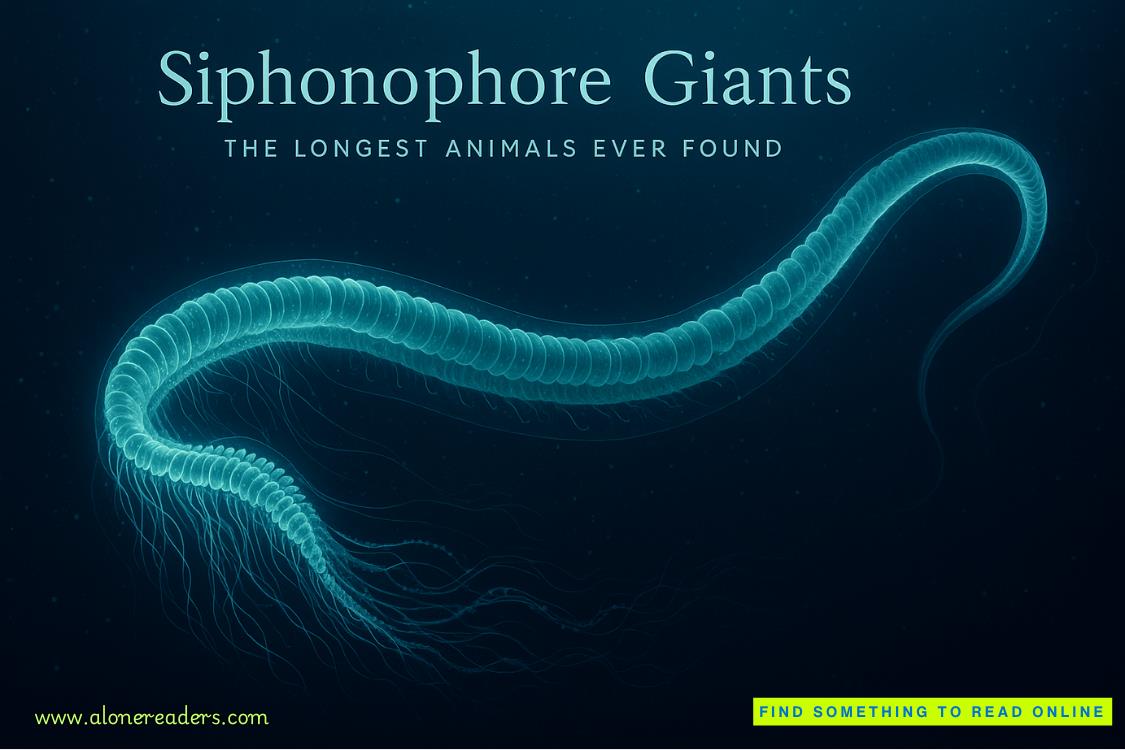
Siphonophores belong to a mysterious and fragile lineage of deep-sea organisms that defy our usual understanding of what an “animal” is. They are not a single creature but a collective of many, operating together so seamlessly that they function as one coherent lifeform. Some species stretch more than forty-five meters in length, making them not just unusual but the longest animals ever discovered on Earth, surpassing even the blue whale. Their appearance—shimmering biological chains floating silently through the abyss—seems more like a living hallucination than a product of natural evolution. But these organisms are not simply biological curiosities; they are highly specialized, deeply complex predators engineered for survival in an environment where energy is scarce, light is minimal, and the rules of life are fundamentally different from anything on the surface.
At the core of a siphonophore’s existence is the principle of division of labor. Rather than having one body perform all functions, the siphonophore organizes itself as a colony of genetically identical units known as zooids, each specialized for a particular task. Some gather prey, others digest food, some reproduce, and others provide buoyancy or propulsion. The remarkable aspect is that no zooid can live independently; they are born to serve the collective. This creates a cooperative super-organism unlike anything else in the marine world. What appears at first glance to be a single elongated creature is actually a meticulously arranged hierarchy of interconnected biological components that together form one of nature’s most efficient hunting machines.
Despite their delicate appearance, siphonophores are formidable predators. They rely on a network of tentacles armed with stinging cells capable of paralyzing small fish, crustaceans, and planktonic life. These tentacles can extend outward like a vast underwater web, increasing their hunting radius without requiring the organism to expend unnecessary energy. In the deep sea, where food is sparse and competition is relentless, this ability to maximize reach while minimizing exertion gives siphonophores a tremendous evolutionary advantage. Their bodies may be fragile, but their strategy for capturing prey is ruthless in its efficiency.
One of the most extraordinary discoveries came when marine researchers documented a siphonophore estimated to be more than forty-six meters in length, arranged in an elegant, spiraling feeding formation. This arrangement allowed the organism to suspend itself in mid-water like a cosmic vortex, capturing prey that drifted unknowingly into its orbit. The structure demonstrated a previously unknown level of organizational complexity, challenging scientists’ existing assumptions about deep-sea life. The sheer scale of this specimen also confirmed something astonishing: in an ocean filled with enormous sharks, giant squids, and whales, the title of longest known animal belongs to an organism so fragile that a strong current could tear it apart.
Understanding how siphonophores grow to such extraordinary lengths requires an appreciation of their unique developmental biology. Unlike traditional animals that grow through cell division and expansion of a cohesive body plan, siphonophores grow through zooid proliferation, creating new units along their body stem as needed. This modular design theoretically allows for limitless length as long as energy and environmental conditions permit. Each zooid emerges with a predetermined purpose, contributing to the collective’s survival in an intricate choreography of specialization. This is why siphonophores can seem endless, drifting like glowing threads of living silk through the blackness of the ocean.
The deep-sea environment plays a crucial role in shaping these organisms. At depths where siphonophores thrive, temperatures approach freezing, sunlight never penetrates, and pressure reaches levels that would crush most surface-dwelling animals. In this alien world, fragility can paradoxically become a survival strategy. Lightweight, gelatinous bodies require minimal energy to maintain buoyancy. Slow drifting reduces metabolic demands. Bioluminescence becomes an essential communication and hunting tool. Each adaptation is a response to the hostile yet stable conditions of the deep ocean. What seems like fragility is actually a perfectly tuned evolutionary solution for life in one of the harshest environments on Earth.
The visual beauty of siphonophores contributes significantly to their allure. Many species glow with bioluminescent blue, green, or white patterns, shimmering like underwater constellations. Their luminescence can confuse predators, attract prey, or communicate within the colony. The optical display is mesmerizing not because of intentional artistry but because of biochemical reactions optimized for survival. In a realm without sunlight, light becomes a language—a way to hunt, defend, and navigate. Siphonophores speak this language fluently, sometimes emitting flashes synchronized along their entire length, creating a rippling wave of illumination across dozens of meters of living tissue.
While their beauty is undeniable, their fragility makes them extremely difficult to study. Most siphonophores disintegrate even with gentle contact, making them challenging to capture or transport to research facilities. Scientists often rely on ROV footage, high-resolution underwater cameras, and deep-sea submersibles to observe them without causing damage. Every sighting becomes a rare scientific treasure, offering glimpses into biological strategies that may unlock new understandings about modular systems, cooperative genetics, and the evolution of specialized functions within a single super-organism.
Another aspect that fascinates biologists is the siphonophore’s hunting behavior. Instead of actively chasing prey, they use a strategy of ambush and passive capture, deploying their tentacles like invisible drifting nets. When prey touches a tentacle, it becomes instantly immobilized. Feeding zooids then pull the catch toward the digestive region, distributing nutrients across the colony. This efficient resource sharing ensures that every zooid—regardless of its position along the massive body—receives nourishment. The colony thrives because the collective is prioritized over the individual, creating a stable and unified biological system.
Their importance in marine ecology is often underestimated. As mid-water predators, siphonophores play a significant role in controlling populations of small fish and zooplankton. They influence nutrient distribution and carbon cycling in the deep sea, helping maintain ecological balance in environments that are delicate and slow-recovering. Understanding their role may prove critical for modeling how deep-sea ecosystems respond to climate change, warming waters, and shifting food availability patterns.
Yet perhaps the most intriguing question surrounding siphonophores is how much more remains undiscovered. The deep ocean is vast, largely uncharted, and filled with pressures and temperatures that make sustained exploration difficult. For every documented siphonophore species, there may be dozens—perhaps hundreds—yet unseen. If one specimen can exceed forty-five meters, it is entirely plausible that even larger ones exist, drifting unnoticed in the darkness. The idea that the longest animals on Earth are still poorly understood speaks volumes about how much of the ocean remains unexplored.
In many ways, siphonophores embody the essence of the deep sea: enigmatic, fragile, ancient, and breathtakingly alien. They challenge our definitions of individuality, complexity, and scale. They demonstrate that life can organize itself in ways entirely different from the blueprints followed by familiar terrestrial animals. And they remind us that in the vast, cold darkness of the abyss, some of Earth’s most extraordinary organisms live beyond the reach of sunlight yet remain integral to the planet’s biological machinery.
The story of siphonophore giants is not merely a tale of size but one of biological innovation and survival under extreme conditions. These organisms represent an evolutionary experiment refined over millions of years—one that has produced creatures of astonishing length, elegant structure, and intricate cooperation. As technology advances and exploration deepens, humanity may soon witness even more spectacular examples of these oceanic giants. Until then, the siphonophore remains a symbol of life’s ability to evolve in unimaginable forms, floating in silent majesty through the deepest waters of our planet.



 Château de Vincennes: France’s Forgotten Royal Fortress and Medieval Stronghold
 Château de Carcassonne: Europe’s Greatest Medieval Citadel and Fortress
 Château de Chenonceau: The Castle Built by Remarkable Women
 Château de Chambord: France’s Magnificent Renaissance Castle and Architectural Wonder
 Tehri Dam: India's Tallest Dam and the Debate Behind It
 Bhakra Nangal Dam: India's Temple of Modern Development