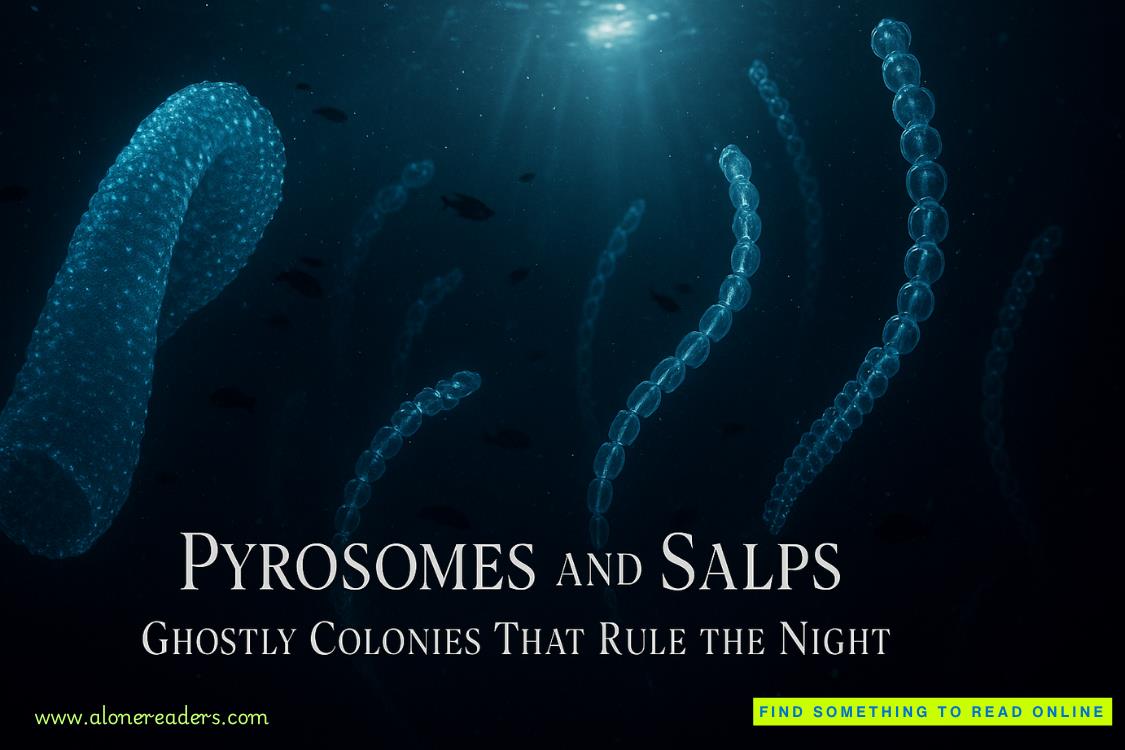
Pyrosomes and salps are among the ocean’s most enigmatic drifters—creatures so delicate, transparent, and otherworldly that early sailors mistook them for pieces of a fallen star. These organisms rule the nighttime ocean in ways that are invisible to most of humanity. They rise from the deep, form vast colonies stretching meters or even tens of meters long, pulse with faint blue light, and quietly alter global nutrient cycles on a scale that rivals major geological forces. Despite their ethereal nature, pyrosomes and salps are powerful players in Earth’s marine ecosystems, and their behavior reveals the complexity of life in the open ocean.
Both pyrosomes and salps belong to a group of animals called tunicates, a lineage surprisingly more closely related to humans than to jellyfish. Their bodies are gelatinous and almost perfectly transparent, allowing them to drift without attracting predators. Yet the most striking feature of these organisms is how they exist not merely as individuals but as colonies—living chains or tubes composed of thousands of clonal zooids working together with near-perfect coordination. This cooperative design allows them to feed, move, reproduce, and even glow as a synchronized group, giving them the delicate appearance of floating lanterns in the blackness of the sea.
Pyrosomes, often called “sea pickles,” are hollow, cylindrical colonies that can range from a few centimeters to more than 20 meters in length. Each pyrosome is composed of thousands of small, identical zooids embedded in a flexible matrix. These zooids pump water inward, filter out microscopic plankton, and expel water outward through the colony’s shared central cavity. The result is a gentle propulsion that moves the entire structure through the water like an enormous, glowing spacecraft. Their bioluminescence is particularly impressive; a single touch can send waves of bright blue light rippling across the entire colony, and nearby pyrosomes can respond, creating a cascading display across the dark ocean. This collective glow has been reported by sailors for centuries, often described as eerie, magical, or terrifying.
Salps, by contrast, are barrel-shaped individuals that frequently link together in long, chain-like colonies that move with rhythmic pulses. Each salp is a powerhouse of filtration, capable of clearing massive quantities of phytoplankton from the surrounding water. Though they appear fragile, salps hold a surprising ecological influence: during bloom years, their populations explode, forming dense aggregations that can stretch for kilometers. These colonies migrate vertically each day, rising toward the surface at night and sinking to the depths during daylight hours. This movement transports carbon into the deep ocean more efficiently than almost any other animal group, making salps essential contributors to the planet’s carbon cycle.
One of the most fascinating aspects of pyrosomes and salps is how they thrive in environments that seem too harsh or barren for most marine life. Pyrosomes often appear unexpectedly in regions far outside their typical tropical and subtropical ranges. When ocean temperatures or nutrient dynamics shift, they may swarm in staggering numbers, overwhelming coastal ecosystems and surprising researchers with their sudden abundance. Their ability to expand rapidly comes from their reproductive strategy; pyrosomes grow through asexual budding, adding new zooids to expand the colony continuously, while salps alternate between solitary and chain-forming reproductive stages. This dual strategy allows them to multiply at extraordinary rates when conditions permit.
For many marine scientists, the rise of pyrosomes in certain years is a phenomenon that signals deeper shifts in ocean health. Warmer temperatures, altered current patterns, and changing plankton communities can create perfect conditions for pyrosome proliferation. When they appear in regions like the Pacific Northwest, where they historically were rare, they can clog fishing nets, disrupt food webs, and reshape local marine environments. Their presence becomes both a curiosity and a warning sign, indicating the extent to which global climate patterns influence even the ocean’s most hidden creatures.
While pyrosomes drift passively and rely on synchronized pumping to move, salps employ jet propulsion. Each salp contracts its muscular body, expelling water and propelling itself forward. When linked together, this motion becomes a beautifully coordinated wave, much like a school of tiny engines working in harmony. This mode of locomotion is incredibly energy-efficient, allowing salps to travel long distances with minimal effort while filtering enormous volumes of seawater. Their feeding efficiency makes them one of the most successful plankton grazers on Earth, capable of outcompeting many other organisms during phytoplankton blooms.
Another mysterious dimension to these creatures is their interaction with bioluminescence. Pyrosomes are known for their extraordinary glow, but salps also generate light in certain species, often as a byproduct of symbiotic organisms living within them. This light serves multiple purposes: it may help deter predators, attract mates, or communicate colony-wide signals. In the deep ocean, where visibility is minimal, light becomes a language, and these animals use it in ways that remain poorly understood. Their glowing colonies drifting silently through the night contribute to the ethereal atmosphere of the open ocean’s “midnight zone.”
Despite their delicate appearance, pyrosomes and salps have a profound effect on the carbon cycle. As they feed, they produce dense, fast-sinking fecal pellets that transport carbon from the surface to the deep sea. Unlike many marine organisms whose waste decomposes before sinking far, salp pellets can reach the ocean floor in a matter of hours. This rapid burial of organic matter plays a crucial role in regulating atmospheric carbon dioxide levels, effectively acting as a biological pump. Pyrosome tissues themselves also sequester carbon, and when large colonies die, they sink to the deep ocean, removing carbon from the surface ecosystem for decades or centuries.
The fragile bodies of these organisms also provide habitats for small fish, crustaceans, and microorganisms. Juvenile fish often hide inside pyrosome tubes, gaining shelter from predators while feeding on plankton drifting through the colony’s filtration system. This symbiotic relationship adds another layer of ecological significance, turning pyrosomes into mobile nurseries drifting across the ocean. Salp chains also serve as temporary refuges for tiny marine species, illustrating how even the most delicate organisms can shape the survival of others.
Their impact on human activities is equally notable. When pyrosome swarms occur near fishing grounds, they often overwhelm nets, causing massive bycatch of gelatinous biomass that is difficult to remove. Fishermen must haul up hundreds of kilograms of harmless but obstructive organisms that complicate daily operations. Salp blooms can produce similar challenges, clogging equipment and altering the availability of plankton for commercially important species. Though these animals are not harmful, their presence in large numbers highlights the complex and unpredictable nature of ocean ecosystems.
As research continues, scientists are uncovering new insights into how pyrosomes and salps respond to environmental change. Their rapid reproduction, sensitivity to temperature, and role in nutrient cycling make them critical indicators of ocean health. When their numbers surge or plummet, it reflects deeper atmospheric or oceanographic shifts. Some researchers propose that in a warming world, salps may become more dominant than traditional grazers like krill, reshaping food webs across entire ocean basins. Similarly, pyrosomes may expand into cooler waters, creating new ecological interactions and challenging long-standing assumptions about marine biogeography.
Ultimately, the story of pyrosomes and salps is one of contrast: they appear delicate but influence global systems, drift passively yet reshape ecosystems, and glow softly while playing a massive role in carbon sequestration. Their ghostly presence in the night ocean reminds us that some of Earth’s most powerful ecological forces come not from massive predators or dramatic geological events, but from translucent colonies drifting quietly beneath the moonlit waves. These organisms, barely known to most people, are architects of marine balance, sculpting the flow of carbon, nurturing young fish, and illuminating the sea with their subtle blue glow.
Their beauty lies not just in their appearance, but in their role as living evidence of nature’s complexity. As we learn more about them, pyrosomes and salps challenge our understanding of how the ocean breathes, changes, and sustains life. In their glowing, ghostly dance through the night ocean, they reveal a hidden world that thrives in silence yet shapes the future of the planet.



 Château de Vincennes: France’s Forgotten Royal Fortress and Medieval Stronghold
 Château de Carcassonne: Europe’s Greatest Medieval Citadel and Fortress
 Château de Chenonceau: The Castle Built by Remarkable Women
 Château de Chambord: France’s Magnificent Renaissance Castle and Architectural Wonder
 Tehri Dam: India's Tallest Dam and the Debate Behind It
 Bhakra Nangal Dam: India's Temple of Modern Development










