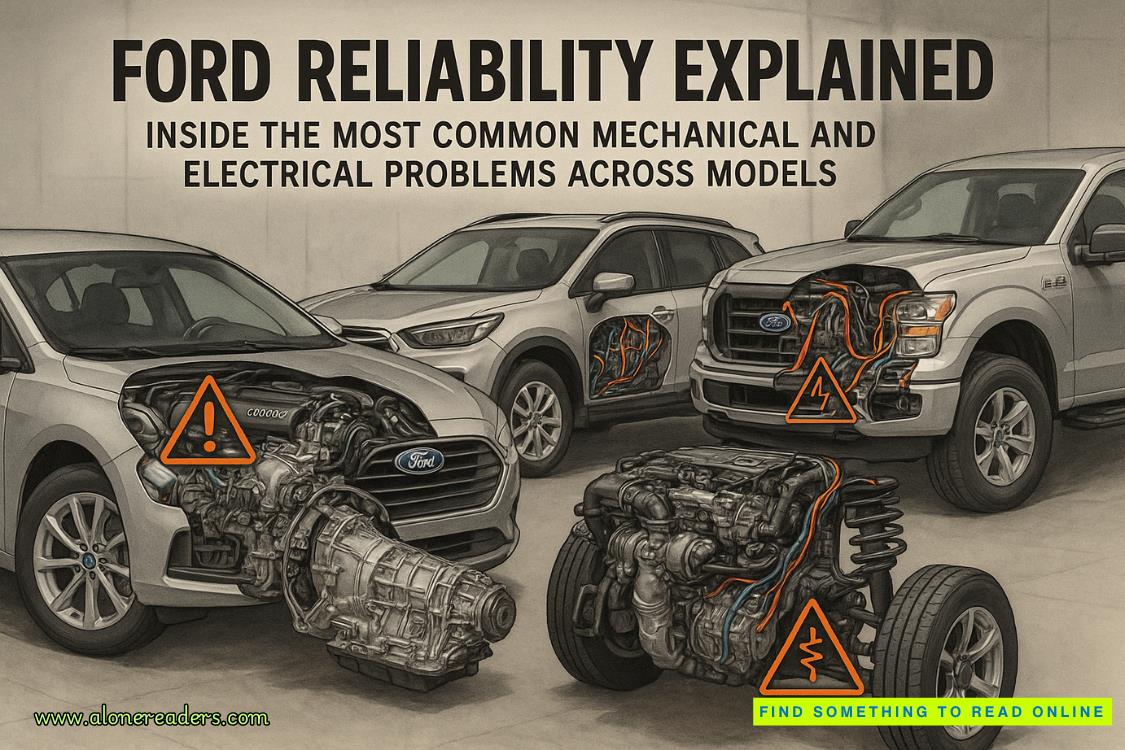
Ford is one of the world’s most recognizable automotive brands, with a product range that spans compact cars, family SUVs, electric crossovers, and heavy-duty pickup trucks. Yet across decades of ownership reports, technical service bulletins, and repair-shop data, a clear pattern has emerged: many Ford vehicles share a consistent set of mechanical and electrical problem types that recur across different models, platforms, and production years. These issues are not random defects. They are the predictable outcome of specific engineering choices, aggressive efficiency targets, increasingly complex electronics, and real-world maintenance behavior that often falls short of what modern vehicles demand.
One of the most persistent and widely discussed problem areas in Ford vehicles is automatic transmission reliability, particularly during the last fifteen years. The most notorious example is the dual-clutch “PowerShift” transmission used in models such as the Fiesta and Focus. While the design promised improved fuel economy and faster shifts, its real-world execution proved deeply problematic. Owners frequently reported shuddering during takeoff, harsh or delayed gear changes, hesitation, and premature clutch wear. These were not isolated incidents but systemic behaviors tied to the transmission’s dry clutch design, highly sensitive shift logic, and reliance on precise electronic calibration. Minor variations in driving style, traffic conditions, or software updates could significantly alter how the transmission behaved, often for the worse.
Even outside the PowerShift units, some conventional Ford automatics in SUVs and trucks have demonstrated reliability concerns. Symptoms often include rough downshifts, slipping under load, overheating when towing, and early failure of valve bodies or torque converters. In many cases, the underlying causes trace back to thermal stress, marginal internal components, and fluid degradation. Modern Ford transmissions depend heavily on electronic control modules and sensor feedback, meaning a failing solenoid, corrupted software adaptation, or low battery voltage can produce mechanical-feeling symptoms without a purely mechanical failure. When fluid changes are delayed or skipped, these vulnerabilities compound rapidly.
Another major area of concern involves Ford’s EcoBoost engine family, which has been widely praised for delivering strong performance and fuel efficiency from smaller displacement turbocharged engines. However, certain EcoBoost variants, particularly in vehicles like the Escape, Edge, and F-150, have developed a reputation for specific and sometimes severe issues. Among the most serious are coolant intrusion problems, where coolant leaks internally into combustion chambers due to head gasket or block design weaknesses. These leaks can lead to misfires on startup, white exhaust smoke, overheating, and in advanced cases, catastrophic internal damage.
EcoBoost engines operate under exceptionally high thermal and mechanical stress. Turbocharging dramatically increases combustion pressures and temperatures, placing heavy demands on cooling systems, oil quality, and internal sealing surfaces. When cooling system maintenance is neglected, or when coolant chemistry degrades, these engines are far less forgiving than older naturally aspirated designs. Oil change intervals that might be acceptable on simpler engines can quickly become destructive in turbocharged units, accelerating wear on timing components, turbo bearings, and variable valve timing systems. In rare but alarming cases, a combination of oil leaks and extreme heat has even led to engine fires.
Electrical and infotainment issues form another broad category of recurring Ford complaints, particularly in late-model vehicles loaded with digital features. Problems such as intermittent power windows, malfunctioning door locks, flickering or blank instrument clusters, unexplained battery drains, and frozen SYNC infotainment systems are commonly reported across models like the Escape, Explorer, and Mustang Mach-E. These issues often frustrate owners because they appear random, disappear temporarily, or trigger warning messages without clear mechanical faults.
At the root of many of these electrical problems is the increasing complexity of vehicle electronics. Modern Fords rely on dozens of interconnected control modules communicating over data networks. A single weak ground, corroded connector, or chafed wiring harness can destabilize multiple systems simultaneously. Moisture intrusion, particularly in SUVs exposed to weather, car washes, or off-road use, is a frequent contributor. Additionally, many Ford vehicles are unusually sensitive to the health of the 12-volt battery. As batteries age or lose capacity, voltage fluctuations can cause modules to reset, malfunction, or log false error codes, creating symptoms that mimic more serious failures.
Engine-related issues extend beyond turbocharging into ignition and fuel systems, where several Ford engine families show consistent wear patterns. Ignition coil failures are common on both four-cylinder and V6 engines, leading to misfires, rough idle, reduced fuel economy, and persistent check-engine lights. Coils are exposed to intense heat and, in some engines, oil contamination from leaking valve cover gaskets or worn seals around spark plug wells. Extended spark plug replacement intervals, combined with lower-quality aftermarket parts, further accelerate coil degradation.
Fuel delivery problems also appear with notable frequency. Symptoms such as hard starting, hesitation, stalling, and sudden power loss are often linked to failing in-tank fuel pump modules or high-pressure pumps used in direct-injection systems. Contaminated fuel, clogged filters, and repeated low-fuel operation can strain pump assemblies, while direct-injection pumps face additional stress from high operating pressures and marginal lubrication. These issues are particularly disruptive because they often present intermittently before failing completely, leaving drivers uncertain whether the problem has been resolved.
Check-engine warnings in Ford vehicles frequently trace back to oxygen sensors, mass-airflow sensors, variable cam timing solenoids, and catalytic converters. While these components are technically consumable, they tend to fail prematurely when underlying engine conditions are poor. Persistent misfires, vacuum leaks, sludge from infrequent oil changes, or overheating can dramatically shorten their lifespan. As a result, two otherwise identical Ford vehicles can show vastly different reliability records depending on how meticulously they were maintained and how early minor issues were addressed.
Suspension and body-related problems are more prevalent in Ford’s SUVs and crossovers, reflecting the demands placed on these vehicles in real-world use. Owners of Explorers and similar models often report clunking noises, premature wear of bushings and stabilizer links, uneven tire wear, and alignment difficulties. These problems are rarely caused by a single defective part. Instead, they arise from heavy vehicle weight, frequent towing, rough road conditions, and suspension components that operate close to their design limits. Over time, small amounts of play and wear accumulate, producing noticeable handling and noise issues.
Body integrity issues also surface as vehicles age. Water leaks around windshields, sunroofs, tailgates, and door seals are a recurring complaint, particularly in SUVs with large openings and flexible body structures. When drainage channels clog or seals degrade, moisture can enter interior panels and electrical compartments. If left unaddressed, this leads not only to corrosion and mold but also to secondary electrical failures as connectors and modules are exposed to damp conditions. Wind noise and panel misalignment often accompany these problems, signaling gradual body flex and seal fatigue rather than sudden damage.
The recurring nature of these problems across Ford’s lineup is not accidental. Platform and component sharing means that a design weakness in one transmission, engine family, or electronic module can propagate across multiple models and production years. Once a system enters mass production, incremental fixes through software updates or minor hardware revisions may reduce symptoms without eliminating root causes. At the same time, cost pressures and regulatory demands push manufacturers toward lighter components, tighter tolerances, and more complex systems that leave little margin for neglect.
Ultimately, Ford vehicle reliability is highly sensitive to maintenance discipline and early intervention. Many of the brand’s most common failures do not occur suddenly but develop gradually as heat, contamination, software drift, and mechanical wear interact. Vehicles that receive timely fluid changes, software updates, battery replacements, and prompt repairs of minor faults often avoid the worst outcomes. Those that do not tend to experience accelerated and more expensive failures, reinforcing the perception of chronic unreliability.
Taken together, the pattern is clear. Ford’s recurring mechanical and electrical issues are the result of ambitious engineering choices meeting the realities of daily driving, environmental exposure, and imperfect maintenance. Understanding these patterns allows owners, buyers, and technicians to make informed decisions, anticipate risks, and mitigate problems before they escalate into major failures.



 Top 10 Affordable Electric Cars for 2026: Best Budget EVs Worldwide
 Tesla Model S Review: Speed, Range, and Features in 2026
 Honda Accord vs Toyota Camry: Which Mid-Size Sedan Is Better?
 Chevrolet Silverado vs GMC Sierra: Which Truck Wins?
 2026 Jeep Wrangler Review: Off-Road Capabilities Tested in Extreme Terrain
 2026 Nissan Altima Review: Tech, Comfort, and Safety – In-Depth Expert Analysis










