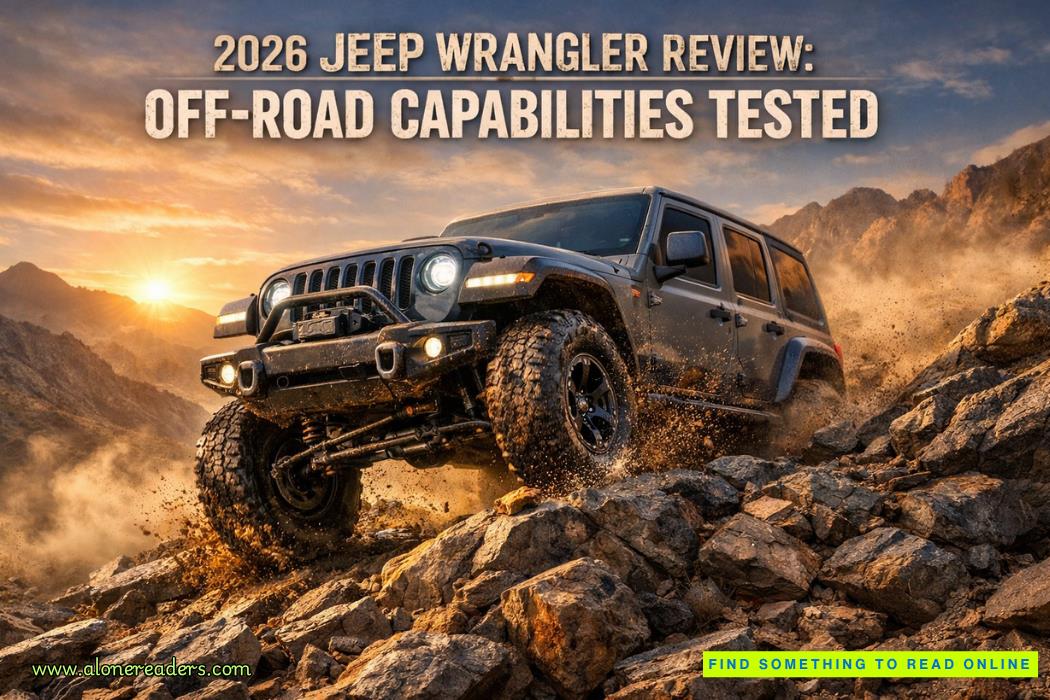
The 2026 Jeep Wrangler doesn’t try to reinvent itself—and that’s exactly why it still dominates the off-road world. Instead of chasing crossover comfort trends, Jeep has doubled down on what the Wrangler does best: conquering terrain that most vehicles wouldn’t dare approach. But this year’s model isn’t just about heritage. It introduces subtle engineering upgrades, smarter off-road tech, and refined drivability that push it further ahead of competitors like the Ford Bronco and Toyota 4Runner.
To understand how capable the 2026 Wrangler truly is, we tested it in real-world extreme conditions—rock crawling, deep mud trails, desert sand, and steep inclines. This isn’t a surface-level review. It’s a deep dive into how the Wrangler performs when the pavement ends and the real driving begins.
The 2026 Wrangler continues to offer a wide range of powertrains, but each serves a different type of off-road enthusiast.
During testing, the 4xe impressed the most in controlled environments. The electric torque delivery allows smoother throttle modulation, reducing wheel spin on slippery rocks. On steep climbs, it felt more controlled than the V8, which tends to overpower traction.
The V6, however, remains the most predictable and easiest to manage for long trail runs, especially when reliability matters more than raw power.
The Wrangler’s off-road capability starts with its hardware, and Jeep has refined it further for 2026.
In rock crawling tests, the articulation was exceptional. One wheel could climb a boulder while the others maintained contact, keeping the vehicle stable without excessive body roll.
Ground clearance remains one of the Wrangler’s strongest advantages, especially in the Rubicon trim. With approach, departure, and breakover angles optimized for steep terrain, it handled sharp inclines without scraping the underbody.
Jeep’s Trail Rated system is more than just branding—it plays a real role in how the Wrangler adapts to different environments.
The Selec-Trac and Rock-Trac 4x4 systems allow drivers to switch between modes depending on terrain:
During sand testing, the Wrangler maintained forward momentum without digging itself in—a common issue with less specialized SUVs. In muddy conditions, the system balanced wheel spin and traction effectively, preventing the vehicle from getting stuck.
Traditionally, Wranglers have been criticized for on-road stiffness, but the 2026 model shows noticeable improvement.
Jeep has fine-tuned the suspension to reduce harshness without compromising off-road performance. On uneven trails, the suspension absorbs impacts well, keeping the cabin relatively stable even during aggressive driving.
However, it’s still not a comfort-focused SUV. On highways, you’ll feel the solid axle setup, especially over bumps and expansion joints. But that trade-off is exactly what enables its off-road dominance.
In technical terrain, the suspension truly shines. It maintains tire contact with the ground, which is crucial for traction, especially in rock crawling scenarios.
The 2026 Wrangler offers a range of tire options, but the all-terrain and mud-terrain tires are where it truly comes alive.
During testing:
The tire width and aggressive tread patterns significantly impact performance. In loose gravel and sand, the Wrangler maintained stability without excessive sliding.
One standout feature is the ability to air down the tires for increased surface contact. This simple adjustment dramatically improved traction during rock crawling tests.
The Wrangler’s interior is designed with off-road use in mind rather than luxury.
Jeep has also improved visibility with better camera systems, including forward-facing trail cameras. These are incredibly useful when navigating tight obstacles where the hood blocks your view.
Storage remains practical, though not spacious. This isn’t a family SUV—it’s a purpose-built off-road machine.
The 2026 Wrangler includes several tech features that genuinely enhance off-road driving rather than distract from it.
One of the most useful additions is the improved hill descent control. It maintains a steady speed on steep declines without requiring constant brake input, reducing driver fatigue and improving safety.
Let’s be honest—the Wrangler isn’t built for fuel efficiency.
However, efficiency drops quickly in extreme conditions. Crawling over rocks or powering through mud demands constant torque, which increases fuel consumption regardless of the engine type.
If efficiency is a priority, the 4xe is the best option. But if maximum capability is the goal, the traditional engines still deliver more consistency over long expeditions.
After extensive testing across different terrains, the 2026 Wrangler delivered consistent results:
The key takeaway is that the Wrangler doesn’t excel in just one area—it performs well across all types of off-road conditions.
Despite its strengths, the Wrangler isn’t perfect.
These limitations are expected given its design priorities. The Wrangler is built for capability first, comfort second.
The 2026 Jeep Wrangler proves that staying true to a core identity can be more powerful than chasing trends. While competitors try to balance off-road ability with everyday comfort, the Wrangler remains unapologetically focused on conquering terrain.
Its combination of proven hardware, smart technology, and versatile powertrains makes it one of the most capable off-road vehicles available today. Whether you're navigating rocky trails, muddy paths, or desert landscapes, the Wrangler delivers performance that feels both controlled and confident.
If your driving rarely leaves the pavement, there are better options. But if off-road capability is your priority, the 2026 Wrangler continues to set the standard others are still trying to reach.



 Top 10 Affordable Electric Cars for 2026: Best Budget EVs Worldwide
 Tesla Model S Review: Speed, Range, and Features in 2026
 Honda Accord vs Toyota Camry: Which Mid-Size Sedan Is Better?
 Chevrolet Silverado vs GMC Sierra: Which Truck Wins?
 2026 Nissan Altima Review: Tech, Comfort, and Safety – In-Depth Expert Analysis
 Hyundai Tucson vs Kia Sportage: 2026 Compact SUV Comparison Guide