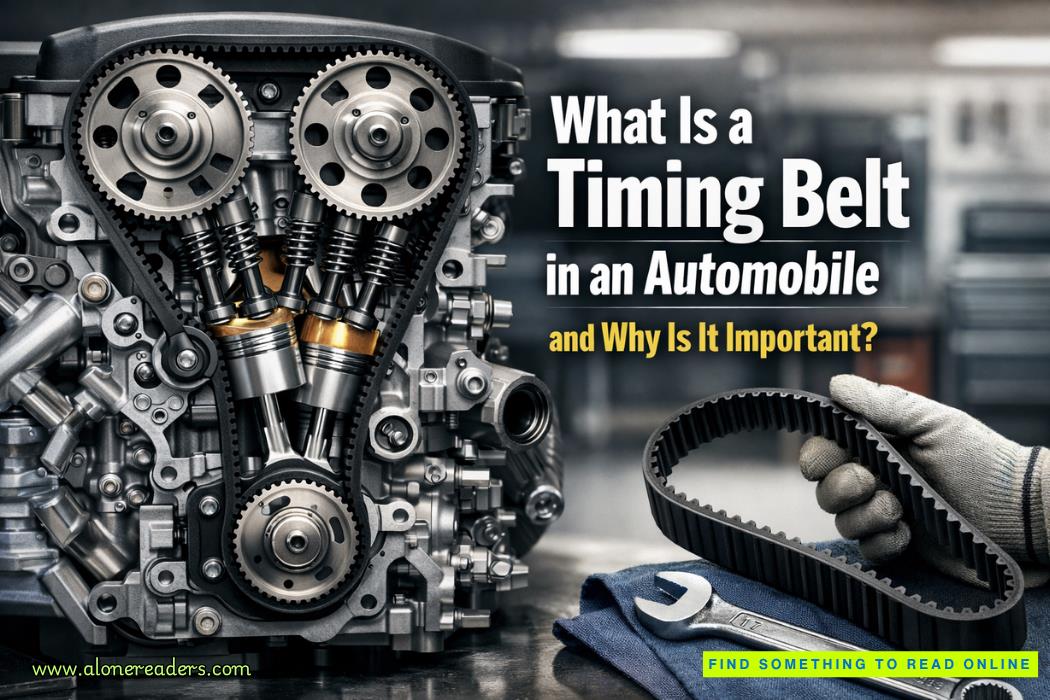
A timing belt is one of the most important components inside an internal combustion engine because it keeps the crankshaft and camshaft moving in perfect synchronization. Without that coordination, the engine cannot time valve opening and closing correctly, and serious mechanical damage can occur.
Understanding the Timing Belt
The timing belt is usually a toothed rubber belt reinforced for strength, and its job is not to carry power to the wheels. Instead, it controls the timing relationship between the crankshaft and the camshaft so that the engine’s valves open and close at exactly the right moments during the four-stroke cycle.
The crankshaft converts the up-and-down motion of the pistons into rotational motion, while the camshaft controls the valve train. The belt connects these two systems so they stay locked in precise phase with each other, which is essential for efficient combustion and smooth engine operation.
How the Timing Belt Works
In a running engine, the pistons and valves must never be treated as separate systems. The timing belt ensures that when a piston reaches a certain point, the correct valve is either opening or closing at the proper time, preventing interference between moving parts.
A typical four-stroke engine depends on this timing across the intake, compression, power, and exhaust strokes. If valve timing is even slightly off, the engine may misfire, lose power, run roughly, or fail to start properly.
The belt also works with a tensioner and pulleys, which keep it tight and aligned. If the belt becomes loose, stretches, or skips teeth, synchronization is lost and the engine’s timing can shift enough to cause major problems.
Why It Is Important
The importance of the timing belt comes down to one thing: engine coordination. Modern engines rely on exact mechanical timing, and the belt is the component that maintains that order between the rotating crankshaft and the valve-operating camshaft.
This matters not only for performance but also for reliability and safety. A properly functioning timing belt helps the engine breathe correctly, burn fuel efficiently, and avoid uncontrolled internal contact between pistons and valves.
When everything is aligned, the engine produces power smoothly and efficiently. When it is not aligned, the consequences can be immediate and expensive, especially in engines where piston-to-valve clearance is very small.
Timing Belt vs Timing Chain
Many people confuse timing belts with timing chains, but they are not the same part. A timing belt is typically made of reinforced rubber and is quieter and lighter, while a timing chain is made of metal and often designed to last longer under certain conditions.
The key point is that both parts perform the same basic job: synchronizing the crankshaft and camshaft. The difference is in material, wear pattern, noise level, service interval, and replacement cost.
Some manufacturers prefer timing belts because they are quiet and efficient. Others use timing chains for durability, though chains can still wear, stretch, or create timing issues over time.
What Happens When It Fails
If a timing belt fails, the engine can stop instantly because the camshaft and crankshaft are no longer synchronized. In many cases, the vehicle may stall and refuse to restart; in others, the failure can happen while driving and lead to sudden loss of engine power.
The most serious risk is in interference engines, where pistons and valves occupy nearly the same space at different times. If the belt breaks or slips badly, the pistons can strike open valves, bending valve stems, damaging pistons, and in severe cases destroying the engine.
That is why timing belt failure is not a minor maintenance issue. It can turn a routine service item into an engine rebuild or replacement, which is far more expensive than preventative replacement.
Warning Signs of Wear
A timing belt does not always fail without warning, although it can. Common signs of trouble include rough running, misfiring, hard starting, unusual engine noise, or visible wear if the belt cover is removed during inspection.
Some engines may show symptoms from related components such as tensioners, idler pulleys, or the water pump if they are driven by the same belt system. In practice, this means timing belt service often includes replacing several parts at once rather than the belt alone.
If the belt is aged, cracked, glazed, frayed, or contaminated by oil, it should not be ignored. Rubber deterioration and mechanical wear both reduce the belt’s ability to hold accurate timing under load.
Replacement and Maintenance
Timing belt replacement is preventive maintenance, not optional decoration. Manufacturers set service intervals based on time or mileage, and these intervals should be followed closely because rubber deteriorates even when a car is not driven much.
When replacing a timing belt, mechanics often inspect or replace the tensioner, idler pulleys, seals, and sometimes the water pump. This is because labor overlap is high, and a second failure in a related part can force the entire job to be repeated.
Skipping scheduled replacement is risky because the belt may look acceptable from the outside while already losing strength internally. That hidden aging is one reason timing belt service is treated as a critical maintenance item rather than a cosmetic one.
Why Mechanics Take It Seriously
Automotive technicians pay close attention to timing belt condition because they know how much damage a failure can cause. A good timing belt keeps engine performance predictable, while a neglected one can create failures that are sudden, severe, and costly.
The belt’s importance is especially clear in engines designed with tight internal clearances. In those engines, the belt is not just a support part; it is a safeguard that prevents internal collision and preserves the entire top end of the engine.
That is why belt condition, correct tension, and proper installation matter so much. Even a new belt can cause trouble if it is installed incorrectly or paired with worn tensioning components.
Practical Example
Imagine a small sedan with a timing belt that has never been replaced despite being well past its service interval. The car may still drive normally right up until the belt slips or snaps, and at that moment the engine can misfire, stall, or suffer valve damage.
Now compare that with a car whose owner replaces the belt on schedule along with the tensioner and related parts. That vehicle is far less likely to suffer sudden breakdown, and the engine’s internal timing remains stable for thousands of additional miles.
This is why timing belt maintenance is one of the smartest forms of preventive engine care. It protects performance, reliability, and repair costs all at once.
Conclusion
A timing belt is a small part with a very large responsibility. It keeps the engine’s crankshaft and camshaft synchronized so the valves and pistons work in harmony, and that coordination is essential for proper combustion and engine survival.
Its importance comes from the fact that failure can lead to stalling, misfiring, and in the worst cases catastrophic internal engine damage. For that reason, timely inspection and replacement are among the most valuable maintenance steps a car owner can take.



 Top 10 Affordable Electric Cars for 2026: Best Budget EVs Worldwide
 Tesla Model S Review: Speed, Range, and Features in 2026
 Honda Accord vs Toyota Camry: Which Mid-Size Sedan Is Better?
 Chevrolet Silverado vs GMC Sierra: Which Truck Wins?
 2026 Jeep Wrangler Review: Off-Road Capabilities Tested in Extreme Terrain
 2026 Nissan Altima Review: Tech, Comfort, and Safety – In-Depth Expert Analysis