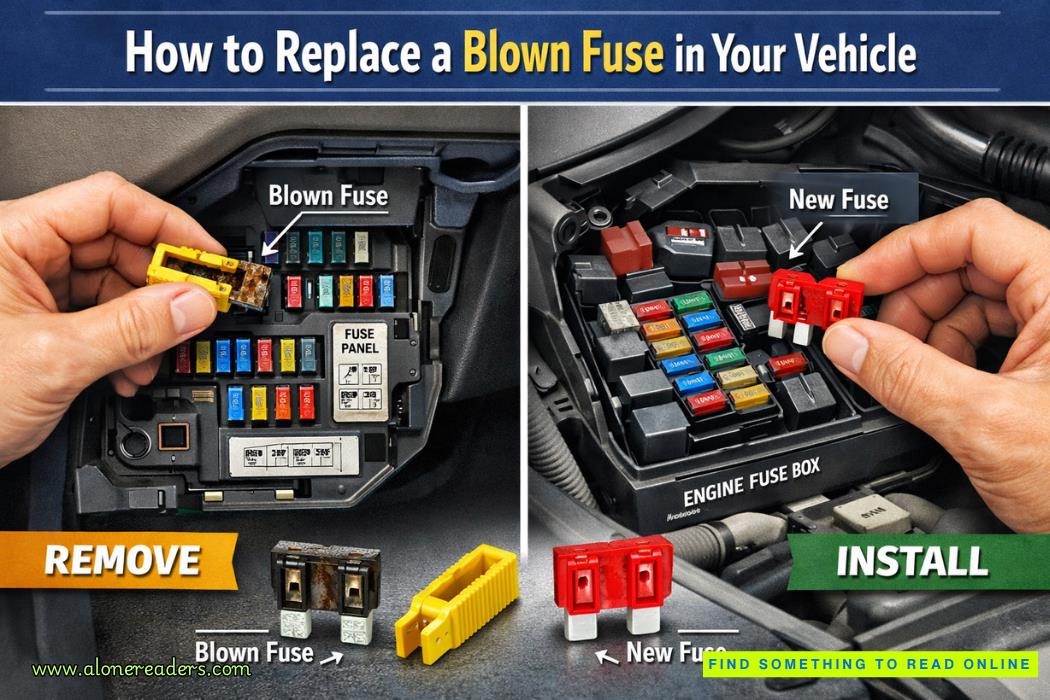
Modern vehicles rely heavily on electrical systems. From headlights and infotainment screens to power windows, sensors, fuel pumps, and engine control units, nearly every function in a car depends on electricity flowing correctly. When one of these systems suddenly stops working without warning, the cause is often far simpler than many drivers expect—a blown fuse.
A fuse is a small but critical safety component designed to protect your vehicle’s electrical circuits. When excessive current flows through a circuit, the fuse sacrifices itself, breaking the connection before wires overheat or electronic modules are damaged. Replacing a blown fuse is one of the few vehicle repairs that most drivers can safely perform themselves, provided it is done correctly and methodically.
This guide explains the process in professional detail, covering how fuses work, how to identify the correct fuse, how to replace it safely, and how to recognize when a blown fuse is actually a symptom of a deeper electrical fault.
Purpose of a fuse
A fuse acts as a controlled failure point. Instead of allowing high electrical current to melt wiring or damage expensive control units, the fuse melts internally and stops power instantly.
Why fuses blow
A fuse typically blows for one of the following reasons:
Why replacing a fuse matters
Ignoring a blown fuse can lead to:
Replacing it correctly restores function while preserving system safety.
Blade fuses (most common)
These are flat plastic fuses with two metal prongs and a visible internal conductor. They come in standardized colors and sizes:
Glass tube fuses (older vehicles)
Found mostly in classic or early-model cars, these contain a visible wire inside a glass cylinder.
Cartridge fuses
Used in higher-load circuits such as ABS modules or cooling fans.
Most modern vehicles use blade-style fuses, which makes identification and replacement straightforward.
Electrical system suddenly stops working
Power windows, radio, or interior lights stop simultaneously.
Single function failure
For example, one headlight or the horn stops working while everything else functions normally.
No warning lights but feature failure
Fuses often fail silently without dashboard alerts.
Component works intermittently
A partially failed fuse can cause inconsistent operation.
When a failure is isolated and sudden, checking the fuse should always be the first diagnostic step.
Most vehicles have two or more fuse boxes.
Interior fuse box
Usually located:
This box typically controls:
Engine bay fuse box
Located near the battery or along the firewall. This box controls:
The fuse box cover normally includes a diagram showing fuse positions and functions.
Basic tools required
Important note
Never use metal tools aggressively. Excess force can damage terminals or create short circuits.
Step 1: Turn off the vehicle completely
Remove the key or switch off the ignition. Never replace fuses with the engine running.
Step 2: Locate the fuse for the failed system
Use the fuse diagram printed on:
Match the function name (for example “RADIO”, “ACC”, “PWR WND”, “HORN”).
Step 3: Remove the suspected fuse
Use the fuse puller to gently pull the fuse straight out.
Step 4: Inspect the fuse visually
A healthy fuse will have an unbroken metal strip inside.
A blown fuse will show:
In blade fuses, this is usually very easy to see.
Match the amperage exactly
Each fuse has an amperage rating printed on top (e.g., 10A, 15A, 20A).
Common color codes include:
Never install a higher-rated fuse
Using a higher amp fuse can:
Never wrap foil or wire around a fuse
This bypasses protection entirely and can cause severe electrical damage.
Always replace with the same amperage rating specified by the manufacturer.
Step 1: Ensure ignition is OFF
The vehicle must be fully powered down to prevent electrical surge.
Step 2: Remove the faulty fuse
Pull it out gently without twisting.
Step 3: Insert the new fuse
Push the replacement fuse firmly into the same slot until seated evenly.
Step 4: Reinstall fuse box cover
This protects against moisture and dust intrusion.
Step 5: Test the system
Turn the ignition on and test the previously failed component.
If it works normally, the repair is complete.
This is a critical diagnostic moment.
Immediate re-blow indicates a deeper issue, such as:
In this case:
Repeated fuse failure means professional electrical diagnosis is required.
Some fuse-controlled systems are more sensitive.
Airbag systems
Never attempt fuse replacement with ignition on. Accidental deployment risk exists.
ABS and stability systems
Improper fuse handling can store fault codes.
ECU-related circuits
Incorrect replacement can cause engine warning lights.
If unsure, replace only accessory and comfort-system fuses yourself and seek assistance for safety-critical circuits.
Avoid cheap aftermarket electronics
Low-quality chargers and accessories often overload circuits.
Inspect wiring during installations
Poor grounding or pinched wires are common causes of blown fuses.
Protect fuse boxes from moisture
Water intrusion is a major cause of corrosion and short circuits.
Replace missing fuse box covers
Open fuse panels invite dust and humidity damage.
Sometimes the fuse is intact, yet the system still does not work.
This can indicate:
In such cases, fuse replacement alone will not restore function, and further diagnosis is necessary.
Every vehicle owner should carry:
These take minimal space and can prevent being stranded due to minor electrical issues.
Replacing a blown fuse is one of the most practical vehicle maintenance skills a driver can learn. It requires no mechanical background, minimal tools, and only a few minutes when done correctly. Understanding how fuses protect your vehicle helps you respond calmly when an electrical feature suddenly fails.
However, a fuse should never be treated as the root cause—only as the warning sign. A single blown fuse is normal. Repeated failures are not. Knowing when to stop and seek professional diagnosis is just as important as knowing how to replace the fuse itself.
With careful inspection, correct amperage selection, and safe handling, fuse replacement can be performed confidently and safely, saving time, money, and unnecessary workshop visits while maintaining your vehicle’s electrical integrity.



 Top 10 Affordable Electric Cars for 2026: Best Budget EVs Worldwide
 Tesla Model S Review: Speed, Range, and Features in 2026
 Honda Accord vs Toyota Camry: Which Mid-Size Sedan Is Better?
 Chevrolet Silverado vs GMC Sierra: Which Truck Wins?
 2026 Jeep Wrangler Review: Off-Road Capabilities Tested in Extreme Terrain
 2026 Nissan Altima Review: Tech, Comfort, and Safety – In-Depth Expert Analysis