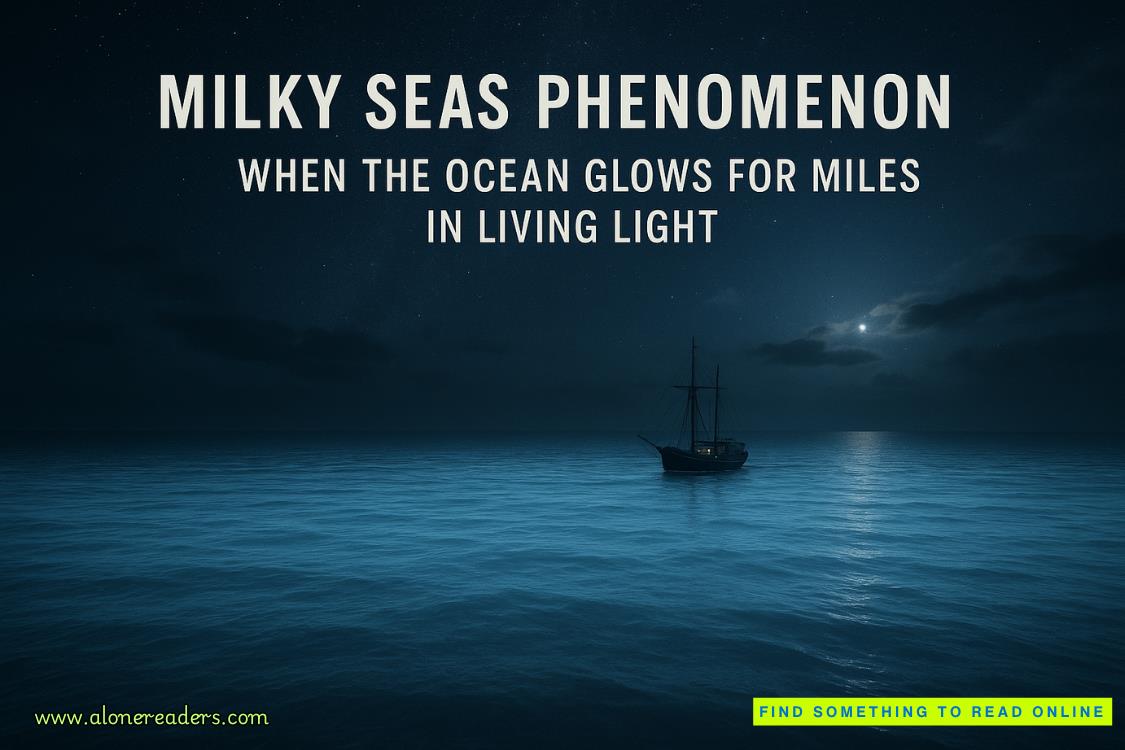
The Milky Seas phenomenon is one of the most astonishing yet least understood natural spectacles on Earth, a rare event in which enormous areas of the ocean emit a steady, ghostly glow that can stretch for tens of thousands of square kilometers. Unlike the brief sparkles of bioluminescent plankton commonly seen near shorelines or stirred by passing boats, Milky Seas appear as vast, softly illuminated plains of water, glowing continuously through the night as if the ocean itself were emitting moonlight. Sailors who have encountered it describe an almost unreal experience: a calm, luminous sea merging seamlessly with the horizon, erasing the boundary between water and sky.
Historical accounts of glowing seas date back centuries and are scattered throughout the logs of merchant vessels, naval ships, and explorers. These reports often emerged from remote regions of the Indian Ocean, the Arabian Sea, and waters near Southeast Asia. Early mariners struggled to describe what they were seeing, sometimes attributing the glow to supernatural forces, underwater fires, or divine omens. The uniformity of the light was especially unsettling, as it lacked the flickering or pulsing typically associated with known marine bioluminescence. For generations, the Milky Seas phenomenon remained a maritime mystery, documented but rarely explained.
Modern science has gradually revealed that this phenomenon is biological in origin, driven by vast colonies of luminous marine bacteria rather than plankton or larger organisms. The primary culprit is believed to be Vibrio harveyi or closely related species, microscopic bacteria capable of emitting light through a biochemical reaction. These bacteria produce light continuously, not in flashes, which explains the smooth, milk-like glow that defines the phenomenon. What makes Milky Seas extraordinary is not just the light itself, but the sheer scale at which it occurs, requiring bacterial populations numbering in the trillions.
At the heart of this glow is a process known as quorum sensing, a form of chemical communication that allows bacteria to coordinate behavior based on population density. Each bacterium releases signaling molecules into the surrounding water. When the concentration of these molecules reaches a critical threshold, indicating that enough bacteria are present, specific genes are activated simultaneously across the population. One of those genes triggers bioluminescence. In small numbers, the bacteria remain dark, conserving energy. In massive numbers, they light up in unison, transforming the ocean surface into a continuous luminous field.
The biochemical mechanism behind the light is both elegant and efficient. The bacteria use an enzyme called luciferase to catalyze a reaction between luciferin, oxygen, and cellular energy molecules. This reaction releases energy in the form of visible light, typically a pale blue or bluish-white hue that travels efficiently through seawater. Unlike fire or electrical light, this bioluminescence produces virtually no heat, making it a “cold light” phenomenon that can persist for days or even weeks under the right conditions.
Environmental conditions play a crucial role in enabling Milky Seas to form. They are most often reported in warm tropical waters where sea surface temperatures are high and nutrient levels are elevated. One prevailing hypothesis links Milky Seas to large algal blooms that release organic matter into the water as they decay. This organic material provides an abundant food source for luminous bacteria, allowing their populations to explode. Calm seas are also essential, as strong waves or storms would disrupt bacterial concentrations and disperse the light-producing colonies before they could reach critical mass.
Satellite technology has transformed our understanding of the Milky Seas phenomenon by confirming that these events are not isolated or exaggerated sailor’s tales. In the early 2000s, low-light imaging sensors aboard weather satellites detected enormous glowing patches in the Indian Ocean that matched historical descriptions almost perfectly. Some of these luminous areas were estimated to cover more than 15,000 square kilometers, making them visible from space and confirming that Milky Seas rank among the largest bioluminescent events on the planet.
Despite these advances, direct scientific observation remains rare. Milky Seas often occur far from shipping lanes and may persist unnoticed for days before fading. Coordinating a research vessel to reach the location in time is logistically challenging, and many confirmed events have ended before scientists could collect water samples. As a result, much of what is known still relies on a combination of satellite data, laboratory studies of luminous bacteria, and historical eyewitness accounts.
The experience of encountering a Milky Sea firsthand is described by sailors as both mesmerizing and disorienting. The glow is typically bright enough to read by, casting a soft illumination on sails, hulls, and faces. Shadows appear muted, and the absence of waves or sparkles gives the impression of sailing over a luminous fog frozen in liquid form. The psychological effect can be profound, evoking a sense of isolation, wonder, and disbelief, particularly when the glow extends unbroken to the horizon in every direction.
From an ecological perspective, the phenomenon raises intriguing questions about microbial life in the oceans. The ability of bacteria to coordinate light production across such immense scales suggests a level of collective behavior that challenges traditional views of microorganisms as purely individual actors. Milky Seas demonstrate that microbial processes can influence the visual appearance of the planet on a scale rivaling weather systems or geological features, highlighting the hidden power of microscopic life.
There is also growing interest in how climate change might influence the frequency or intensity of Milky Seas. Rising ocean temperatures, shifting nutrient flows, and changes in plankton dynamics could alter the conditions that favor luminous bacterial blooms. Some scientists speculate that Milky Seas may become more common in certain regions as warming waters expand the habitats suitable for bioluminescent bacteria. Others caution that increased ocean turbulence and acidification could disrupt the delicate balance required for such large-scale light production.
Beyond scientific curiosity, the Milky Seas phenomenon has inspired literature, art, and maritime folklore for centuries. Writers have used glowing oceans as symbols of the unknown, the boundary between life and mystery, and the latent magic hidden within the natural world. Unlike mythical sea monsters or lost continents, Milky Seas occupy a unique space where legend and laboratory converge, a reminder that even in the age of satellites and sensors, the oceans still harbor phenomena that feel almost otherworldly.
Technological interest in bioluminescent bacteria extends beyond observation. Researchers study these organisms for potential applications in environmental monitoring, medical diagnostics, and low-energy lighting systems. The natural efficiency and sustainability of bacterial light production make it an appealing model for future innovations. Understanding the conditions that allow bacteria to synchronize their glow across vast distances could inform new approaches to biological signaling and collective behavior in engineered systems.
Ultimately, the Milky Seas phenomenon stands as a powerful example of how much remains unseen in the world’s oceans. Covering more than seventy percent of Earth’s surface, the oceans are not just reservoirs of water but dynamic, living systems capable of producing spectacles that rival auroras and eclipses. The glowing seas remind us that some of the planet’s most extraordinary events occur far from human habitation, unfolding silently under the stars, witnessed only by passing ships, orbiting satellites, and the microorganisms themselves.
In a time when much of the natural world feels mapped and measured, Milky Seas continue to defy easy explanation and routine observation. They invite humility, curiosity, and sustained scientific attention. Each recorded event adds another piece to a puzzle that spans biology, chemistry, oceanography, and atmospheric science. As technology improves and exploration continues, future encounters may finally allow researchers to observe these glowing oceans in real time, transforming one of Earth’s most elusive wonders into a fully understood chapter of natural science, without diminishing the sense of awe that has accompanied it for centuries.



 Château de Vincennes: France’s Forgotten Royal Fortress and Medieval Stronghold
 Château de Carcassonne: Europe’s Greatest Medieval Citadel and Fortress
 Château de Chenonceau: The Castle Built by Remarkable Women
 Château de Chambord: France’s Magnificent Renaissance Castle and Architectural Wonder
 Tehri Dam: India's Tallest Dam and the Debate Behind It
 Bhakra Nangal Dam: India's Temple of Modern Development










