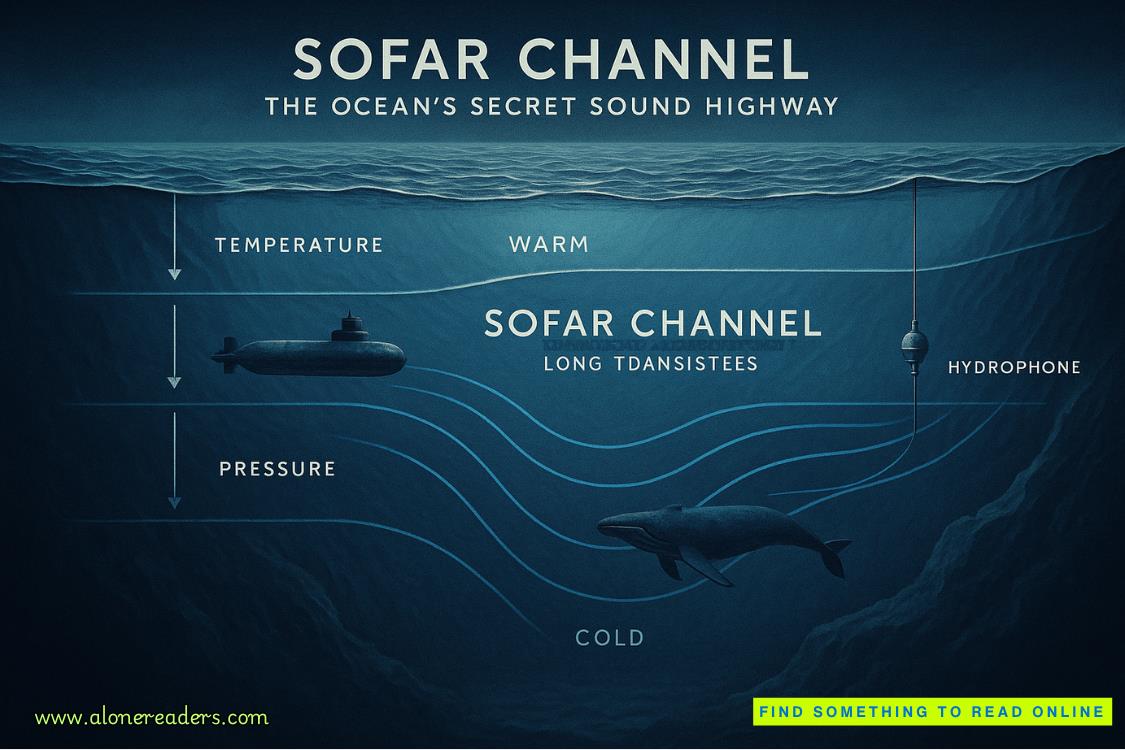
The ocean is not a silent world. Beneath the surface, sound travels farther and more efficiently than light, shaping how marine life communicates, how scientists study the planet, and how navies have monitored the seas for decades. At the heart of this acoustic realm lies one of the most fascinating and least understood natural phenomena in ocean science: the SOFAR Channel. Short for Sound Fixing and Ranging channel, it is often described as the ocean’s secret sound highway, a naturally occurring layer where sound can travel across entire ocean basins with remarkably little loss of energy.
The SOFAR Channel exists because sound in seawater behaves in ways that are tightly controlled by physics. Sound speed in the ocean is not constant; it changes with temperature, pressure, and salinity. Near the surface, warmer water allows sound to travel faster. As depth increases, temperature drops sharply through the thermocline, causing sound speed to decrease. Deeper still, pressure becomes the dominant factor, gradually increasing sound speed again. These competing influences create a minimum sound speed at an intermediate depth, typically between 600 and 1,200 meters in mid-latitude oceans, though the exact depth varies by region. This minimum forms the core of the SOFAR Channel.
What makes the SOFAR Channel extraordinary is how it traps sound. When a sound wave moves away from the depth of minimum sound speed, it enters water where sound travels faster. According to the principles of refraction, the wave bends back toward the slower-speed region. This bending happens both upward and downward, effectively corralling the sound energy into a horizontal corridor. Once trapped, the sound can propagate thousands of kilometers with minimal spreading and attenuation, far beyond what would be possible in surface waters or the deep abyss.
This phenomenon was first recognized during the Second World War, when scientists and naval engineers were searching for better ways to detect submarines and locate downed aircraft at sea. Researchers noticed that low-frequency sounds, when generated near a certain depth, could be detected at unexpectedly long distances. This discovery led to the formal identification of the SOFAR Channel and its rapid integration into military and scientific applications. The name itself reflects its original purpose: using sound to fix positions and measure ranges in the vast, otherwise opaque ocean.
From a physical perspective, the SOFAR Channel acts as a natural waveguide. Unlike artificial waveguides, such as fiber-optic cables or metal pipes, it is formed entirely by gradients in water properties. The channel favors low-frequency sounds, typically below a few hundred hertz, because these frequencies lose less energy to absorption. High-frequency sounds dissipate quickly and cannot take full advantage of the channel’s guiding effect. As a result, the SOFAR Channel is especially well suited for signals that need to travel extreme distances.
One of the most compelling natural users of the SOFAR Channel is marine life, particularly large whales. Baleen whales, such as blue whales and fin whales, produce powerful low-frequency calls that can fall squarely within the channel’s optimal range. These calls are believed to travel hundreds, and possibly thousands, of kilometers, allowing individuals to communicate across vast stretches of ocean. While the precise biological intent is still under study, this capability likely plays a role in mating, navigation, and maintaining social connections in the open sea. In this sense, the SOFAR Channel is not merely a physical curiosity but a critical component of ocean ecology.
For oceanographers, the SOFAR Channel has become an indispensable tool for studying the Earth system. Because sound speed is sensitive to temperature, long-range acoustic transmissions can be used to infer changes in ocean heat content. By sending controlled acoustic signals through the channel and measuring their travel times, scientists can detect subtle warming or cooling trends over basin-scale distances. This technique, often referred to as acoustic thermometry, provides insights that complement satellite observations and direct temperature measurements, particularly in the deep ocean where data are sparse.
The channel also plays a crucial role in global hydrophone networks. Arrays of underwater microphones placed near the SOFAR axis can listen to sounds from across the planet. These systems have detected undersea earthquakes, volcanic eruptions, iceberg calving events, and even meteorite impacts that strike the ocean. Because the SOFAR Channel efficiently carries low-frequency energy, it allows these events to be monitored in near real time, offering valuable data for geophysics, climate science, and hazard assessment.
Naval applications of the SOFAR Channel are perhaps the most sensitive and least publicly discussed, but their importance is undeniable. Submarines operating near the channel can exploit it to communicate covertly or, conversely, may be detected by distant listening systems if they generate sufficient noise at the right frequencies. During the Cold War, extensive networks of hydrophones were deployed to monitor submarine activity, relying heavily on the channel’s unique propagation properties. Even today, understanding the SOFAR Channel remains central to undersea surveillance and acoustic warfare strategies.
Despite its power, the SOFAR Channel is not uniform across the globe. Its depth, strength, and effectiveness vary with latitude, season, and local oceanography. In polar regions, where surface waters are cold and the temperature profile differs markedly from mid-latitudes, the channel can rise closer to the surface or even merge with surface sound channels. In tropical regions, strong and persistent thermoclines can deepen the channel. Seasonal heating and cooling can shift its position by tens or hundreds of meters, influencing how sound propagates at different times of year.
Human activity has introduced new complexities into this delicate acoustic environment. Increased shipping, offshore construction, and resource exploration have raised background noise levels in many parts of the ocean. Low-frequency ship noise, in particular, overlaps with the frequencies used by whales and favored by the SOFAR Channel. This raises concerns about acoustic masking, stress on marine life, and long-term changes to the underwater soundscape. Understanding how anthropogenic noise interacts with the SOFAR Channel is now a key area of research in marine conservation and environmental policy.
Technological advances continue to expand how the SOFAR Channel is used and studied. Autonomous underwater vehicles and deep-sea floats can now carry acoustic sources and receivers, enabling more flexible and detailed experiments. Improved modeling techniques allow scientists to simulate sound propagation with greater accuracy, accounting for complex ocean dynamics. These tools are helping researchers refine their understanding of how the channel responds to climate change, including shifts in temperature structure that could alter sound speed profiles on a global scale.
The SOFAR Channel also challenges common intuitions about the ocean. To most people, the sea seems vast and isolating, a place where signals quickly fade into nothingness. The existence of a natural conduit that can carry whispers across entire basins overturns this perception. It reveals the ocean as an interconnected acoustic system, where distant events are linked through invisible pathways shaped by physics and water itself.
In many ways, the SOFAR Channel embodies the intersection of natural law and human ingenuity. It was not engineered, yet it has been harnessed for navigation, science, and security. It supports the lives of some of the largest animals on Earth while enabling precise measurements of planetary change. Its study requires a deep understanding of thermodynamics, fluid dynamics, acoustics, and biology, making it a truly interdisciplinary subject.
As exploration of the deep ocean continues, the importance of the SOFAR Channel is likely to grow rather than diminish. Climate change is altering temperature structures, melting polar ice, and reshaping circulation patterns, all of which can influence sound propagation. Monitoring these changes through acoustic methods may become increasingly valuable as traditional observation techniques struggle to cover the vastness of the seas.
The SOFAR Channel remains largely invisible to the public, hidden far below the waves, yet its influence is profound. It is a reminder that the ocean operates according to subtle rules, where gradients measured in fractions of a degree can determine whether a sound fades nearby or echoes across half the planet. In understanding this secret sound highway, we gain not only technical knowledge but a deeper appreciation of the ocean as a dynamic, interconnected, and surprisingly communicative world.



 Château de Vincennes: France’s Forgotten Royal Fortress and Medieval Stronghold
 Château de Carcassonne: Europe’s Greatest Medieval Citadel and Fortress
 Château de Chenonceau: The Castle Built by Remarkable Women
 Château de Chambord: France’s Magnificent Renaissance Castle and Architectural Wonder
 Tehri Dam: India's Tallest Dam and the Debate Behind It
 Bhakra Nangal Dam: India's Temple of Modern Development