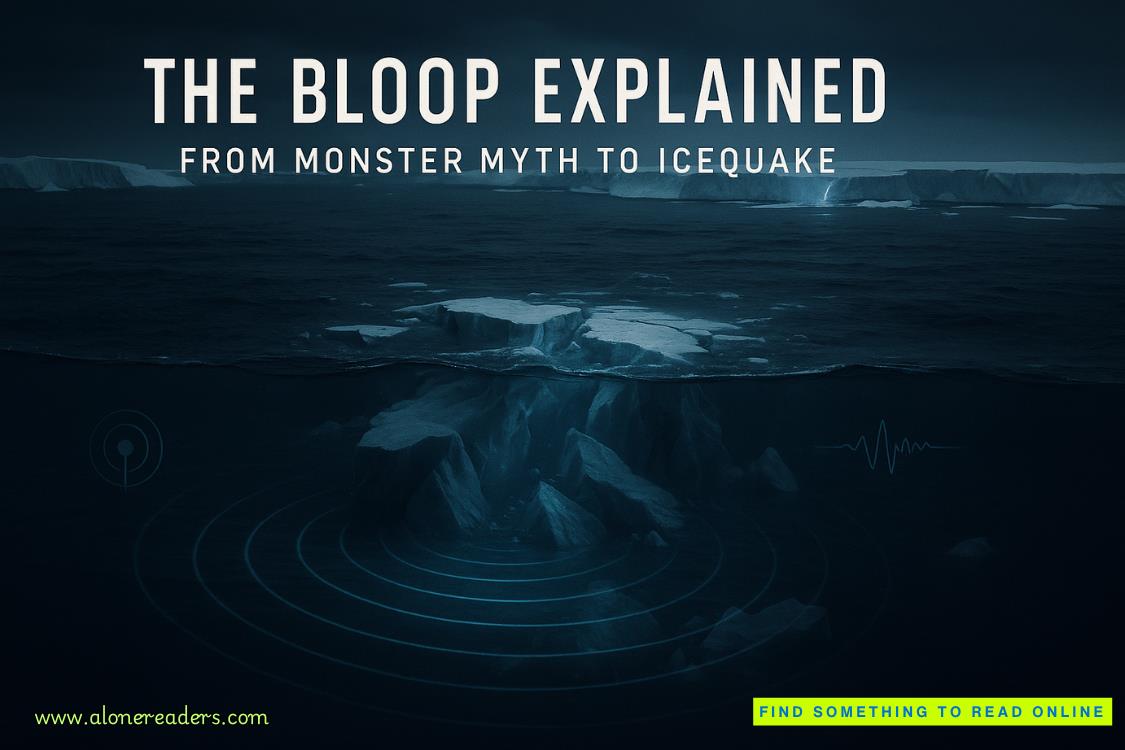
In the late 1990s, a single sound captured the imagination of scientists, conspiracy theorists, and ocean-mystery enthusiasts alike. It was not a visual anomaly, not a strange object recovered from the deep, but a sound—immensely powerful, hauntingly organic, and entirely unexplained at the time. Known simply as “The Bloop,” this ultra-low-frequency noise was detected in 1997 by underwater microphones operated by the U.S. National Oceanic and Atmospheric Administration. Its sheer scale and unusual acoustic profile immediately placed it outside anything previously recorded, igniting one of the most enduring modern ocean myths.
The Bloop was not just loud; it was colossal. Analysis showed that the sound was strong enough to be picked up by hydrophones positioned more than 5,000 kilometers apart across the Pacific Ocean. In underwater acoustics, such range is extraordinary. Even the loudest known animals, including blue whales—the largest creatures ever to exist—do not produce sounds detectable across entire ocean basins. This alone suggested that whatever produced The Bloop was operating on a scale far beyond known biology.
What made the sound even more unsettling was its organic acoustic signature. Unlike earthquakes, volcanic eruptions, or undersea explosions, which tend to have sharp, abrupt waveforms, The Bloop exhibited a slow frequency rise, a long sustain, and a gradual decay. To many acoustic analysts, it resembled something alive—something moving. This interpretation, though cautious at first, quickly escaped scientific circles and entered popular culture, where it evolved into darker and more imaginative forms.
Within months, speculative theories proliferated. Some suggested an unknown deep-sea megafauna, perhaps a creature larger than any cataloged species, lurking in the cold abyssal waters of the Southern Ocean. Others connected The Bloop to Lovecraftian mythology, likening it to the call of a sleeping ancient entity hidden beneath the ice. Internet forums and documentaries fueled the narrative, often emphasizing that over 80 percent of the ocean remains unexplored. If there were ever a place for monsters to hide, it would be there.
Yet from the beginning, many scientists remained skeptical of a biological explanation. The energy required to generate such a sound would exceed the metabolic capabilities of any known life form. Additionally, the frequency characteristics of The Bloop fell below the typical vocalization ranges of marine animals. Even blue whales, whose calls can travel thousands of kilometers, produce structured patterns tied to communication, not the singular, non-repeating burst that defined The Bloop.
To understand the sound properly, researchers had to look beyond biology and into geophysics. The hydrophones that detected The Bloop were originally installed not to listen for animals, but to monitor underwater nuclear tests and seismic activity. This network, designed during the Cold War, was extraordinarily sensitive to large-scale oceanic events. When scientists re-examined the data using improved analytical techniques in the early 2000s, a new possibility emerged—one tied not to life, but to ice.
The source region of The Bloop was traced to high southern latitudes, near Antarctica. This was significant. Antarctica is not a silent continent; it is a dynamic, shifting mass of ice constantly under stress. As massive ice shelves fracture, collide, scrape against the seabed, or calve into the ocean, they generate powerful acoustic signals. These phenomena are known as icequakes, and under the right conditions, they can rival or exceed tectonic earthquakes in acoustic intensity.
Ice behaves very differently from rock. When ice fractures, it does so slowly, elastically, and over extended durations. This produces long, sweeping sound waves rather than sharp seismic spikes. When enormous Antarctic ice shelves—sometimes larger than cities—break apart or grind against one another, the resulting sound can propagate efficiently through cold, dense seawater. The acoustic profile of such events turned out to be a near-perfect match for The Bloop.
Further evidence strengthened this conclusion. Similar sounds were detected in later years and were conclusively linked to ice activity. These signals shared the same low-frequency rise and decay pattern, the same immense range, and the same geographical clustering around polar regions. As climate monitoring improved, scientists observed that such sounds increased during periods of accelerated ice shelf destabilization.
By the mid-2000s, NOAA officially reclassified The Bloop as an icequake generated by large-scale ice fracturing in Antarctica. The mystery, at least scientifically, was resolved. No monster. No unknown leviathan. No secret underwater civilization. Just ice—ancient, immense, and violently reshaping itself in response to environmental forces.
However, the resolution of The Bloop did not diminish its significance. In many ways, it made the phenomenon even more profound. The sound was not evidence of a hidden creature, but of a planet undergoing structural change. Icequakes are closely tied to climate dynamics, particularly warming ocean temperatures that weaken ice shelves from below. In this context, The Bloop became one of the earliest widely publicized acoustic signals of large-scale polar ice instability.
What once inspired fear now inspires concern. The sound represents the breaking of ice systems that have existed for tens of thousands of years. Each massive fracture contributes incrementally to sea-level rise and alters ocean circulation patterns. The Bloop was not a warning from a monster, but a signal from the Earth itself—deep, distant, and impossible to ignore.
Culturally, The Bloop occupies a rare space where myth and science intersect. It demonstrates how limited human perception still is when it comes to the deep ocean, and how quickly uncertainty can give rise to legends. At the same time, it highlights the power of scientific tools to strip away fear without stripping away wonder. The ocean remains vast and largely unexplored, but its mysteries are increasingly understood not as supernatural threats, but as complex natural systems.
The enduring fascination with The Bloop also reflects a deeper psychological truth. Humans are drawn to the idea that something immense and unknown might exist just beyond our reach. When science offers a grounded explanation, it does not eliminate that fascination—it reframes it. The idea that entire ice shelves can scream across oceans as they tear themselves apart is, in its own way, just as awe-inspiring as any sea monster.
In the end, The Bloop stands as a reminder that the most powerful forces on Earth do not need faces, teeth, or tentacles. Sometimes, the most haunting sounds come from ice breaking in the dark, thousands of kilometers away, carrying with them the story of a changing planet.



 Château de Vincennes: France’s Forgotten Royal Fortress and Medieval Stronghold
 Château de Carcassonne: Europe’s Greatest Medieval Citadel and Fortress
 Château de Chenonceau: The Castle Built by Remarkable Women
 Château de Chambord: France’s Magnificent Renaissance Castle and Architectural Wonder
 Tehri Dam: India's Tallest Dam and the Debate Behind It
 Bhakra Nangal Dam: India's Temple of Modern Development










