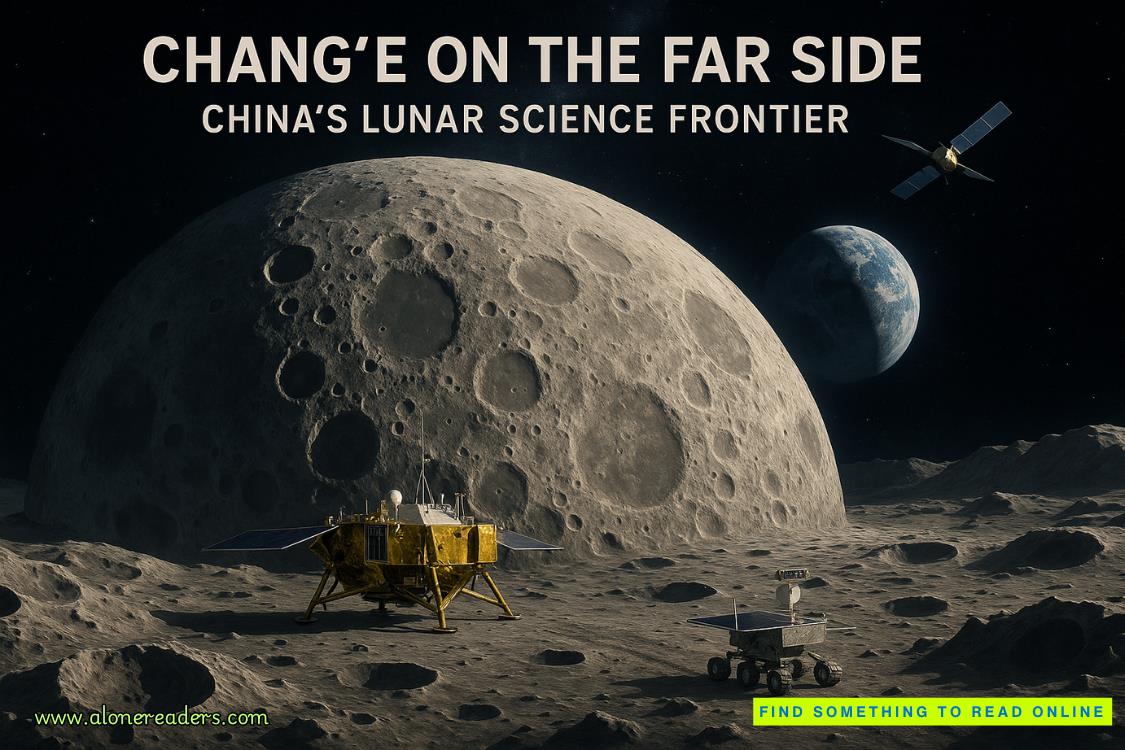
For most of human history, the Moon’s far side was not merely unexplored but fundamentally unreachable. Locked by tidal forces, it never faces Earth, denying direct communication and visual observation until the space age. When China’s Chang’e program set its sights on this hidden hemisphere, it was not pursuing symbolism alone. The mission was conceived as a deliberate scientific intervention into unanswered questions about lunar formation, deep crustal composition, space environment physics, and the strategic mastery of complex space systems. Chang’e on the far side represents not a single landing, but a carefully orchestrated scientific campaign that reshaped how humanity studies the Moon.
The defining breakthrough came in January 2019 with Chang’e-4, the first spacecraft in history to achieve a soft landing on the Moon’s far side. The landing site, Von Kármán crater within the vast South Pole–Aitken basin, was chosen for its exceptional scientific value rather than engineering convenience. This basin is the oldest and deepest known impact structure on the Moon, excavated billions of years ago by a colossal collision that may have punched through the lunar crust. By placing instruments directly within this region, China positioned itself to examine materials originating from the Moon’s lower crust or even upper mantle, something no previous mission had been able to do in situ.
One of the most profound scientific outcomes of Chang’e-4 lies in its contribution to understanding lunar geological asymmetry. The near side of the Moon is dominated by vast basaltic plains, while the far side is heavily cratered and geochemically distinct. Prior hypotheses attributed this difference to variations in crustal thickness, internal heat flow, and early volcanic activity. Chang’e-4’s spectrometers detected minerals such as olivine and low-calcium pyroxene, strengthening the argument that mantle-derived materials are exposed in the South Pole–Aitken basin. These findings offer concrete evidence supporting models of early lunar differentiation and the violent processes that shaped the Moon shortly after its formation.
Equally significant is the mission’s exploration of space environment dynamics on the far side. Without Earth constantly in view, the far side experiences a subtly different interaction with solar wind, cosmic radiation, and charged particles. Chang’e-4’s instruments measured energetic neutral atoms and radiation fluxes, contributing to a more refined understanding of how airless bodies evolve under continuous solar bombardment. These data have direct implications not only for lunar science but also for future human exploration, where radiation exposure remains one of the most formidable challenges.
Perhaps the most visionary component of Chang’e-4 was its low-frequency radio astronomy experiment. Earth is saturated with radio noise from human technology and its ionosphere blocks long-wavelength signals from deep space. The lunar far side, permanently shielded from terrestrial interference, is the quietest radio environment in the inner solar system. By deploying a low-frequency radio spectrometer, Chang’e-4 opened a new observational window into the universe. This experiment aims to detect signals from the cosmic “dark ages,” the period before the first stars ignited, which remains one of modern cosmology’s most elusive frontiers.
None of this science would have been possible without solving an unprecedented engineering problem: communication. Direct radio contact with Earth is impossible from the lunar far side, forcing China to pioneer a dedicated relay architecture. The Queqiao satellite, placed in a halo orbit around the Earth–Moon L2 point, became a permanent bridge between Earth and the far side surface. This system demonstrated China’s growing sophistication in orbital mechanics, deep-space navigation, and long-duration spacecraft operations. More importantly, it established an infrastructure model that future far side missions, including international ones, may rely upon.
The Yutu-2 rover, deployed by Chang’e-4, has far exceeded its original design life, becoming one of the longest-operating lunar rovers in history. Its slow, methodical traverse across the crater floor reflects a scientific philosophy centered on precision rather than spectacle. By repeatedly analyzing regolith composition, subsurface structure, and rock morphology, Yutu-2 has built a layered understanding of the local geology, revealing a complex history of ejecta deposition from multiple impact events over billions of years. This stratigraphic record functions as a natural archive of the inner solar system’s bombardment history.
Chang’e’s far side success must also be understood within the broader architecture of China’s lunar strategy. The Chang’e program was never designed as isolated missions, but as sequential steps toward long-term lunar presence. Earlier near-side missions validated landing and sampling technologies, while Chang’e-4 pushed operational boundaries. Subsequent missions, including sample return from the near side and plans for south polar exploration, indicate a systematic progression toward resource assessment, infrastructure development, and potentially crewed operations. The far side is a crucial piece of this roadmap, offering scientific prestige and strategic depth.
Internationally, Chang’e-4 altered the geopolitical landscape of space exploration. It demonstrated that cutting-edge lunar science is no longer the exclusive domain of traditional space powers. While the mission included limited international payloads, it was fundamentally a nationally led endeavor, showcasing China’s ability to conceive, fund, and execute complex scientific exploration independently. This has accelerated global interest in lunar collaboration, competition, and the establishment of norms for future activity on the Moon.
Beyond geopolitics and science, Chang’e on the far side carries a deeper philosophical weight. It represents humanity’s willingness to confront environments that are not merely distant but inherently inaccessible without technological mediation. The far side of the Moon, once a symbol of cosmic mystery, has become a working laboratory where hypotheses are tested directly against reality. In doing so, China has contributed not just data, but a shift in perspective: that the Moon is not a static relic, but an active participant in understanding planetary evolution, space physics, and humanity’s future beyond Earth.
As data from Chang’e-4 continues to be analyzed and integrated into global lunar science, its true legacy is still unfolding. What is already clear is that the mission transformed the far side from an abstract concept into a tangible scientific domain. It proved that with deliberate planning, patient execution, and strategic ambition, even the most hidden landscapes in the solar system can yield their secrets. Chang’e on the far side stands as a defining chapter in modern space exploration, marking the moment when the Moon’s silent hemisphere finally began to speak.



 Château de Vincennes: France’s Forgotten Royal Fortress and Medieval Stronghold
 Château de Carcassonne: Europe’s Greatest Medieval Citadel and Fortress
 Château de Chenonceau: The Castle Built by Remarkable Women
 Château de Chambord: France’s Magnificent Renaissance Castle and Architectural Wonder
 Tehri Dam: India's Tallest Dam and the Debate Behind It
 Bhakra Nangal Dam: India's Temple of Modern Development