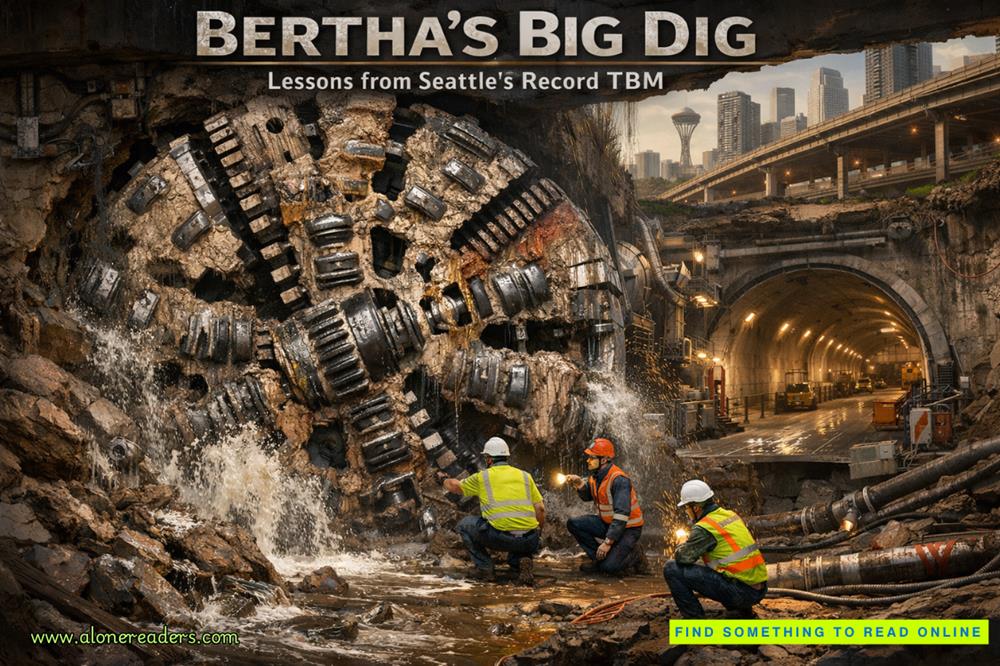
Bertha’s Big Dig stands as one of the most ambitious and cautionary chapters in modern underground engineering. Conceived as the centerpiece of Seattle’s State Route 99 tunnel replacement project, Bertha was not just another tunnel boring machine but the largest ever built at the time, with a cutterhead diameter of over 17.4 meters. The goal was straightforward in concept yet formidable in execution: replace the aging Alaskan Way Viaduct with a deep-bore tunnel capable of carrying traffic beneath downtown Seattle while minimizing surface disruption. What unfolded instead was a multi-year struggle that exposed the limits of scale, the unforgiving nature of mixed geology, and the systemic risks embedded in mega-infrastructure projects.
The design philosophy behind Bertha was rooted in optimism about technological escalation. Larger diameter meant fewer tunnels, higher capacity, and theoretically faster construction. Bertha was engineered as a pressure-balanced earth pressure balance machine capable of handling Seattle’s notoriously complex subsurface conditions, which include glacial till, soft clay, loose sands, and high groundwater pressure. The cutterhead alone weighed thousands of tons and was equipped with hundreds of cutting tools designed to fracture rock, shear clay, and manage variable soil conditions in a single pass. Supporting systems included an intricate slurry handling network, segment erectors, hydraulic drives, and real-time monitoring systems intended to maintain face stability at all times.
However, the ground beneath Seattle did not conform neatly to design assumptions. Almost immediately after launch, Bertha encountered heterogeneous soils that shifted unpredictably across short distances. Abrasive glacial deposits caused accelerated cutter wear, while water-bearing sands challenged pressure control at the tunnel face. These conditions required frequent interventions, adjustments to operational parameters, and tool changes that proved far more complex than anticipated for a machine of such unprecedented size. Unlike smaller TBMs, Bertha could not easily stop, reverse, or be accessed for repairs without extensive planning and risk.
The first major failure occurred when Bertha’s cutterhead seals were compromised, allowing groundwater and abrasive material to infiltrate the main bearing. This was not a minor defect but a critical mechanical failure. The main bearing is the heart of a TBM, supporting the massive rotating cutterhead while maintaining precise alignment under extreme loads. Once damaged, continued operation risked catastrophic seizure. Yet accessing this bearing required excavating a retrieval shaft from the surface, an operation that would take months and cost hundreds of millions of dollars.
What followed was a prolonged standstill that transformed Bertha from a symbol of engineering prowess into a public emblem of delay and cost overruns. Engineers excavated a 120-foot-deep access pit, froze surrounding ground to stabilize waterlogged soils, and dismantled the cutterhead piece by piece underground. This process revealed the cumulative impact of wear, inadequate seal performance under real-world conditions, and the difficulty of maintaining massive rotating assemblies in variable geology. The repair itself became an engineering project within an engineering project, introducing new risks even as it sought to mitigate existing ones.
Beyond mechanical failure, Bertha’s experience exposed deeper systemic issues in project planning and risk allocation. The contractual framework placed substantial responsibility on the contractor to manage geotechnical uncertainty, despite limited ability to fully characterize subsurface conditions in an urban environment. Borehole data and geotechnical surveys, while extensive, could not capture the full variability of glacially deposited soils. When reality diverged from models, disputes arose over responsibility, compensation, and schedule recovery, compounding technical challenges with legal and financial strain.
The machine’s immense size amplified every problem. Tool changes that might take hours on smaller TBMs required days or weeks with Bertha. Slurry management became exponentially more complex, with higher volumes of excavated material and greater sensitivity to pressure imbalances. Thermal loads on bearings and seals increased due to scale, pushing materials closer to their performance limits. Even logistics above ground, such as segment fabrication and transport, became tightly coupled to TBM performance, leaving little room for recovery when delays occurred.
Despite these setbacks, Bertha eventually resumed boring after repairs and completed the tunnel. This outcome, while often overshadowed by earlier failures, is itself significant. It demonstrated the resilience of engineering teams under sustained pressure and the capacity to recover from near-catastrophic setbacks through methodical problem-solving. Lessons learned during Bertha’s downtime led to improved monitoring protocols, more conservative operational parameters, and enhanced communication between field engineers, designers, and operators.
One of the most enduring lessons from Bertha’s Big Dig is the danger of assuming linear scalability in engineering systems. A TBM twice the diameter is not merely twice as complex; it introduces nonlinear increases in stress, wear, heat, and risk. Components that perform reliably at smaller scales may fail unpredictably when pushed beyond proven limits. This realization has since influenced TBM design philosophy, with greater emphasis on modularity, maintainability, and redundancy rather than sheer size.
Another critical takeaway lies in the relationship between geology and machine selection. Bertha was designed as a hybrid solution capable of handling multiple soil types, yet this versatility came at the cost of specialization. In retrospect, some engineers argue that a different alignment, multiple smaller tunnels, or alternative construction methods might have reduced exposure to extreme geotechnical risk. The project underscored the importance of aligning machine capabilities not just with average conditions but with worst-case scenarios that may occur only briefly yet define project success or failure.
Bertha’s story also reshaped how infrastructure owners and the public perceive underground construction risk. Prior to the project, TBMs were often marketed as near-magical solutions that could quietly and efficiently carve tunnels beneath cities. Bertha revealed the reality: tunneling is an exercise in controlled uncertainty, where even the most advanced machines are ultimately subordinate to geology. This shift in perception has led to more transparent communication about risk, contingency planning, and schedule uncertainty in subsequent mega-projects worldwide.
From an engineering culture perspective, Bertha’s Big Dig reinforced the value of humility. Advanced modeling, sophisticated materials, and powerful machinery cannot eliminate uncertainty; they can only manage it. Successful projects are those that acknowledge this fact early, embed flexibility into design and contracts, and empower engineers to adapt rather than adhere rigidly to initial assumptions. Bertha’s failures were not solely technical but also organizational, arising from misaligned expectations about what technology alone could achieve.
Today, Bertha stands as both a cautionary tale and a milestone. The SR 99 tunnel now carries traffic beneath Seattle, fulfilling its functional promise. Yet the true legacy of Bertha lies in the lessons absorbed by the global tunneling community. Future TBM projects increasingly favor incremental innovation over record-breaking scale, deeper geotechnical investigation, and design-for-repair principles that assume failure is not an anomaly but an eventuality.
In the end, Bertha’s Big Dig reminds engineers, planners, and policymakers that progress in infrastructure is rarely linear. It advances through bold attempts, hard-earned lessons, and the willingness to confront failure without abandoning ambition. Bertha may have stalled, broken, and frustrated an entire city, but it also pushed the boundaries of what was known, leaving behind a richer, more cautious understanding of how to build beneath the world’s most complex urban landscapes.



 Château de Vincennes: France’s Forgotten Royal Fortress and Medieval Stronghold
 Château de Carcassonne: Europe’s Greatest Medieval Citadel and Fortress
 Château de Chenonceau: The Castle Built by Remarkable Women
 Château de Chambord: France’s Magnificent Renaissance Castle and Architectural Wonder
 Tehri Dam: India's Tallest Dam and the Debate Behind It
 Bhakra Nangal Dam: India's Temple of Modern Development