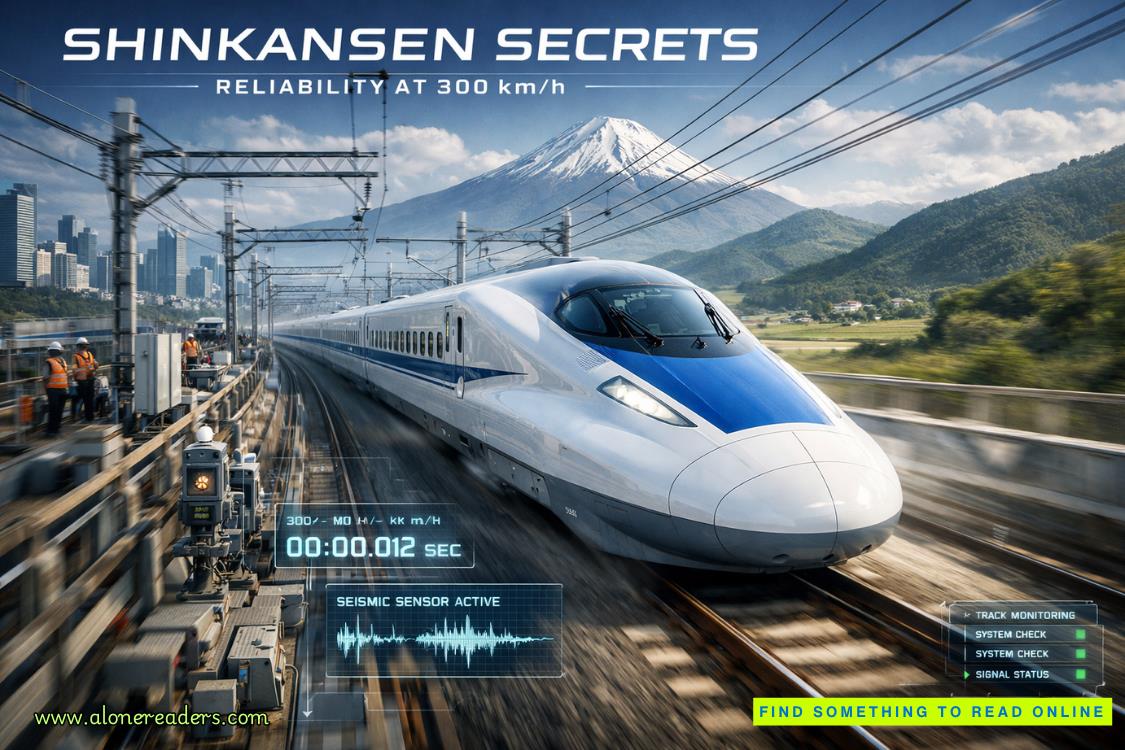
The Shinkansen is not simply a fast train. It is the physical expression of a national obsession with precision, safety, and operational perfection. While many countries have built high-speed rail systems capable of reaching impressive top speeds, none have matched Japan’s ability to run trains at nearly 300 kilometers per hour with clockwork reliability year after year. Delays measured in seconds, accident records that remain virtually spotless, and passenger confidence that borders on absolute trust are not the result of a single innovation, but of an entire ecosystem designed around failure prevention rather than failure response.
What makes the Shinkansen extraordinary is not how fast it can go, but how predictably it can go fast. At these velocities, even small inconsistencies—track imperfections, power fluctuations, human error—can cascade into serious risks. Japan’s answer has been to engineer uncertainty out of the system long before trains ever leave the station.
From its earliest conception in the 1950s, the Shinkansen was designed as a closed, purpose-built system. Unlike conventional railways that share tracks with freight trains, level crossings, or legacy infrastructure, Shinkansen lines are completely isolated. This separation eliminates one of the most common causes of rail accidents worldwide: interaction with slower trains, vehicles, or pedestrians. The result is a controlled environment where every variable is known, monitored, and optimized.
Reliability begins with the track itself. Shinkansen rails are laid with tolerances far tighter than those used in conventional rail systems. Track geometry is continuously measured using specialized inspection trains that operate at full speed, identifying deviations measured in fractions of a millimeter. When deviations appear, maintenance crews intervene immediately, often overnight, long before passengers ever experience discomfort or instability. The track is not allowed to degrade gradually; it is restored to near-perfect condition as a matter of routine.
This obsession with precision extends to the train’s interface with the track. Shinkansen wheel profiles are engineered to distribute loads evenly and minimize wear, reducing vibration and maintaining stable contact at high speeds. Bogies—the assemblies that house wheels, suspension, and braking systems—are tuned specifically for each train series and route profile. Curves, gradients, and expected wind conditions are all factored into their design, ensuring consistent performance across diverse terrain.
Aerodynamics is another pillar of reliability. At 300 km/h, air becomes a dominant force. Pressure waves, crosswinds, and tunnel entry shock can destabilize trains if not properly managed. The iconic elongated nose of modern Shinkansen models is not aesthetic flair; it is a carefully calculated solution to pressure management. By smoothing airflow and reducing sudden pressure changes, these designs protect both structural components and passenger comfort, while also reducing long-term fatigue on the train body.
Power delivery is equally critical. Shinkansen trains draw electricity from overhead lines through pantographs designed to maintain constant contact even at extreme speeds. Any loss of contact could cause arcing, power interruptions, or equipment damage. To prevent this, overhead catenary systems are tensioned with extraordinary precision, and pantographs are actively monitored for wear, vibration, and alignment. Power substations along the route provide redundancy, ensuring that even localized failures do not disrupt service.
Behind the scenes, control systems function as the nervous system of the entire network. Shinkansen operations rely on advanced automatic train control rather than traditional signaling. Trains are continuously supervised by centralized systems that calculate safe speeds, braking distances, and spacing in real time. Drivers do not rely on trackside signals; instead, permitted speeds are transmitted directly into the cab, and trains will automatically slow or stop if limits are exceeded. This removes a significant layer of human risk from high-speed operations.
Human involvement, however, is not minimized—it is refined. Shinkansen drivers undergo some of the most rigorous training programs in the transportation industry. They practice emergency scenarios repeatedly, even those that have never occurred in real service. Conductors rehearse procedures for everything from earthquakes to medical emergencies. Importantly, Japan’s rail culture encourages transparent reporting of even minor anomalies. There is no stigma attached to stopping a train or reporting a potential issue; caution is treated as professionalism, not failure.
Perhaps the most famous aspect of Shinkansen reliability is its relationship with earthquakes. Japan sits atop one of the most seismically active regions on Earth, yet high-speed rail accidents due to earthquakes have been virtually nonexistent. This is achieved through a nationwide seismic detection network linked directly to rail operations. Sensors detect primary seismic waves before destructive shaking arrives, automatically cutting power and initiating emergency braking. Trains may still be moving at high speed when detection occurs, but controlled deceleration prevents derailment even during major events.
Maintenance philosophy is where Japan’s approach truly diverges from global norms. Instead of repairing components after they fail, Shinkansen operators replace them based on usage cycles, predictive data, and microscopic signs of wear. Parts are often removed while still fully functional because their replacement window has arrived. This practice may seem costly, but it prevents cascading failures that would be far more expensive—and dangerous—at high speeds.
Nighttime maintenance operations are a carefully choreographed ballet. Once the last train clears the line, crews have only a few hours to inspect tracks, power systems, signaling equipment, and structures before morning service resumes. Specialized vehicles, modular tools, and precise scheduling allow dozens of tasks to be completed simultaneously. Every worker knows exactly where they need to be and what must be finished before dawn.
Reliability also extends into passenger operations. Boarding procedures are standardized down to the second. Platform markings align exactly with train doors, reducing dwell times and preventing crowding. Cleaning crews perform rapid yet meticulous turnarounds, often preparing a train for its next journey in under ten minutes. This consistency ensures that operational delays do not accumulate throughout the day.
One of the most understated secrets of Shinkansen reliability is institutional memory. Incidents, near-misses, and even theoretical risks are documented, analyzed, and shared across the entire rail network. Lessons learned from one line or operator inform procedures nationwide. This collective learning prevents localized mistakes from repeating elsewhere and allows continuous improvement without waiting for accidents to occur.
Critically, the Shinkansen was never designed as a profit-maximization experiment. Its success is measured in punctuality, safety, and public trust as much as in revenue. This allows long-term investments in infrastructure, training, and maintenance that would be difficult to justify under purely short-term financial metrics. The result is a system that ages gracefully, improving over decades rather than degrading.
At 300 km/h, there is no margin for improvisation. Every bolt, sensor, protocol, and human decision must function as intended, every time. The Shinkansen achieves this not through a single technological breakthrough, but through a holistic philosophy that treats reliability as a design requirement, not an operational goal.
In a world increasingly fascinated by speed records and futuristic transport concepts, the true lesson of the Shinkansen is quieter and more profound. Sustainable high-speed travel is not about pushing limits; it is about mastering fundamentals so completely that extraordinary performance becomes routine. Japan’s bullet trains do not feel fast because they feel safe, stable, and predictable—and that is the ultimate secret behind their enduring success.



 Château de Vincennes: France’s Forgotten Royal Fortress and Medieval Stronghold
 Château de Carcassonne: Europe’s Greatest Medieval Citadel and Fortress
 Château de Chenonceau: The Castle Built by Remarkable Women
 Château de Chambord: France’s Magnificent Renaissance Castle and Architectural Wonder
 Tehri Dam: India's Tallest Dam and the Debate Behind It
 Bhakra Nangal Dam: India's Temple of Modern Development