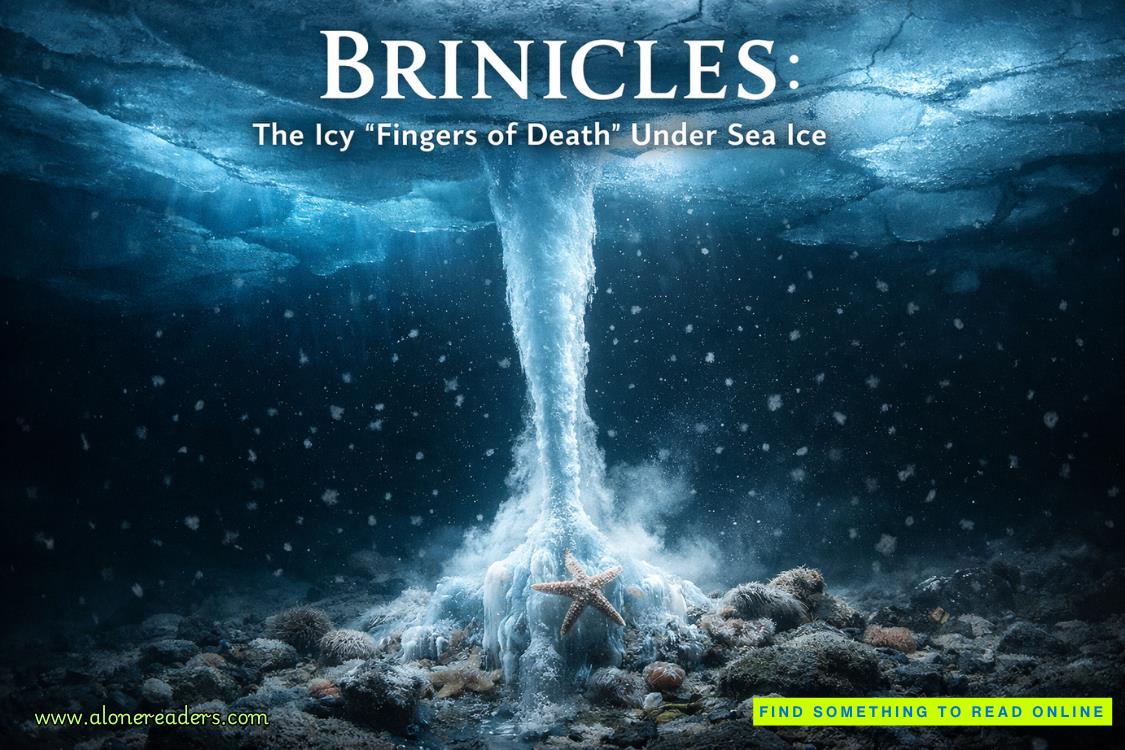
Brinicles are among the most unsettling natural phenomena ever observed in Earth’s oceans, earning the nickname “fingers of death” for their lethal impact on marine life. Hidden beneath floating sea ice in the polar regions, these ghostly structures are not made by wind or waves but by an intricate interaction between salt, temperature, and gravity. To understand brinicles properly requires moving beyond surface-level explanations and into the physics of sea ice formation, where microscopic changes cascade into dramatic, deadly structures.
When seawater begins to freeze, the process is fundamentally different from freshwater ice formation. Seawater contains salt and other dissolved minerals that cannot be incorporated into the crystalline structure of ice. As ice crystals grow at the ocean’s surface, they reject salt, concentrating it into pockets of dense brine trapped within the forming ice. Over time, these brine pockets connect into channels that run through the ice like a network of veins. The ice above may look solid and static, but internally it is alive with slow-moving, super-saline liquid.
As polar winter deepens and air temperatures plunge far below freezing, the brine trapped inside the ice becomes colder and denser. Cold brine is heavier than the surrounding seawater because it is both saltier and colder. Eventually, gravity wins. The brine drains downward through a weak point in the ice, spilling into the ocean below. This is the moment a brinicle is born.
The descending brine behaves unlike any ordinary liquid flow. As it pours into the seawater, it is so cold that it instantly freezes the surrounding water upon contact. A thin shell of ice forms around the descending stream, creating a hollow tube that lengthens downward as more brine continues to flow. This tube grows steadily, sometimes reaching several meters in length, stretching from the underside of the ice toward the ocean floor like a frozen stalactite turned upside down.
Why brinicles grow downward rather than upward
The downward growth of a brinicle is dictated by density differences and thermal gradients. The brine is denser than the seawater, so it sinks instead of dispersing horizontally. At the same time, the extreme cold of the brine freezes water at its boundary, reinforcing the tubular structure. This feedback loop allows the brinicle to extend farther and farther, provided the brine supply continues and the surrounding water remains close to its freezing point.
The internal structure of a brinicle is just as fascinating as its appearance. The core is a flowing stream of ultra-cold brine, while the walls are made of newly frozen seawater ice. This makes brinicles fragile yet persistent, capable of maintaining their form for minutes or even hours depending on conditions. Unlike ordinary ice formations, they are dynamic, actively growing and reshaping themselves in real time.
Why they are called “fingers of death”
The ominous name is not poetic exaggeration. When a brinicle reaches the seafloor, it spreads outward like a frozen spider web. Any slow-moving or immobile marine organisms in its path, such as starfish, sea urchins, mollusks, or anemones, are rapidly encased in ice. Unlike fish, which can usually swim away, these creatures have no escape. The freezing process is swift and lethal, effectively flash-freezing the organisms alive.
This form of mortality is rare in marine environments, where freezing is typically limited to surface layers or shallow tidal zones. Brinicles introduce freezing temperatures into deeper waters, creating isolated but devastating events on the seafloor. Although brinicles do not occur frequently enough to threaten entire ecosystems, their localized impact can be severe, altering small patches of benthic life in dramatic fashion.
Environmental conditions required for brinicle formation
Brinicles only form under very specific conditions, which is why they are relatively rare and confined to polar regions. First, the air temperature must be extremely low to promote rapid sea ice growth. Second, the seawater beneath the ice must be near its freezing point, allowing the brine to freeze surrounding water efficiently. Third, the ice must be thick enough to develop a network of brine channels but not so impermeable that brine cannot escape.
Even slight changes in temperature or salinity can prevent brinicle formation. Warmer water disperses the brine too quickly, while thinner ice cannot sustain the internal brine network needed to feed a growing tube. This delicate balance makes brinicles a precise indicator of environmental conditions in polar seas.
What brinicles reveal about sea ice physics
Beyond their visual drama, brinicles offer scientists valuable insight into how sea ice forms and evolves. The movement of brine through ice affects its strength, permeability, and thermal properties. These factors play a critical role in larger-scale processes such as heat exchange between the ocean and atmosphere, nutrient cycling, and the behavior of polar ice sheets.
Brinicles also highlight how small-scale processes can have outsized effects. A microscopic exclusion of salt during ice formation ultimately leads to meter-long ice structures capable of killing marine organisms. This chain reaction exemplifies the complexity of cryospheric systems, where physics, chemistry, and biology intersect in unexpected ways.
Implications for climate research
As polar climates change, the conditions required for brinicle formation may also shift. Thinner sea ice, warmer ocean temperatures, and altered salinity patterns could reduce the frequency of brinicles or change where they occur. Studying them helps researchers understand how sensitive sea ice systems are to environmental change and provides a tangible example of how warming trends might disrupt long-standing polar processes.
At the same time, brinicles serve as a reminder that extreme cold environments are not static or inert. They are active, evolving systems capable of producing sudden and dramatic phenomena. In a warming world, the disappearance of such processes would represent not just a loss of spectacle, but a fundamental alteration of polar ocean dynamics.
Why brinicles remain largely unknown
Despite their striking nature, brinicles remained undocumented for most of human history simply because they occur in places that are exceptionally difficult to observe. They form beneath sea ice, in dark, freezing waters, often hundreds of kilometers from human settlements. Only with modern polar diving expeditions and underwater cameras did scientists begin to capture them directly.
Even today, observing a brinicle in the wild requires a rare convergence of conditions, careful planning, and a willingness to work in one of the planet’s most hostile environments. This rarity contributes to their mystique and to the lingering sense that Earth still harbors phenomena capable of surprising even seasoned scientists.
Brinicles are not monsters, nor are they supernatural forces of destruction. They are the inevitable outcome of well-understood physical laws operating under extreme conditions. Yet their appearance, behavior, and effects challenge our intuition about ice and oceans. In the silent darkness beneath polar sea ice, these icy fingers remind us that nature’s most elegant processes can also be its most unforgiving.



 Château de Vincennes: France’s Forgotten Royal Fortress and Medieval Stronghold
 Château de Carcassonne: Europe’s Greatest Medieval Citadel and Fortress
 Château de Chenonceau: The Castle Built by Remarkable Women
 Château de Chambord: France’s Magnificent Renaissance Castle and Architectural Wonder
 Tehri Dam: India's Tallest Dam and the Debate Behind It
 Bhakra Nangal Dam: India's Temple of Modern Development










