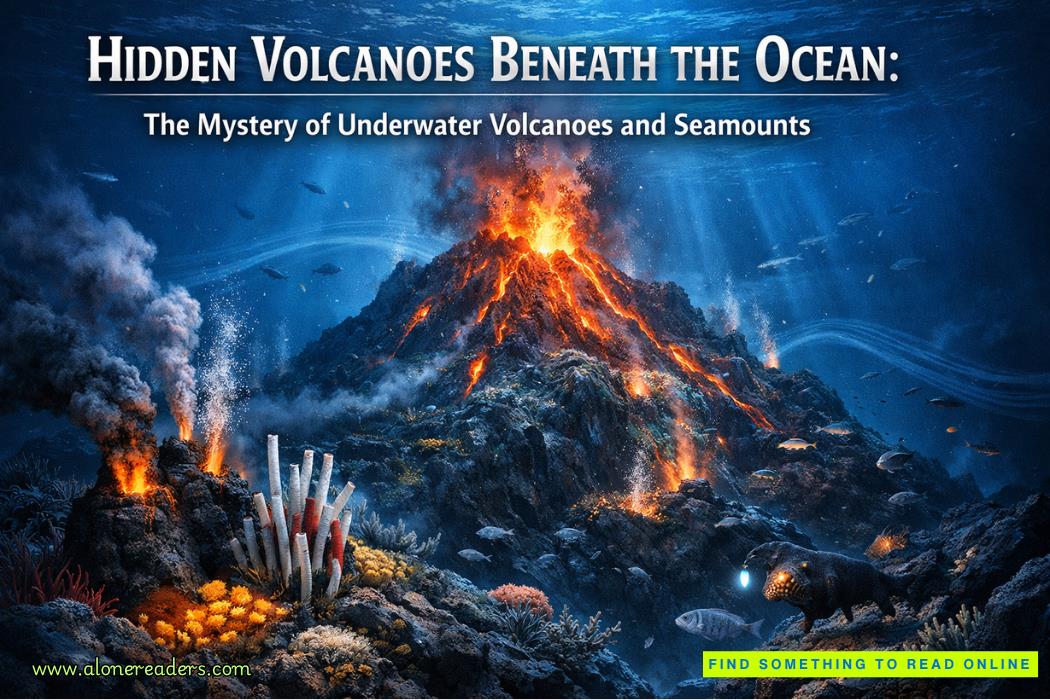
The surface of the Earth often appears familiar to humanity—continents, mountains, deserts, forests, and rivers are all landscapes that have been studied for centuries. Yet beneath the world’s oceans lies a vastly larger and more mysterious terrain that remains largely unexplored. Covering nearly seventy percent of the planet’s surface, the oceans conceal a dynamic geological environment where powerful forces constantly reshape the seafloor. Among the most fascinating features hidden in these depths are underwater volcanoes and seamounts, enormous structures formed through volcanic activity that occur far beyond the reach of human observation.
For centuries, scientists assumed that volcanic activity was mainly confined to land or shallow coastal regions. However, modern oceanographic research has revealed that the vast majority of Earth’s volcanoes actually exist beneath the ocean. These submarine volcanoes are responsible for building mountain-like formations known as seamounts, which rise from the seabed and sometimes reach thousands of meters toward the ocean surface. Although many of them remain dormant today, their formation represents a powerful geological process that has been shaping the Earth’s crust for millions of years.
Formation of Underwater Volcanoes
The creation of underwater volcanoes is deeply connected to the movement of the Earth’s tectonic plates. The outer shell of the planet, known as the lithosphere, is divided into multiple massive plates that slowly move across the semi-fluid mantle beneath them. Where these plates interact, intense geological activity often occurs. Submarine volcanic activity is most common along tectonic plate boundaries, especially in regions where plates diverge or collide.
At divergent plate boundaries, two tectonic plates gradually move away from each other, creating cracks in the Earth’s crust. Through these openings, molten magma from the mantle rises toward the surface. When this magma comes into contact with cold ocean water, it cools rapidly, solidifying into new volcanic rock. Over long periods of repeated eruptions, layers of solidified lava accumulate, gradually forming underwater volcanic mountains.
At convergent boundaries, one tectonic plate is forced beneath another in a process known as subduction. As the descending plate sinks deeper into the mantle, it melts partially due to extreme temperature and pressure. This melting produces magma that rises upward through fractures in the crust, eventually forming volcanic structures on the ocean floor.
These processes occur continuously along thousands of kilometers of mid-ocean ridges, the longest mountain chains on Earth. In fact, the global mid-ocean ridge system stretches for more than 65,000 kilometers, making it the largest geological structure on the planet. Along this network of ridges, new oceanic crust is constantly created through submarine volcanic eruptions.
Seamounts: Underwater Mountains of Volcanic Origin
When underwater volcanic activity continues for long periods in the same location, the accumulated lava forms towering structures known as seamounts. These formations resemble underwater mountains, often rising several thousand meters above the surrounding seafloor. However, unlike continental mountains formed by tectonic uplift, seamounts are built almost entirely from successive layers of volcanic rock.
Some seamounts grow so tall that they eventually reach the ocean surface. When this occurs, they can create volcanic islands. One of the most famous examples of this process is the Hawaiian Island chain, which originated from volcanic activity on the ocean floor. The islands themselves are simply the visible peaks of a much larger underwater volcanic system that extends deep into the Pacific Ocean.
However, most seamounts never reach the surface. They remain hidden beneath kilometers of water, forming a vast underwater landscape of volcanic peaks scattered across the ocean floor. Scientists estimate that there may be more than one hundred thousand seamounts across the world’s oceans, although only a fraction have been fully mapped.
Interestingly, some seamounts develop flattened tops over time. These structures, known as guyots, were once volcanic islands that were gradually eroded by waves when they stood above sea level. Later, as the oceanic crust cooled and sank, the eroded island subsided beneath the ocean surface, leaving behind a flat-topped underwater plateau.
The Chemical Influence of Submarine Volcanoes
Underwater volcanoes do more than simply shape the seafloor—they also play a crucial role in maintaining the chemical balance of the oceans. When submarine eruptions occur, they release a wide variety of minerals and gases into surrounding seawater. These substances include iron, manganese, sulfur compounds, and other elements that can influence ocean chemistry.
One of the most significant features associated with submarine volcanic activity is the presence of hydrothermal vents. These vents occur where seawater seeps deep into the oceanic crust, becomes superheated by underlying magma, and then rises back to the seafloor carrying dissolved minerals. When this mineral-rich water emerges from the vents and meets the cold ocean water, it forms dark clouds of particles known as black smokers.
Hydrothermal vent systems represent some of the most extreme environments on Earth. Temperatures near the vent openings can exceed 350 degrees Celsius, yet these environments support thriving ecosystems. The minerals released by these vents provide the chemical energy needed for unique forms of life that do not rely on sunlight.
Extraordinary Life Around Submarine Volcanoes
Perhaps one of the most astonishing discoveries of modern oceanography is the presence of vibrant biological communities around hydrothermal vents and seamounts. Unlike most ecosystems on Earth, which depend on photosynthesis powered by sunlight, these deep-sea environments rely on a process called chemosynthesis.
In chemosynthesis, specialized bacteria use chemical compounds such as hydrogen sulfide to produce organic matter. These bacteria form the base of a unique food chain that supports a remarkable range of organisms. Among them are giant tube worms, unusual crustaceans, strange mollusks, and fish adapted to extreme conditions.
Many of these species possess unusual biological adaptations. For example, giant tube worms found near hydrothermal vents can grow up to two meters long and have no digestive system. Instead, they host symbiotic bacteria within their bodies that produce nutrients through chemosynthesis.
These ecosystems demonstrate that life can thrive in environments once thought completely inhospitable. As a result, scientists studying submarine volcanoes have begun to consider how similar processes might support life on other planetary bodies with subsurface oceans.
Seamounts as Biodiversity Hotspots
Seamounts also serve as important habitats for marine life. Because they rise high above the surrounding seafloor, they disrupt ocean currents and cause nutrient-rich water from deeper layers to circulate upward. This process, known as upwelling, brings essential nutrients into the upper ocean where plankton and other microscopic organisms can flourish.
The increased productivity around seamounts attracts a wide variety of marine species. Many fish populations gather around these underwater mountains because they provide both food and shelter. Coral communities often grow along their slopes, creating complex habitats that support diverse ecosystems.
Large predators such as sharks, tuna, and deep-sea squid are frequently found near seamount regions, making them vital locations for marine biodiversity. In some cases, seamounts act as stepping stones for migrating species that travel long distances across the ocean.
However, these ecosystems can be fragile. Deep-sea coral reefs that grow on seamounts may take centuries to develop, and they can be easily damaged by human activities such as deep-sea trawling.
Technological Exploration of the Deep Ocean
Despite their importance, underwater volcanoes and seamounts remain among the least explored geological features on Earth. The immense pressure and darkness of the deep ocean make exploration extremely challenging. For decades, scientists relied primarily on sonar mapping techniques to identify underwater mountains and volcanic structures.
In recent years, however, technological advances have dramatically improved our ability to study the ocean floor. Remotely operated vehicles (ROVs) and autonomous underwater vehicles equipped with high-resolution cameras now allow researchers to explore submarine volcanoes directly. These robotic systems can dive thousands of meters beneath the surface, capturing detailed images and collecting samples from deep-sea environments.
Submersible research vessels capable of carrying human explorers have also contributed valuable insights into underwater volcanic systems. Using these technologies, scientists have discovered new hydrothermal vent fields, mapped previously unknown seamount chains, and documented unusual biological communities living near volcanic vents.
Satellite-based ocean mapping techniques are also helping researchers identify hidden seamounts by measuring subtle variations in sea surface height caused by underwater mountains.
Future Discoveries Beneath the Ocean
Even with modern technology, humanity has explored only a small portion of the ocean floor. Some estimates suggest that less than twenty percent of the seafloor has been mapped in detail. This means that countless submarine volcanoes, hydrothermal vents, and seamount ecosystems may still remain undiscovered.
The continued exploration of these environments could provide valuable insights into Earth’s geological history, the origins of life, and the potential for biological resources in the deep sea. At the same time, scientists emphasize the importance of protecting these fragile ecosystems from destructive human activities.
Underwater volcanoes and seamounts represent a hidden world where geology, chemistry, and biology interact in remarkable ways. These structures are not merely geological curiosities—they are essential components of the planet’s dynamic systems, shaping ocean circulation, influencing marine biodiversity, and revealing the powerful forces that continue to mold the Earth from beneath its oceans.
As exploration technology advances, the deep ocean may reveal even more extraordinary secrets. Somewhere in the dark depths, new volcanic peaks may still be forming, new ecosystems may be evolving, and the silent geological engines of the planet continue their ancient work—building mountains beneath the waves that most of humanity will never see.



 Château de Vincennes: France’s Forgotten Royal Fortress and Medieval Stronghold
 Château de Carcassonne: Europe’s Greatest Medieval Citadel and Fortress
 Château de Chenonceau: The Castle Built by Remarkable Women
 Château de Chambord: France’s Magnificent Renaissance Castle and Architectural Wonder
 Tehri Dam: India's Tallest Dam and the Debate Behind It
 Bhakra Nangal Dam: India's Temple of Modern Development










