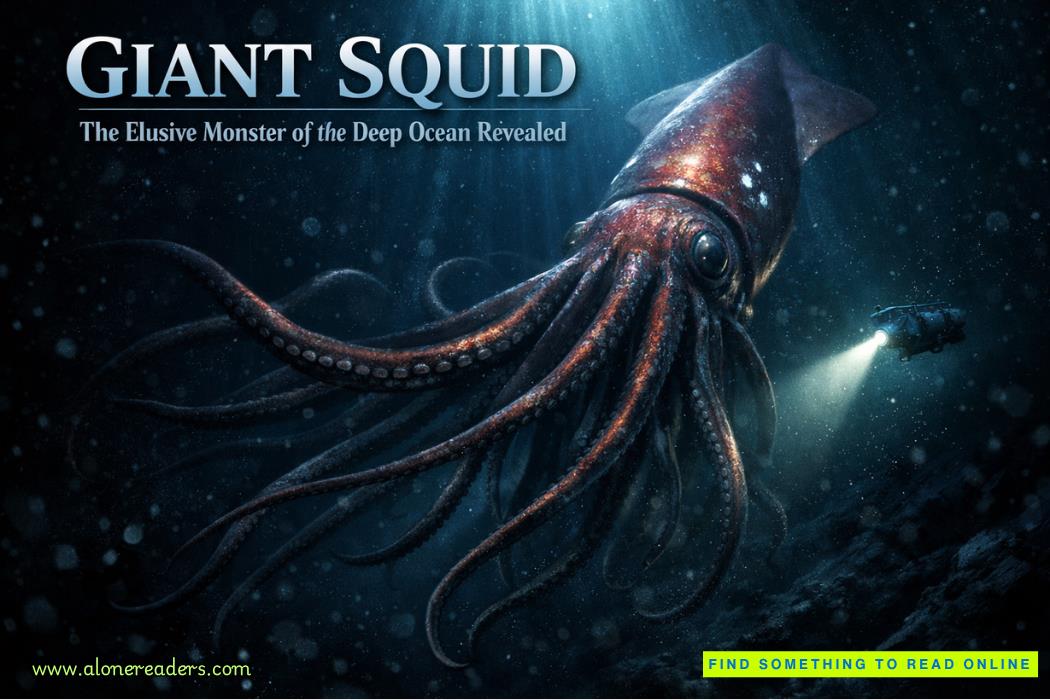
The giant squid has long occupied a peculiar space between myth and science, a creature once relegated to the margins of sailors’ tales and maritime folklore, yet now recognized as a legitimate, though still poorly understood, inhabitant of the deep ocean. Known scientifically as Architeuthis dux, this species represents one of the most extreme adaptations to life in the abyss, where light is scarce, pressure is immense, and survival depends on highly specialized biological mechanisms. Despite centuries of speculation, only in recent decades has the giant squid begun to emerge from obscurity, thanks to advances in deep-sea exploration and imaging technologies.
The morphology of the giant squid is both striking and functionally sophisticated. Individuals can reach lengths exceeding 10 meters, with some estimates suggesting even larger sizes in exceptional cases. The body is composed of a muscular mantle, which houses vital organs and enables jet propulsion, and eight arms accompanied by two elongated feeding tentacles. These tentacles are equipped with powerful suction cups lined with serrated chitinous rings, allowing the squid to secure prey with remarkable efficiency. The beak, hidden at the center of the arms, is one of the most formidable structures in the animal kingdom, capable of slicing through tough flesh with ease.
One of the most fascinating aspects of the giant squid is its eye structure. Possessing the largest eyes of any known animal, often exceeding 25 centimeters in diameter, these organs are highly adapted for detecting minimal light in the deep ocean. The evolutionary advantage of such large eyes lies in their ability to perceive faint bioluminescent signals and the subtle movements of predators or prey. In particular, these eyes are thought to be crucial for detecting the presence of large predators such as sperm whales, which are among the few known natural enemies of the giant squid.
The habitat of the giant squid is primarily within the mesopelagic and bathypelagic zones of the ocean, typically ranging from depths of 300 to over 1,000 meters. These zones are characterized by near-total darkness, low temperatures, and immense hydrostatic pressure. The squid’s physiology is finely tuned to these conditions, with a buoyancy system that allows it to maintain neutral buoyancy without expending excessive energy. Its tissues are relatively soft and gelatinous, reducing the risk of damage under high pressure while also minimizing metabolic demands.
Feeding behavior in giant squids remains one of the least directly observed aspects of their biology, but indirect evidence provides compelling insights. It is believed that they are ambush predators, using their long tentacles to capture prey such as deep-sea fish and smaller cephalopods. Once captured, the prey is drawn toward the arms and positioned for consumption by the beak. The presence of sucker scars on the skin of sperm whales has provided additional confirmation of interactions between these species, suggesting that giant squids are not only predators but also prey in a dynamic deep-sea ecosystem.
Reproductive biology in giant squids is similarly enigmatic. Males are known to produce spermatophores, which are transferred to females during mating, often embedding into the female’s tissue. Unlike many shallow-water cephalopods, which exhibit relatively short lifespans and rapid reproductive cycles, the life history of the giant squid is less well understood, though it is believed to follow a similar pattern of rapid growth and a single reproductive event before death. The scarcity of observed specimens, particularly of mature individuals, has made it difficult to construct a complete picture of their reproductive strategies.
The rarity of direct sightings has historically contributed to the mystique surrounding giant squids. For centuries, knowledge of these creatures was derived primarily from carcasses washed ashore or found in the stomachs of whales. The first confirmed photographs of a live giant squid in its natural habitat were not obtained until 2004, marking a significant milestone in marine biology. Subsequent video footage, captured using deep-sea submersibles and remote-operated vehicles, has provided unprecedented insights into the behavior and appearance of these animals in their native environment.
Technological advancements have been instrumental in these discoveries. High-sensitivity cameras, specialized bait systems, and deep-sea exploration platforms have enabled researchers to venture into previously inaccessible regions of the ocean. These tools have revealed that giant squids are not the aggressive monsters once imagined, but rather cautious and deliberate organisms, often retreating when confronted with unfamiliar stimuli. This behavioral pattern aligns with the broader characteristics of deep-sea fauna, where energy conservation and risk avoidance are critical for survival.
The ecological role of the giant squid extends beyond its interactions with predators and prey. As a mid-to-upper-level predator within the deep-sea food web, it contributes to the regulation of species populations and the transfer of energy through the ecosystem. Its interactions with sperm whales, in particular, represent a significant link between different trophic levels, illustrating the interconnectedness of marine life across vast depths. The study of such relationships provides valuable insights into the functioning of deep-sea ecosystems, which remain among the least understood environments on Earth.
From a physiological perspective, the giant squid exhibits several adaptations that are of particular interest to scientists. Its nervous system, while complex, is optimized for rapid response and coordination, enabling precise control of its tentacles during hunting. The presence of chromatophores, specialized pigment cells in the skin, allows for subtle changes in coloration, which may play a role in communication or camouflage, although this function is less pronounced than in some other cephalopods. Additionally, the squid’s circulatory system is adapted to operate efficiently under low oxygen conditions, a necessity in the deep ocean.
The cultural significance of the giant squid cannot be overlooked. Historically, it has inspired myths of sea monsters such as the Kraken, a legendary creature said to drag entire ships beneath the waves. These stories, while exaggerated, were likely rooted in real encounters with large squids, amplified by the limited scientific understanding of the time. Today, the giant squid continues to captivate the public imagination, serving as a symbol of the unknown and the enduring mysteries of the ocean.
Despite recent advances, many questions about the giant squid remain unanswered. Key aspects such as population size, distribution patterns, and detailed behavioral traits are still subjects of ongoing research. The challenges associated with studying such a remote and elusive species are considerable, requiring not only advanced technology but also sustained investment and interdisciplinary collaboration. As exploration of the deep ocean continues to expand, it is likely that new discoveries will further illuminate the life and ecology of this remarkable organism.
The giant squid stands as a testament to the complexity and diversity of life in extreme environments. Its existence challenges conventional notions of biological limits, demonstrating how evolution can produce highly specialized forms capable of thriving under conditions that would be inhospitable to most other organisms. In many ways, it represents a frontier of scientific inquiry, a reminder that vast portions of our planet remain largely unexplored and that even in the modern age, there are still creatures that defy easy explanation.
In conclusion, the giant squid is not merely a curiosity of the deep sea, but a critical component of marine biodiversity and a subject of significant scientific interest. Its unique adaptations, ecological role, and historical significance combine to make it one of the most compelling organisms in the natural world. As research continues to advance, the giant squid will undoubtedly yield further insights into the hidden dynamics of the ocean’s depths, reinforcing its status as one of the most elusive and fascinating creatures ever discovered.



 Château de Vincennes: France’s Forgotten Royal Fortress and Medieval Stronghold
 Château de Carcassonne: Europe’s Greatest Medieval Citadel and Fortress
 Château de Chenonceau: The Castle Built by Remarkable Women
 Château de Chambord: France’s Magnificent Renaissance Castle and Architectural Wonder
 Tehri Dam: India's Tallest Dam and the Debate Behind It
 Bhakra Nangal Dam: India's Temple of Modern Development










