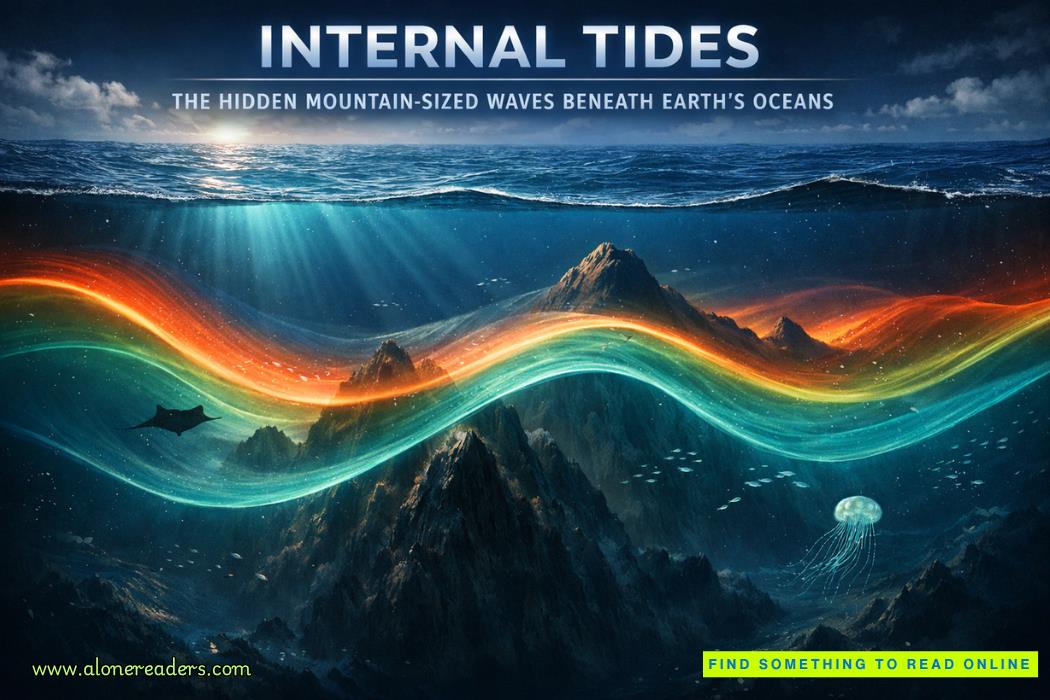
The ocean surface often appears deceptively calm, its waves governed by wind, storms, and tides visible to the human eye. Yet far below, in the stratified interior of the ocean, exists a vastly more powerful and complex system of motion—internal tides. These are not surface undulations but subsurface waves of extraordinary scale, sometimes reaching heights comparable to mountain ranges. Unlike surface waves, which travel along the interface between water and air, internal tides propagate along boundaries between layers of different densities, primarily shaped by variations in temperature and salinity.
At the core of this phenomenon lies the concept of density stratification. Ocean water is not uniform; it is layered. Warmer, less dense water tends to sit above colder, denser water, forming a vertical structure that resists mixing. This layered structure creates interfaces—most prominently the thermocline—where internal waves can propagate. When tidal forces, driven by the gravitational pull of the Moon and the Sun, interact with underwater topography such as ridges, continental slopes, and seamounts, they disturb these density layers. The result is the generation of internal tides: oscillations that can span hundreds of kilometers horizontally and rise hundreds of meters vertically.
What makes internal tides particularly fascinating is their scale relative to their invisibility. While surface waves rarely exceed tens of meters in height under normal conditions, internal waves can reach amplitudes exceeding 100 meters, and in some regions, even approach 300 meters. These waves are effectively hidden giants, moving vast volumes of water without leaving obvious traces at the surface. Their presence is often only detectable through sophisticated instruments or satellite measurements that capture subtle changes in sea surface height caused by subsurface dynamics.
The energy driving internal tides is immense. When tidal currents flow over underwater features, they generate oscillations that convert kinetic energy into wave energy within the stratified layers. This energy does not remain localized. Instead, internal tides can propagate across entire ocean basins, carrying energy thousands of kilometers from their origin. This redistribution of energy plays a crucial role in global ocean circulation, particularly in processes of vertical mixing. Without such mixing, the deep ocean would remain largely isolated from surface processes, leading to stagnation and reduced nutrient cycling.
The physics of internal wave propagation reveals a fundamentally different behavior compared to surface waves. Internal waves move more slowly because the restoring force—buoyancy—is weaker than gravity acting on surface waves. However, this slower movement allows for greater vertical displacement. As these waves travel, they can interact with other oceanic processes, including currents, eddies, and even atmospheric forcing. When internal tides encounter continental shelves or shallow regions, they often steepen and break, much like surface waves crashing on a shoreline. This breaking process is a major mechanism for dissipating energy and enhancing mixing between layers.
One of the most critical implications of internal tides is their role in thermohaline circulation, the large-scale movement of ocean water driven by density gradients. This circulation is a key component of Earth’s climate system, regulating heat distribution across the planet. Internal tides contribute to the vertical mixing necessary to maintain this circulation. Without sufficient mixing, the deep ocean would not receive the energy needed to sustain upward movement of cold, dense water, potentially disrupting global climate patterns.
Internal tides also influence biological productivity. Nutrients in the ocean are often concentrated in deeper waters, below the reach of sunlight. Through the mixing induced by internal wave breaking, these nutrients can be transported upward into the photic zone, where they support the growth of phytoplankton. This process forms the foundation of marine food webs, ultimately sustaining fisheries and marine biodiversity. In regions where internal tides are particularly strong—such as near island chains or steep continental slopes—enhanced productivity is often observed.
The interaction between internal tides and underwater topography creates localized hotspots of activity. For example, when internal waves encounter steep slopes, they can generate turbulent mixing zones that significantly alter local ocean conditions. These zones are of particular interest to oceanographers because they represent areas where energy dissipation is concentrated. Understanding these processes is essential for improving ocean models, which are used to predict climate change, sea level rise, and ecosystem dynamics.
Advancements in observational technology have transformed our understanding of internal tides. Satellite altimetry, for instance, can detect minute variations in sea surface height that correspond to internal wave activity below. Autonomous underwater vehicles and moored instruments provide detailed measurements of temperature, salinity, and velocity, allowing scientists to map the structure and movement of internal tides with increasing precision. These tools have revealed that internal tides are not uniform; they vary in intensity and structure depending on location, season, and ocean conditions.
Despite significant progress, many aspects of internal tides remain poorly understood. One of the challenges lies in accurately representing these processes in numerical models. The complexity of ocean stratification, combined with the variability of topographic features, makes it difficult to simulate internal wave generation and propagation at a global scale. Yet, improving these models is crucial, particularly in the context of climate projections. Internal tides influence how heat and carbon are distributed within the ocean, directly affecting predictions of future climate scenarios.
Another intriguing dimension of internal tides is their interaction with human activities. Submarine navigation, offshore engineering, and undersea communication systems can all be affected by the presence of strong internal waves. These waves can create significant vertical displacements and currents, posing challenges for underwater operations. In some cases, internal waves have been observed to impact drilling platforms and pipelines, highlighting the need for better monitoring and prediction.
From a broader perspective, internal tides exemplify the hidden complexity of Earth’s natural systems. They operate on scales that are both vast and subtle, influencing processes that range from microscopic nutrient transport to global climate regulation. Their study requires an interdisciplinary approach, combining physics, oceanography, geology, and biology. As research continues, it is becoming increasingly clear that internal tides are not merely a curiosity of ocean dynamics but a fundamental component of the Earth system.
The concept of “mountain-sized waves beneath the surface” is not an exaggeration but a precise description of these phenomena. Unlike mountains, however, internal tides are dynamic, constantly evolving structures that move through the ocean’s interior. They are shaped by the interplay of gravitational forces, fluid dynamics, and the intricate layering of seawater. Their presence challenges our intuitive understanding of the ocean, reminding us that what lies beneath the surface is often far more complex than what we can see.
In the context of climate change, the importance of internal tides is likely to grow. As ocean temperatures rise and stratification patterns shift, the behavior of internal waves may change, potentially altering mixing processes and energy distribution. This could have cascading effects on ocean circulation, weather patterns, and marine ecosystems. Understanding these changes is essential for developing accurate predictions and effective mitigation strategies.
Ultimately, internal tides represent a hidden engine of the ocean, driving processes that sustain life and regulate the planet’s climate. They are a testament to the complexity and interconnectedness of natural systems, where unseen forces can have profound and far-reaching impacts. By continuing to explore and understand these underwater giants, we gain not only scientific insight but also a deeper appreciation of the dynamic world beneath the ocean’s surface.



 Château de Vincennes: France’s Forgotten Royal Fortress and Medieval Stronghold
 Château de Carcassonne: Europe’s Greatest Medieval Citadel and Fortress
 Château de Chenonceau: The Castle Built by Remarkable Women
 Château de Chambord: France’s Magnificent Renaissance Castle and Architectural Wonder
 Tehri Dam: India's Tallest Dam and the Debate Behind It
 Bhakra Nangal Dam: India's Temple of Modern Development