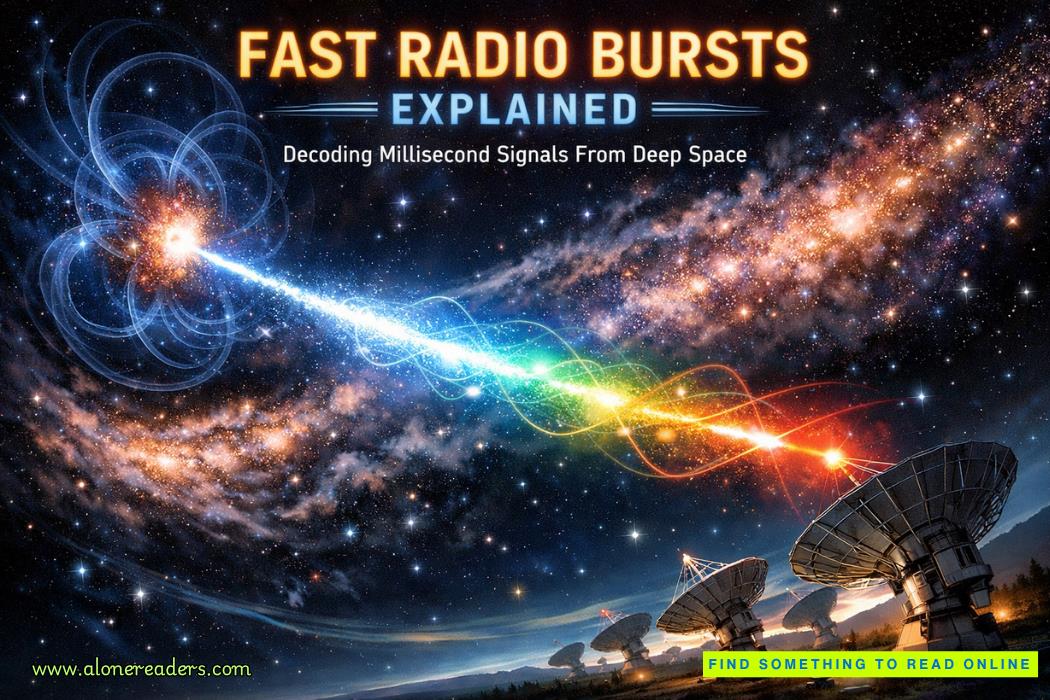
Fast Radio Bursts (FRBs) represent one of the most intriguing and technically challenging phenomena in modern astrophysics. These are extremely brief, high-energy pulses of radio waves that originate far beyond our galaxy and last only a few milliseconds. Despite their fleeting nature, they release an astonishing amount of energy—equivalent to what the Sun emits over several days or even weeks—compressed into a moment shorter than the blink of an eye.
What makes FRBs particularly compelling is not just their intensity, but their unpredictability and diversity. Since their discovery in 2007, the field has evolved rapidly, transitioning from speculative curiosity to a structured domain of observational cosmology and plasma astrophysics. Yet, even today, they remain only partially understood, sitting at the intersection of extreme physics, intergalactic medium studies, and transient astronomy.
The defining characteristic of an FRB is its dispersion signature. As radio waves travel through space, they pass through ionized plasma—primarily free electrons—that slows down lower-frequency components more than higher-frequency ones. This causes the signal to arrive at Earth with a characteristic “sweep” from high to low frequencies. By measuring this dispersion, astronomers can infer the amount of matter the signal has traversed, effectively turning FRBs into probes of the otherwise invisible baryonic matter distributed across the universe.
The detection of FRBs requires highly sensitive radio telescopes with wide fields of view and rapid time resolution. Instruments such as the Canadian Hydrogen Intensity Mapping Experiment (CHIME) have revolutionized the field by enabling continuous monitoring of large portions of the sky. Unlike traditional telescopes that focus on narrow regions, CHIME uses a transit design, allowing it to capture transient events like FRBs as they pass overhead. Its high detection rate has dramatically increased the known population of FRBs, transforming statistical analysis from speculative to empirical.
One of the early mysteries surrounding FRBs was whether they were singular cataclysmic events or recurring phenomena. This question was partially answered with the discovery of repeating FRBs, such as those detected from a source cataloged as FRB 121102. This object, located in a distant dwarf galaxy, produces multiple bursts over time, ruling out one-time catastrophic origins like supernova explosions for at least some FRBs. Instead, repeating sources point toward persistent, highly energetic astrophysical engines.
Among the leading candidates for FRB progenitors are magnetars—neutron stars with extraordinarily strong magnetic fields, often exceeding 10¹⁴ gauss. These objects are capable of producing intense bursts of electromagnetic radiation through mechanisms such as magnetic reconnection or crustal starquakes. The connection between magnetars and FRBs gained strong support when a burst detected from within our own galaxy was traced back to a known magnetar, SGR 1935+2154. Although this galactic event was less energetic than extragalactic FRBs, it exhibited similar temporal and spectral characteristics, suggesting a common underlying mechanism.
However, magnetars do not explain all observed FRB properties. The diversity in burst duration, frequency structure, polarization, and repetition patterns indicates that there may be multiple classes of FRB sources or different emission mechanisms operating under varying physical conditions. Some FRBs exhibit complex substructures within a single burst, including microsecond-scale spikes and drifting frequency patterns, implying highly dynamic emission regions and possibly relativistic plasma effects.
Polarization measurements have added another layer of complexity. Many FRBs show strong linear polarization, and some exhibit extremely high rotation measures—indicating that their signals have passed through regions with intense magnetic fields. This suggests that at least some FRBs originate in environments such as the vicinity of massive black holes or within dense supernova remnants. The interaction between the emitted radio waves and the surrounding medium encodes valuable information about the magnetic and plasma conditions near the source.
Localization of FRBs has been a major technical challenge due to their transient nature. Early detections lacked precise positional information, making it difficult to associate bursts with host galaxies. Advances in interferometric arrays, such as the Australian Square Kilometre Array Pathfinder (ASKAP), have enabled real-time localization with arcsecond precision. This has allowed astronomers to identify host galaxies and measure redshifts, confirming that FRBs originate at cosmological distances.
These host galaxy identifications have revealed a surprising diversity. Some FRBs come from star-forming dwarf galaxies, while others are associated with massive, more evolved galaxies. This diversity reinforces the idea that FRBs are not produced by a single type of astrophysical object or environment. Instead, they may represent a broader class of high-energy transient phenomena unified by similar emission processes.
From a cosmological perspective, FRBs have emerged as powerful tools for studying the large-scale structure of the universe. One of the longstanding problems in astrophysics is the “missing baryon problem”—the discrepancy between the amount of normal matter predicted by cosmological models and what is observed directly. FRBs offer a solution by acting as probes of the intergalactic medium. By analyzing the dispersion measures of multiple FRBs across different lines of sight, scientists can map the distribution of ionized gas between galaxies, effectively accounting for the missing baryons.
Another promising application lies in measuring cosmic expansion. Since FRBs can be detected at vast distances and their dispersion correlates with distance, they have the potential to serve as independent cosmological distance indicators. While not yet as refined as Type Ia supernovae or cosmic microwave background measurements, FRBs could complement existing methods and improve constraints on parameters such as the Hubble constant.
The temporal resolution required to study FRBs has also driven advancements in signal processing and data analysis. Detecting a millisecond-scale burst within massive streams of radio data involves sophisticated algorithms capable of distinguishing genuine astrophysical signals from terrestrial interference. Machine learning techniques are increasingly being employed to classify and identify FRB candidates in real time, reducing false positives and improving detection efficiency.
Despite the progress, several key questions remain unresolved. The exact emission mechanism—how coherent radio waves are generated with such intensity—remains a subject of active research. Proposed models include synchrotron maser emission from relativistic shocks, plasma lensing effects, and magnetospheric processes within neutron stars. Each model accounts for certain observational features but fails to fully explain the entire range of FRB behavior.
Additionally, the role of the local environment around the source is not fully understood. Some FRBs show evidence of scattering and scintillation, indicating interaction with turbulent plasma. Others appear relatively clean, suggesting propagation through less dense regions. Understanding these propagation effects is crucial for accurately interpreting the intrinsic properties of the bursts.
The field is also moving toward multi-wavelength and multi-messenger observations. Coordinated campaigns aim to detect counterparts to FRBs in X-ray, optical, or gamma-ray bands. While most FRBs have not shown clear counterparts outside the radio spectrum, any confirmed multi-wavelength association would provide critical constraints on emission models and source environments.
Looking forward, next-generation observatories such as the Square Kilometre Array (SKA) are expected to transform FRB research. With unprecedented sensitivity and resolution, the SKA will detect thousands of FRBs, enabling detailed population studies and high-precision cosmological measurements. This will likely shift the field from discovery-driven exploration to precision astrophysics.
In essence, Fast Radio Bursts have evolved from enigmatic anomalies into indispensable tools for probing the universe. They encapsulate extreme physics, from the behavior of matter under intense magnetic fields to the distribution of baryons across cosmic scales. Their study requires an interdisciplinary approach, combining observational astronomy, theoretical modeling, plasma physics, and advanced data analytics.
As detection rates increase and observational techniques improve, the expectation is not just to solve the mystery of FRBs, but to leverage them as a new class of astrophysical instruments. They are no longer just signals to be decoded—they are messengers carrying encoded information about the universe’s most extreme environments and its vast, largely invisible structure.



 Château de Vincennes: France’s Forgotten Royal Fortress and Medieval Stronghold
 Château de Carcassonne: Europe’s Greatest Medieval Citadel and Fortress
 Château de Chenonceau: The Castle Built by Remarkable Women
 Château de Chambord: France’s Magnificent Renaissance Castle and Architectural Wonder
 Tehri Dam: India's Tallest Dam and the Debate Behind It
 Bhakra Nangal Dam: India's Temple of Modern Development