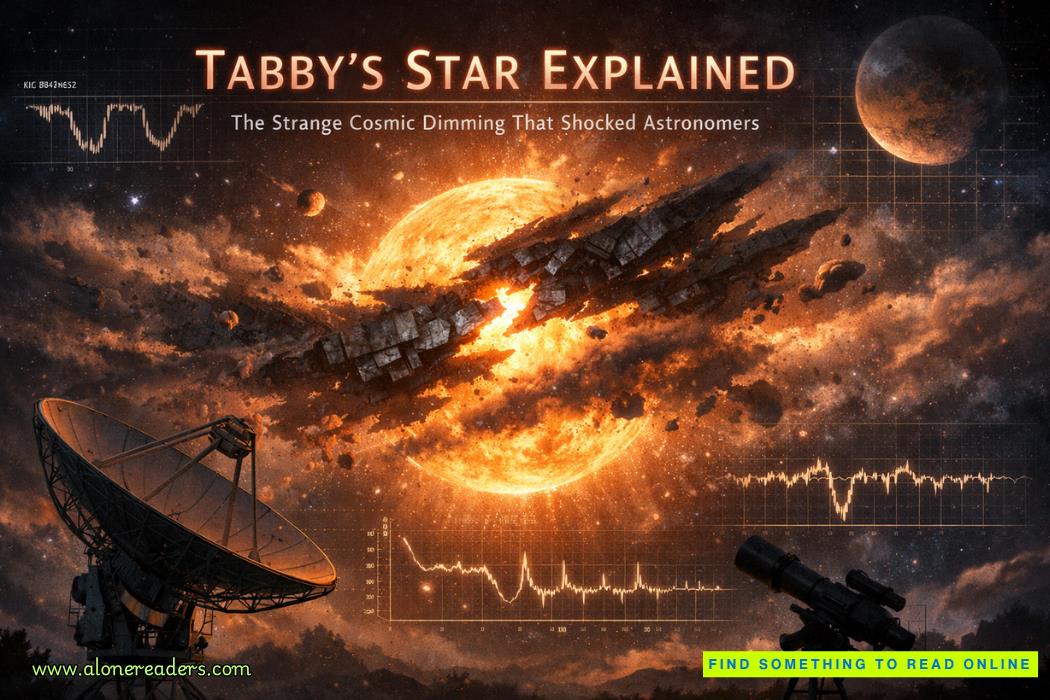
The story of Tabby's Star represents one of the most unusual and intellectually provocative mysteries in modern astrophysics. Unlike typical stellar variability, which follows predictable physical mechanisms, this star exhibits erratic, deep, and aperiodic dips in brightness that defy conventional explanations. For a field grounded in repeatable observations and well-tested models, Tabby’s Star became an anomaly that forced astronomers to reconsider the limits of known stellar behavior.
Located approximately 1,470 light-years away in the constellation Cygnus, the star is formally cataloged as KIC 8462852. It came to prominence through data collected by NASA’s Kepler Space Telescope, a mission designed to detect exoplanets via the transit method. This method relies on observing periodic, shallow dips in a star’s brightness as planets pass in front of it. However, what Kepler detected in this case was entirely different.
Instead of regular, symmetrical dips, the light curve of KIC 8462852 displayed irregular and sometimes extreme reductions in brightness—up to 22 percent in certain events. To put that into context, a Jupiter-sized planet transiting a Sun-like star typically causes a dip of about 1 percent. The magnitude and irregularity of these dips immediately signaled that something far more complex was occurring.
The discovery was first highlighted by Tabetha S. Boyajian and her colleagues in 2015. As a result, the star quickly earned the nickname “Tabby’s Star.” The initial analysis ruled out many standard astrophysical explanations. Stellar pulsations, starspots, and binary companions could not account for the observed light curve. The absence of periodicity was particularly problematic, as most known dimming phenomena repeat over consistent intervals.
One of the earliest hypotheses proposed that a swarm of cometary fragments could be responsible. In this model, a large family of comets—possibly disrupted by gravitational interactions—would pass in front of the star, creating irregular and asymmetric dips. While this explanation was physically plausible, it required an extraordinarily large number of comets, far exceeding what is typically observed in stellar systems. Moreover, such a scenario would likely produce detectable infrared emissions from dust heated by the star, yet early observations did not show the expected thermal signature.
As the scientific community grappled with the data, a more speculative idea captured public imagination: the possibility of an alien megastructure. This concept, often associated with the theoretical construct known as a Dyson sphere, involves an advanced civilization building massive structures to harvest stellar energy. While this idea was never the leading scientific explanation, it gained attention due to the unusual characteristics of the dimming events.
Importantly, the alien megastructure hypothesis was approached with skepticism by the scientific community. It served more as a reminder of how incomplete the initial understanding was rather than a serious conclusion. Scientists emphasized that extraordinary claims require extraordinary evidence, and at that stage, no such evidence existed.
Subsequent observations shifted the focus toward more conventional, though still complex, explanations. Multi-wavelength studies revealed that the dimming of Tabby’s Star is wavelength-dependent—meaning the star dims differently across various parts of the electromagnetic spectrum. This finding is critical because solid objects, such as planets or megastructures, would block light uniformly across wavelengths. In contrast, fine dust particles scatter shorter wavelengths more effectively, producing a color-dependent dimming pattern.
This evidence strongly supported the hypothesis that circumstellar dust is the primary cause of the observed behavior. However, even this explanation is not straightforward. The dust must be distributed in a highly irregular and dynamic configuration to produce the observed light curve. Additionally, the lack of significant infrared excess suggests that the dust is either transient, very fine, or located in specific geometrical arrangements that minimize thermal emission.
Another layer of complexity arises from long-term observations. Historical data from photographic plates indicate that the star may have experienced a gradual dimming over decades, in addition to the short-term dips observed by Kepler. This combination of short-term variability and long-term trends is unusual and suggests that multiple mechanisms may be at play.
One proposed model involves a combination of dust clouds generated by collisions within a debris disk. In this scenario, large bodies—such as planetesimals or asteroid-like objects—collide, producing clouds of fine dust that intermittently obscure the star. These clouds could disperse over time, accounting for both the irregular dips and the apparent long-term dimming.
Another possibility is that the dust originates from material being stripped from a large object, such as a disintegrating exoplanet. Similar phenomena have been observed in other systems, though not at the same scale or complexity as Tabby’s Star. If such an object exists in the system, it could produce a continuous supply of dust, maintaining the observed variability.
The role of interstellar dust has also been considered. In this model, clouds of dust located between Earth and the star could be responsible for the dimming. However, this explanation faces challenges in accounting for the specific patterns and timescales observed. Interstellar dust typically produces more uniform and stable attenuation, rather than the highly irregular dips seen in Tabby’s Star.
From an observational standpoint, Tabby’s Star has become a focal point for coordinated, multi-instrument campaigns. Ground-based telescopes, space observatories, and even amateur astronomers have contributed to monitoring its brightness. This level of collaboration is relatively rare and highlights the scientific importance of the phenomenon.
One notable aspect of the research effort is the use of real-time monitoring to capture dimming events as they occur. This allows astronomers to rapidly deploy spectroscopic and photometric instruments to gather detailed data during dips. Such observations are crucial for distinguishing between competing models, as different mechanisms produce distinct spectral signatures.
The case of Tabby’s Star also underscores the importance of large-scale data analysis in modern astronomy. The anomaly was initially identified through citizen science initiatives, where volunteers examined light curves from the Kepler mission. This demonstrates how human pattern recognition, combined with automated algorithms, can uncover phenomena that might otherwise be overlooked.
From a theoretical perspective, Tabby’s Star challenges existing models of stellar environments. It raises questions about the formation and evolution of debris disks, the dynamics of dust clouds, and the interactions between stellar radiation and circumstellar material. These are not trivial issues; they touch on fundamental processes that shape planetary systems.
The broader implication is that the universe may contain a wider diversity of astrophysical phenomena than previously assumed. Tabby’s Star is a reminder that even well-studied observational techniques can yield unexpected results when applied at scale. It also highlights the limitations of current models, which are often based on a relatively small sample of well-understood systems.
Despite years of study, Tabby’s Star remains only partially understood. The prevailing consensus favors dust-based explanations, but the exact origin, composition, and dynamics of that dust are still under investigation. This uncertainty is not a weakness of science but rather a reflection of its iterative nature. Each new observation refines the models, gradually converging on a more complete understanding.
In practical terms, the study of Tabby’s Star has driven advancements in observational techniques, data analysis methods, and theoretical modeling. It has also fostered interdisciplinary collaboration, bringing together experts in stellar astrophysics, planetary science, and even materials science to address the problem from multiple angles.
Ultimately, Tabby’s Star stands as a compelling example of how a single anomaly can reshape scientific inquiry. It demonstrates that the frontier of knowledge is not defined by what is known, but by what remains unexplained. In that sense, the true significance of Tabby’s Star lies not only in its mysterious dimming, but in its ability to challenge assumptions and inspire deeper exploration of the cosmos.



 Château de Vincennes: France’s Forgotten Royal Fortress and Medieval Stronghold
 Château de Carcassonne: Europe’s Greatest Medieval Citadel and Fortress
 Château de Chenonceau: The Castle Built by Remarkable Women
 Château de Chambord: France’s Magnificent Renaissance Castle and Architectural Wonder
 Tehri Dam: India's Tallest Dam and the Debate Behind It
 Bhakra Nangal Dam: India's Temple of Modern Development