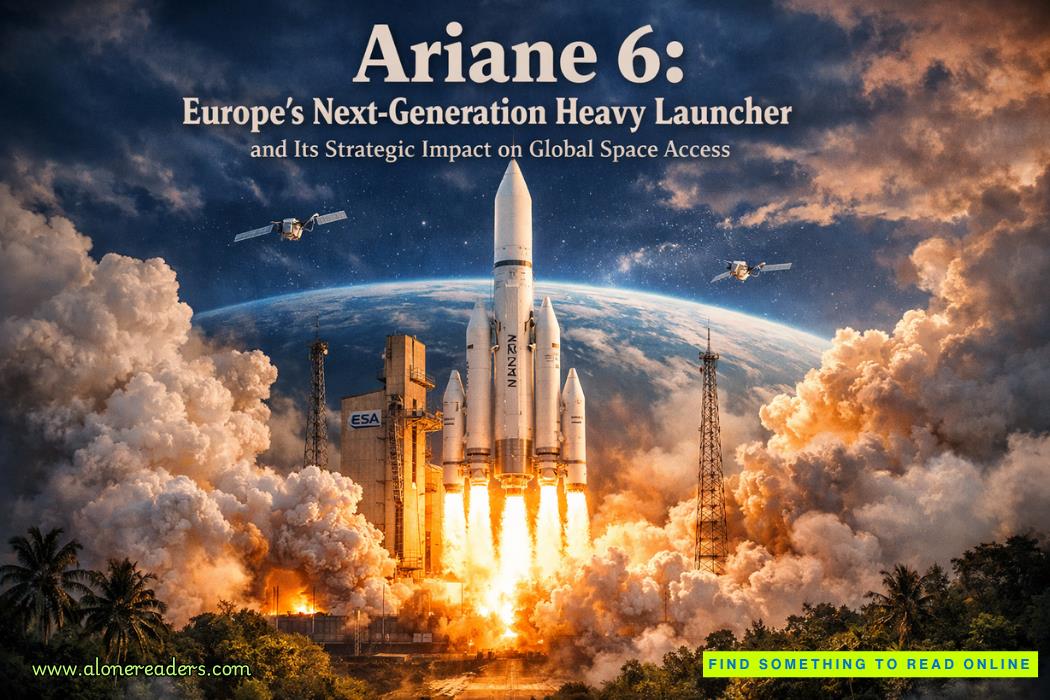
The development of Ariane 6 represents a critical inflection point in Europe’s space strategy, marking a deliberate shift from legacy heavy-lift paradigms toward a modular, cost-optimized launch architecture. Designed under the stewardship of the European Space Agency (ESA) and industrial prime contractors led by ArianeGroup, Ariane 6 is not merely a successor to Ariane 5—it is a structural response to the transformed economics and competitive dynamics of the global launch market.
Ariane 5, long regarded as one of the most reliable heavy launchers in history, operated within a paradigm of dual-satellite geostationary missions and relatively high launch costs justified by reliability and payload mass. However, the rise of commercial competitors offering significantly reduced launch prices, alongside a diversification of payload profiles—including mega-constellations, institutional missions, and flexible deployment architectures—necessitated a rethinking of Europe’s launch capabilities. Ariane 6 is the outcome of that rethinking.
At its core, Ariane 6 introduces a modular design philosophy that enables mission-specific configuration without requiring entirely different launch vehicles. This is achieved through two primary variants: Ariane 62 and Ariane 64. The Ariane 62 configuration uses two solid rocket boosters, while Ariane 64 employs four, effectively scaling thrust and payload capacity depending on mission requirements. This modularity is central to optimizing both performance and cost-efficiency, allowing operators to avoid over-provisioning launch capacity for smaller payloads.
The first stage of Ariane 6 is powered by the Vulcain 2.1 engine, an evolution of the Vulcain 2 used in Ariane 5. While retaining the hydrogen-oxygen propulsion architecture, Vulcain 2.1 incorporates simplifications aimed at reducing manufacturing complexity and cost. These include fewer components and streamlined production processes, reflecting a broader industrial strategy focused on serial production rather than bespoke manufacturing.
Complementing the core stage is the upper stage powered by the Vinci engine, a key technological advancement. Vinci introduces reignition capability, a feature absent in Ariane 5’s upper stage. This allows Ariane 6 to perform complex orbital insertions, deploy multiple payloads into different orbits within a single mission, and execute precise mission profiles required for modern satellite constellations and interplanetary missions. The reignitable upper stage significantly enhances mission flexibility and aligns Ariane 6 with contemporary operational demands.
Another defining element of Ariane 6 is its reliance on solid rocket boosters (P120C), which are shared with the Vega-C launcher. This cross-program standardization is a strategic industrial decision aimed at reducing unit costs through economies of scale. By using the same booster design across multiple launch systems, Europe effectively consolidates its production base, lowers per-unit manufacturing costs, and simplifies logistics.
From a performance standpoint, Ariane 6 is designed to deliver payloads across a wide spectrum of mission profiles. In its Ariane 64 configuration, it can place approximately 11.5 tonnes into geostationary transfer orbit (GTO), while Ariane 62 is optimized for medium-lift missions, including institutional payloads and constellation deployments. The vehicle also supports low Earth orbit (LEO), medium Earth orbit (MEO), and escape trajectories, making it a versatile platform for both commercial and governmental missions.
Cost reduction is one of the central design drivers behind Ariane 6. Unlike Ariane 5, which was developed in an era with less commercial competition, Ariane 6 is engineered to operate within a price-sensitive market dominated by aggressive pricing strategies. This is achieved through a combination of industrial streamlining, modular architecture, and reduced operational complexity at the launch site. The integration process has been redesigned to minimize assembly time and increase launch cadence, enabling a higher frequency of launches per year.
The launch infrastructure itself, located at the Guiana Space Centre in French Guiana, has been adapted to support Ariane 6’s operational model. The new launch complex (ELA-4) is optimized for horizontal integration of certain components and rapid rollout to the launch pad. This approach contrasts with the more time-intensive vertical integration processes used in previous systems and contributes to overall cost and schedule efficiency.
Strategically, Ariane 6 is central to Europe’s objective of maintaining independent access to space. In an environment where geopolitical considerations increasingly intersect with space operations, reliance on foreign launch providers introduces both economic and security vulnerabilities. Ariane 6 ensures that European governments, institutions, and commercial operators retain autonomous launch capabilities, particularly for sensitive payloads such as navigation satellites, Earth observation systems, and defense-related missions.
However, Ariane 6 enters a market that has evolved dramatically since its initial conception. The emergence of partially reusable launch systems has redefined cost expectations and operational benchmarks. While Ariane 6 does not incorporate reusability in its baseline configuration, it represents a transitional architecture within Europe’s broader roadmap, which includes future initiatives focused on reusable technologies. In this context, Ariane 6 can be understood as a bridge between traditional expendable launch systems and next-generation reusable platforms.
The competitive landscape also includes increasing demand for small satellite launches and constellation deployments, which require high-frequency, cost-effective launch solutions. Ariane 6 addresses this through its ability to deploy multiple satellites in a single mission using advanced payload adapters and dispenser systems. This capability is particularly relevant for broadband constellations, Earth observation networks, and scientific missions requiring distributed architectures.
Operational flexibility is further enhanced by Ariane 6’s digital avionics and guidance systems. The onboard flight computer and software architecture are designed to support complex mission sequences, including multiple burns, precise orbital insertions, and adaptive trajectory control. This digital backbone is essential for executing modern mission profiles that demand high levels of precision and adaptability.
In terms of industrial organization, Ariane 6 reflects a shift toward a more commercially oriented governance model. The involvement of ArianeGroup and Arianespace introduces a stronger emphasis on market responsiveness, cost control, and customer-driven service offerings. This marks a departure from earlier models that were more heavily driven by institutional priorities, aligning Europe’s launch industry more closely with global commercial practices.
Environmental considerations also play a role in Ariane 6’s design and operations. While chemical propulsion inherently involves emissions, efforts have been made to optimize fuel efficiency and reduce environmental impact through improved engine performance and streamlined launch operations. Additionally, the use of liquid hydrogen and oxygen as propellants results in water vapor as the primary combustion byproduct, which is comparatively cleaner than hydrocarbon-based fuels.
Looking forward, Ariane 6 is expected to serve as the backbone of Europe’s launch capabilities for at least the next decade. Its success will depend not only on technical performance but also on its ability to compete economically and adapt to evolving market conditions. The integration of Ariane 6 into a broader ecosystem that includes smaller launchers, reusable technology demonstrators, and in-orbit services will be critical to maintaining Europe’s relevance in the global space economy.
In conclusion, Ariane 6 is not simply a new rocket—it is a strategic instrument designed to recalibrate Europe’s position in the space launch sector. By combining modularity, cost efficiency, and mission flexibility, it addresses the structural challenges posed by a rapidly changing industry while preserving Europe’s autonomy in space access. Its development reflects a pragmatic balance between innovation and continuity, positioning it as a foundational element in Europe’s transition toward a more competitive and sustainable space infrastructure.



 Château de Vincennes: France’s Forgotten Royal Fortress and Medieval Stronghold
 Château de Carcassonne: Europe’s Greatest Medieval Citadel and Fortress
 Château de Chenonceau: The Castle Built by Remarkable Women
 Château de Chambord: France’s Magnificent Renaissance Castle and Architectural Wonder
 Tehri Dam: India's Tallest Dam and the Debate Behind It
 Bhakra Nangal Dam: India's Temple of Modern Development