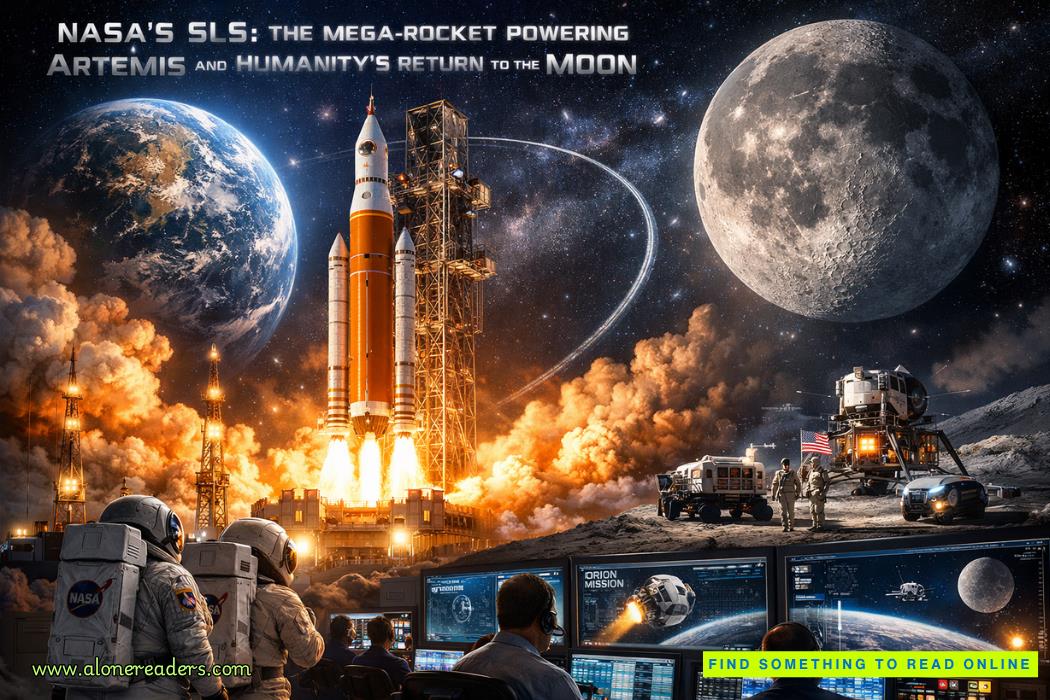
The modern era of human space exploration is defined not only by ambition but by the engineering systems capable of turning that ambition into reality. At the center of this effort stands the NASA Space Launch System (SLS), a super heavy-lift rocket designed to propel humanity beyond low Earth orbit and reestablish a sustained presence on the Moon under the Artemis program. Far more than just a launch vehicle, the SLS represents a convergence of legacy shuttle technologies, cutting-edge aerospace engineering, and long-term strategic planning aimed at deep-space exploration, including eventual missions to Mars.
The SLS is often described as the most powerful rocket ever built, and this claim is grounded in measurable engineering performance. In its initial Block 1 configuration, the rocket produces over 8.8 million pounds of thrust at liftoff, exceeding even the historic Saturn V that powered the Apollo missions. This immense thrust is generated through a combination of four RS-25 engines—repurposed and upgraded from the Space Shuttle program—and two solid rocket boosters derived from shuttle heritage but significantly enhanced for greater power and efficiency. This hybrid architecture allows SLS to leverage decades of proven technology while integrating modern advancements in materials, avionics, and propulsion control systems.
One of the defining characteristics of the SLS is its modular evolution strategy. Rather than designing a single static rocket, NASA engineered SLS as a family of configurations that can adapt to mission requirements. The Block 1 version, used for initial Artemis missions, is capable of delivering approximately 95 metric tons to low Earth orbit. Future upgrades, such as Block 1B and Block 2, will significantly increase payload capacity to over 130 metric tons, enabling more complex missions involving larger crewed spacecraft, lunar infrastructure components, and deep-space cargo.
Central to the SLS architecture is the core stage, a massive liquid hydrogen and liquid oxygen tank structure that feeds the RS-25 engines. This stage alone stands over 65 meters tall and is manufactured using advanced welding techniques, including friction stir welding, to ensure structural integrity under extreme thermal and mechanical stresses. The use of cryogenic propellants allows for higher efficiency compared to kerosene-based systems, albeit with increased engineering complexity in storage and handling.
Above the core stage sits the Interim Cryogenic Propulsion Stage (ICPS) in the Block 1 configuration. This upper stage plays a critical role in trans-lunar injection, providing the necessary velocity change to send payloads from Earth orbit toward the Moon. Future configurations will replace the ICPS with the Exploration Upper Stage (EUS), which will offer significantly greater performance and mission flexibility, including the ability to support co-manifested payloads alongside crewed missions.
Atop the SLS sits the Orion spacecraft, NASA’s next-generation crew vehicle designed for deep-space missions. Orion is engineered to support human life beyond low Earth orbit, incorporating advanced life support systems, radiation shielding, and reentry capabilities capable of withstanding the high velocities associated with lunar return trajectories. The integration of Orion with SLS forms a tightly coupled system optimized for deep-space exploration, where launch vehicle performance and spacecraft design must operate in precise coordination.
The Artemis program, which SLS is built to support, represents a strategic shift in how humanity approaches lunar exploration. Unlike the Apollo missions, which were primarily short-duration visits, Artemis aims to establish a sustainable human presence on and around the Moon. This includes the construction of the Lunar Gateway, a space station in lunar orbit, as well as surface habitats and infrastructure that will enable longer stays and more extensive scientific research. The SLS plays a critical logistical role in this architecture, delivering both crew and heavy cargo necessary to build and maintain this lunar ecosystem.
The first major test of the SLS came with Artemis I, an uncrewed mission that successfully demonstrated the rocket’s performance and the Orion spacecraft’s capabilities in a deep-space environment. This mission validated key systems, including propulsion, navigation, thermal protection, and communication, providing critical data for subsequent crewed missions. Artemis II is planned to carry astronauts on a lunar flyby, while Artemis III aims to land humans on the Moon for the first time since 1972, marking a historic milestone in space exploration.
From an engineering standpoint, one of the most complex challenges addressed by SLS is vibration and structural load management during ascent. The combination of solid rocket boosters and liquid engines creates a dynamic environment with significant acoustic and vibrational forces. Engineers have implemented advanced damping systems, structural reinforcements, and real-time monitoring to ensure vehicle stability and crew safety. Additionally, the rocket’s avionics system integrates sophisticated guidance, navigation, and control algorithms capable of adjusting trajectory in response to changing conditions during flight.
Another critical aspect of SLS design is its ground infrastructure. The rocket is assembled in the Vehicle Assembly Building (VAB) at Kennedy Space Center, one of the largest structures in the world by volume. Once assembled, it is transported to the launch pad atop a crawler-transporter, a massive tracked vehicle designed to carry the fully stacked rocket. The launch pad itself has been extensively modified to accommodate the unique requirements of SLS, including upgraded flame trenches, water suppression systems, and umbilical connections.
Despite its technical achievements, the SLS program has faced significant scrutiny regarding cost and development timelines. Critics argue that the rocket’s reliance on legacy shuttle components and traditional aerospace contracting models has resulted in higher costs compared to newer commercial launch systems. However, proponents emphasize that SLS is designed for missions that currently exceed the capabilities of commercial rockets, particularly in terms of payload mass and direct injection to deep-space trajectories. The debate reflects a broader tension within the space industry between government-led programs and rapidly evolving private-sector innovations.
When compared to emerging heavy-lift vehicles from commercial providers, SLS occupies a unique niche. While companies like SpaceX are developing reusable systems with potentially lower cost per launch, SLS prioritizes reliability, mission assurance, and maximum payload capacity for specific deep-space missions. This distinction is important when considering the requirements of crewed lunar missions, where redundancy, safety margins, and proven technologies are paramount.
Looking ahead, the role of SLS will extend beyond the Moon. As NASA and its international partners develop plans for Mars exploration, the need for a high-capacity, deep-space launch system becomes even more critical. SLS is expected to serve as a backbone for these missions, delivering large spacecraft components, habitats, and propulsion systems necessary for interplanetary travel. In this context, SLS is not merely a rocket but a foundational element of a long-term strategy for human expansion into the solar system.
The significance of SLS also lies in its symbolic value. It represents a continuation of human exploration beyond Earth, bridging the legacy of Apollo with the future ambitions of Mars missions. The Artemis program, powered by SLS, is not just about returning to the Moon; it is about establishing the technological, operational, and logistical frameworks required for sustained deep-space exploration. Each launch of SLS is therefore a step toward a future where humanity is no longer confined to a single planet.
In operational terms, the SLS introduces a new paradigm in mission planning. Its ability to deliver large payloads directly to lunar trajectories reduces the need for complex orbital assembly and multiple launches. This simplifies mission architecture and reduces potential points of failure, albeit at a higher per-launch cost. The trade-off between complexity and cost is a central consideration in modern space mission design, and SLS represents one approach to balancing these factors.
Ultimately, the Space Launch System embodies both the challenges and possibilities of contemporary space exploration. It is a product of decades of accumulated knowledge, shaped by lessons learned from past programs and driven by the ambition to push further into the cosmos. As Artemis missions progress and new milestones are achieved, the SLS will remain a central figure in humanity’s journey beyond Earth, enabling not just exploration but the establishment of a lasting presence in space.



 Château de Vincennes: France’s Forgotten Royal Fortress and Medieval Stronghold
 Château de Carcassonne: Europe’s Greatest Medieval Citadel and Fortress
 Château de Chenonceau: The Castle Built by Remarkable Women
 Château de Chambord: France’s Magnificent Renaissance Castle and Architectural Wonder
 Tehri Dam: India's Tallest Dam and the Debate Behind It
 Bhakra Nangal Dam: India's Temple of Modern Development










