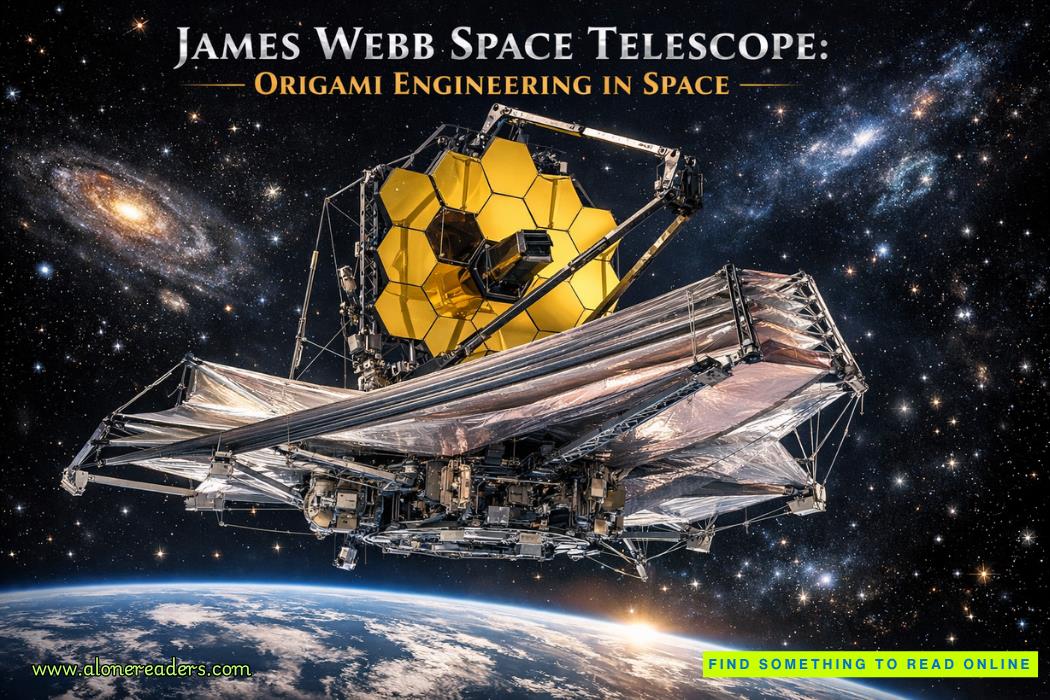
The James Webb Space Telescope represents one of the most sophisticated engineering achievements ever deployed beyond Earth, not merely because of its scientific instrumentation, but due to the extraordinary structural design principles that made its launch and deployment possible. At the core of this achievement lies a concept that appears deceptively simple yet is profoundly complex in execution: origami engineering. The telescope’s ability to fold into a compact configuration and then autonomously unfold in the vacuum of space is a direct application of advanced mechanical design inspired by folding principles, adapted for extreme conditions.
The fundamental constraint driving this innovation was the size limitation imposed by launch vehicles. The telescope’s primary mirror spans approximately 6.5 meters when fully deployed, a dimension far exceeding the payload fairing capacity of rockets such as the Ariane 5. This mismatch between required operational size and launch constraints necessitated a deployable architecture. Unlike terrestrial folding systems, however, space-based deployment must occur without human intervention, under zero gravity, and in an environment where mechanical failure cannot be repaired. Consequently, the design of JWST required an unprecedented level of precision, redundancy, and reliability.
At the heart of the origami concept is the segmentation of large structures into smaller, foldable components. The primary mirror of JWST consists of 18 hexagonal segments made of beryllium and coated with a thin layer of gold to optimize infrared reflectivity. These segments are arranged in a pattern that allows them to fold inward during launch, reducing the telescope’s footprint. Once in space, a carefully orchestrated deployment sequence extends the mirror wings outward, followed by fine alignment using actuators capable of nanometer-scale adjustments. This process is not merely mechanical unfolding but a transition from a compact stowed configuration to an optically precise instrument capable of capturing faint infrared signals from the early universe.
The sunshield represents an even more striking application of origami engineering. Composed of five layers of Kapton, each coated with reflective materials such as aluminum and silicon, the sunshield is designed to block heat and light from the Sun, Earth, and Moon. When fully deployed, it spans roughly the size of a tennis court, yet it must be folded tightly enough to fit within the rocket. The folding pattern is not arbitrary; it follows a highly calculated geometry that prevents tangling, minimizes stress concentrations, and ensures smooth deployment. Each layer is separated by vacuum gaps, enabling passive cooling to temperatures below 50 Kelvin, which is essential for infrared observations.
The deployment sequence of the sunshield is one of the most complex mechanical operations ever attempted in space. It involves hundreds of pulleys, cables, and release mechanisms that must operate in perfect synchronization. The process begins with the extension of telescoping booms that pull the folded layers outward. Subsequently, individual layers are tensioned sequentially, transforming the crumpled stack into a precisely spaced thermal barrier. This transformation exemplifies the principles of origami at scale, where folding patterns dictate not only compactness but also final structural integrity and functionality.
From an engineering perspective, the challenges extend beyond folding and unfolding. Materials must withstand extreme temperature gradients, radiation exposure, and mechanical stress during launch. The Kapton used in the sunshield, for instance, must remain flexible at cryogenic temperatures while maintaining structural stability. Similarly, the hinges and actuators used in the mirror deployment must function flawlessly after enduring the intense vibrations and accelerations of launch. These requirements necessitated extensive testing, including cryogenic vacuum tests and deployment rehearsals, to validate every aspect of the design.
Another critical dimension of origami engineering in JWST is tolerance management. In traditional mechanical systems, small deviations can often be corrected post-assembly. In space, however, there is no margin for error. The folding patterns, hinge placements, and cable tensions must all be calculated with extreme precision to ensure that the deployed structure achieves the exact geometry required for optical performance. This is particularly important for the primary mirror, where even microscopic misalignments can degrade image quality. Advanced computational modeling and simulation played a crucial role in predicting and mitigating potential issues before launch.
The concept of deployable structures inspired by origami is not unique to the James Webb Space Telescope, but the scale and complexity achieved here set a new benchmark. The telescope integrates multiple layers of folding systems, each with distinct functional requirements. The mirror system focuses on optical precision, while the sunshield emphasizes thermal management. Together, they form a cohesive architecture that transforms from a compact payload into a fully operational observatory. This integration highlights the multidisciplinary nature of modern engineering, where mechanical design, materials science, thermal physics, and control systems converge.
In addition to structural considerations, the control logic governing deployment is equally sophisticated. The sequence is executed through a combination of pre-programmed commands and sensor feedback, ensuring that each step is completed successfully before proceeding to the next. Redundant systems are incorporated to handle potential failures, reflecting the high-stakes nature of the mission. The entire deployment process, which unfolded over several weeks after launch, was essentially a single, irreversible operation. Any failure in this sequence could have rendered the telescope unusable.
The success of JWST’s deployment has far-reaching implications for future space missions. As scientific instruments become larger and more complex, the need for deployable structures will only increase. Origami engineering offers a scalable solution, enabling the design of structures that can be compactly stowed and reliably deployed in space. Potential applications include large space telescopes, solar arrays, antennas, and even habitats for human exploration. The principles demonstrated by JWST provide a foundation for these future developments, illustrating how geometric folding can address fundamental constraints in space engineering.
From a broader perspective, the use of origami in JWST underscores the importance of interdisciplinary thinking in solving complex problems. The translation of a traditional art form into a high-tech engineering solution is a testament to human ingenuity. It shows that innovation often arises from the synthesis of seemingly unrelated domains, where insights from one field can unlock breakthroughs in another. In this case, the ancient practice of paper folding has informed the design of a cutting-edge scientific instrument capable of probing the earliest epochs of the universe.
The operational success of JWST also validates the reliability of deployable systems in space, a critical factor for future missions. Historically, engineers have been cautious about relying on mechanisms that must deploy after launch, due to the inherent risks involved. However, JWST demonstrates that with rigorous design, testing, and validation, such systems can achieve high levels of reliability. This opens the door to more ambitious mission architectures, where large structures can be assembled or deployed in orbit, overcoming the limitations of launch vehicle size.
In conclusion, the James Webb Space Telescope represents a paradigm shift in space engineering, where origami principles are not merely a design convenience but a fundamental enabler of capability. The intricate folding and deployment mechanisms that define JWST are the result of decades of research, innovation, and collaboration. They illustrate how engineering challenges can be addressed through creative application of geometric and mechanical principles, transforming constraints into opportunities. As humanity continues to explore the cosmos, the legacy of JWST’s origami engineering will undoubtedly influence the design of future generation spacecraft, shaping the next era of discovery.



 Château de Vincennes: France’s Forgotten Royal Fortress and Medieval Stronghold
 Château de Carcassonne: Europe’s Greatest Medieval Citadel and Fortress
 Château de Chenonceau: The Castle Built by Remarkable Women
 Château de Chambord: France’s Magnificent Renaissance Castle and Architectural Wonder
 Tehri Dam: India's Tallest Dam and the Debate Behind It
 Bhakra Nangal Dam: India's Temple of Modern Development