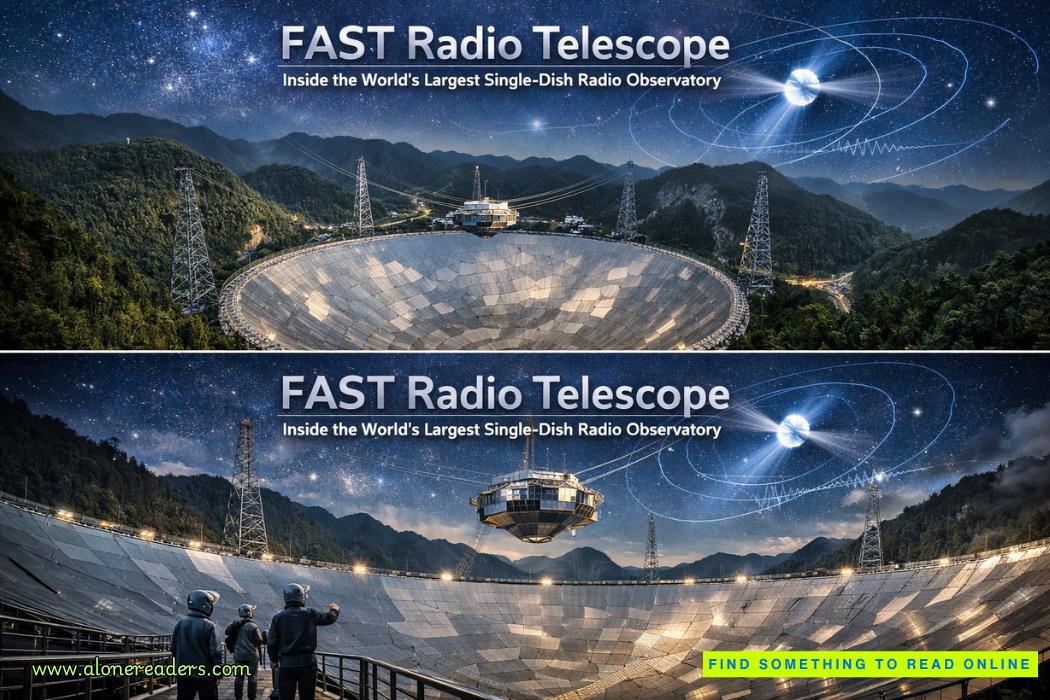
The Five-hundred-meter Aperture Spherical Telescope (FAST) represents a fundamental advancement in radio astronomy, both in engineering scale and scientific capability. Situated in a natural karst depression in Guizhou Province, China, FAST is the largest filled-aperture radio telescope ever constructed. Its immense size and highly adaptive design allow astronomers to detect extremely faint radio signals from deep space, enabling new insights into the structure and evolution of the universe.
Radio astronomy operates in a domain fundamentally different from optical observation. Instead of capturing visible light, instruments like FAST detect radio waves emitted by celestial objects. These signals originate from phenomena such as pulsars, interstellar hydrogen clouds, and fast radio bursts. Because radio signals are often weak and dispersed across vast distances, the effectiveness of a telescope depends heavily on its collecting area and sensitivity. FAST’s 500-meter diameter provides an unprecedented collecting surface, dramatically improving its ability to capture low-intensity signals.
The structural design of FAST is one of its most innovative features. Unlike traditional radio telescopes that rely on a rigid parabolic dish, FAST uses a spherical reflector composed of more than 4,400 triangular panels. These panels are mounted on a flexible cable network and can be adjusted in real time. When observing a specific region of the sky, a portion of the spherical surface is actively reshaped into a parabolic form. This dynamic surface adjustment allows the telescope to focus incoming radio waves with high precision.
Suspended above the dish is a feed cabin, which acts as the signal receiver. Instead of being fixed, this cabin is held in position by a system of cables and servomechanisms that allow it to move with exceptional accuracy. The positioning system must maintain alignment within a margin of a few millimeters, despite the scale of the structure. This combination of an active surface and a movable receiver enables FAST to track celestial objects as they move across the sky.
The location of FAST plays a critical role in its performance. The remote mountainous region of Guizhou provides natural shielding from radio frequency interference. In radio astronomy, even minimal human-generated signals can contaminate observations. By placing the telescope in a geographically isolated area and establishing strict radio-quiet regulations, engineers have minimized interference and ensured optimal observational conditions.
One of the primary scientific objectives of FAST is the study of pulsars. Pulsars are rapidly rotating neutron stars that emit beams of electromagnetic radiation at regular intervals. These objects serve as highly precise cosmic clocks, and their timing properties can be used to test theories of gravity, study the interstellar medium, and even detect gravitational waves indirectly. FAST’s sensitivity has already enabled the discovery of hundreds of new pulsars, significantly expanding the known population.
Another key area of research involves fast radio bursts, or FRBs. These are brief but extremely powerful bursts of radio energy originating from distant galaxies. The exact mechanisms behind FRBs remain one of the most active areas of investigation in astrophysics. FAST’s ability to detect faint and distant signals makes it particularly well-suited for identifying new FRB sources and studying their characteristics in detail. By analyzing repetition patterns, dispersion measures, and polarization properties, researchers aim to determine the physical processes responsible for these enigmatic events.
The telescope also plays an important role in mapping neutral hydrogen in the universe. Hydrogen is the most abundant element in the cosmos, and its distribution provides valuable information about the large-scale structure of galaxies. By observing the 21-centimeter emission line of neutral hydrogen, FAST can trace the formation and evolution of galactic systems. This data contributes to a broader understanding of cosmology and the dynamics of matter distribution.
In addition to astrophysical research, FAST contributes to the ongoing search for extraterrestrial intelligence (SETI). By scanning the sky for artificial radio signals, scientists hope to identify potential indicators of technologically advanced civilizations. The telescope’s sensitivity allows it to detect extremely weak signals that might otherwise go unnoticed. While no confirmed extraterrestrial signals have been identified, FAST significantly enhances the detection capability of SETI initiatives.
From an engineering perspective, the construction of FAST presented numerous challenges. The integration of a flexible reflector system, precise cable control, and real-time computational adjustments required the development of new technologies. The project also involved extensive geological analysis to ensure the stability of the karst depression. Each panel and cable had to be calibrated to maintain structural integrity while allowing dynamic movement.
Data processing is another critical component of FAST’s operation. The telescope generates massive volumes of observational data, requiring advanced computational infrastructure for storage and analysis. Signal processing algorithms must filter out noise, identify patterns, and extract meaningful information from raw data streams. This process often involves machine learning techniques to classify signals and detect anomalies.
Despite its immense capabilities, FAST has certain limitations. Its design restricts its field of view, meaning it cannot observe the entire sky at once. Instead, it relies on targeted observations and survey strategies. Additionally, the complexity of its active surface and suspension system requires continuous maintenance and calibration. However, these limitations are outweighed by its unmatched sensitivity and precision.
International collaboration has become an important aspect of FAST’s scientific output. Although the telescope is operated by China, it has gradually opened to global researchers, enabling collaborative projects and data sharing. This approach enhances the scientific return by integrating diverse expertise and expanding observational programs.
Looking forward, FAST is expected to play a central role in next-generation astrophysical research. Its contributions to pulsar timing arrays may help refine the detection of low-frequency gravitational waves. Its observations of FRBs could lead to breakthroughs in understanding high-energy astrophysical processes. Additionally, its hydrogen mapping capabilities will support large-scale cosmological surveys.
In a broader context, FAST symbolizes the convergence of engineering innovation and scientific ambition. It demonstrates how large-scale infrastructure can push the boundaries of human knowledge. By enabling the detection of signals that were previously beyond reach, FAST effectively expands the observable universe.
The significance of FAST extends beyond its technical specifications. It represents a shift toward increasingly sensitive instruments capable of probing the most subtle phenomena in the cosmos. As radio astronomy continues to evolve, instruments like FAST will remain essential in addressing fundamental questions about the origin, structure, and future of the universe.
Ultimately, FAST is not just a telescope; it is a listening device tuned to the deepest frequencies of existence. Every signal it captures carries information about distant cosmic events, some occurring billions of years ago. By interpreting these signals, scientists can reconstruct the history of the universe and gain insight into its underlying physical laws.



 Château de Vincennes: France’s Forgotten Royal Fortress and Medieval Stronghold
 Château de Carcassonne: Europe’s Greatest Medieval Citadel and Fortress
 Château de Chenonceau: The Castle Built by Remarkable Women
 Château de Chambord: France’s Magnificent Renaissance Castle and Architectural Wonder
 Tehri Dam: India's Tallest Dam and the Debate Behind It
 Bhakra Nangal Dam: India's Temple of Modern Development










