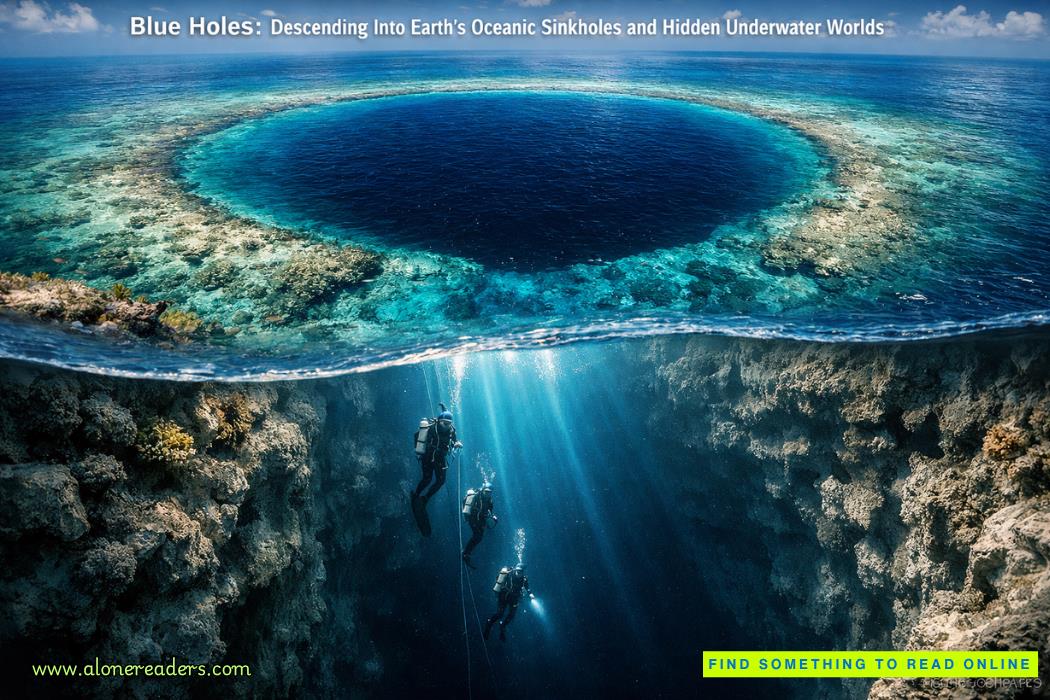
Blue holes are among the most enigmatic geological formations on Earth, representing a convergence of hydrology, marine geology, and environmental extremophiles. These submerged sinkholes, often appearing as perfectly circular patches of deep blue water amidst lighter coastal seas, are not merely visual anomalies; they are vertical gateways into ancient geological processes and isolated ecological systems. Their formation, structure, and internal chemistry reveal a layered history of climatic transitions, particularly those associated with glacial and interglacial cycles.
At a fundamental level, blue holes originate from karst processes, where soluble bedrock such as limestone undergoes dissolution due to slightly acidic groundwater. During periods when sea levels were significantly lower, particularly during the Pleistocene glaciations, vast portions of what are now submerged continental shelves were exposed. Rainwater, enriched with carbon dioxide from the atmosphere and soil, percolated through the ground, dissolving carbonate rock and forming extensive cave systems. Over time, these caves expanded, their ceilings weakened, and eventual collapses created vertical shafts or sinkholes. When sea levels rose again, these features became submerged, forming the blue holes observed today.
What distinguishes blue holes from other marine depressions is their depth, verticality, and often stratified water composition. Many blue holes exhibit a sharp thermocline and halocline, where temperature and salinity gradients create distinct layers within the water column. Below a certain depth, oxygen levels drop dramatically, resulting in hypoxic or anoxic environments. These conditions prevent most marine life from surviving in the deeper sections, but paradoxically, they also preserve organic material exceptionally well. This makes blue holes valuable archives of environmental history, containing sediment layers that can be analyzed to reconstruct past climate conditions, hurricane activity, and even human impacts on nearby ecosystems.
One of the most studied examples is the Great Blue Hole off the coast of Belize, a near-perfect circular formation over 300 meters across and approximately 125 meters deep. Its internal structure includes submerged stalactites and cave formations, remnants of its terrestrial past. These formations provide direct evidence that the cave once existed above sea level. As divers descend into the hole, they transition from vibrant coral ecosystems at the rim into increasingly dark and barren environments, eventually encountering layers of hydrogen sulfide that create a visible, milky boundary within the water. This layer not only limits light penetration but also acts as a chemical barrier, further isolating the lower depths.
Another notable feature of blue holes is their role as natural laboratories for studying extremophiles. The anoxic zones often harbor microbial communities that thrive in conditions similar to those found in early Earth environments or even extraterrestrial settings. These microbes utilize chemosynthesis rather than photosynthesis, deriving energy from chemical reactions involving sulfur or methane. The study of these organisms has implications for astrobiology, particularly in understanding how life might exist in subsurface oceans on icy moons or other planets.
From a hydrodynamic perspective, blue holes can influence local water circulation patterns. Some are connected to extensive underwater cave systems, allowing for the exchange of water between the hole and the surrounding ocean. This exchange can create localized currents, which in turn affect nutrient distribution and sediment transport. In certain regions, blue holes act as conduits for freshwater discharge from underground aquifers into the ocean, a process known as submarine groundwater discharge. This can significantly alter the chemical composition of nearby marine environments, impacting coral reefs and other sensitive ecosystems.
Despite their scientific importance, blue holes are also associated with considerable risk, particularly for divers. The vertical descent, limited visibility, and presence of toxic gases such as hydrogen sulfide create a hazardous environment that requires specialized training and equipment. Nitrogen narcosis, oxygen toxicity, and decompression sickness are all amplified in such settings due to the rapid changes in pressure and depth. Moreover, the psychological impact of descending into a dark, enclosed vertical shaft can be disorienting, even for experienced divers.
In recent years, blue holes have gained attention not only from scientists but also from explorers and filmmakers. Advances in remote-operated vehicles (ROVs) and submersible technology have allowed researchers to map previously inaccessible depths and document unique geological formations within these sinkholes. High-resolution sonar mapping has revealed intricate cave networks extending far beyond the visible openings, suggesting that many blue holes are only the surface expression of much larger subsurface systems.
The ecological significance of blue holes extends beyond their internal environments. The rims often support rich coral reef systems, benefiting from nutrient upwelling and relatively stable conditions. These areas can serve as biodiversity hotspots, attracting a wide range of marine species. However, this balance is delicate. Changes in water chemistry, increased sedimentation, or human activities such as tourism and pollution can disrupt these ecosystems. Given their confined nature, blue holes are particularly vulnerable to contamination, as pollutants can accumulate and persist within their depths.
In terms of sedimentology, blue holes provide a unique record of depositional processes. Fine-grained sediments settle within the still waters of the hole, forming stratified layers that can be dated using radiometric techniques. These layers often contain microfossils, pollen, and isotopic signatures that reflect past environmental conditions. For instance, variations in oxygen isotopes can indicate changes in precipitation patterns, while the presence of certain microfossils can signal shifts in marine or terrestrial influence. In some cases, these sediment cores have been used to reconstruct hurricane frequency over thousands of years, offering valuable data for climate modeling.
Geochemically, the stratification within blue holes leads to distinct zones of chemical activity. The upper layers are typically oxygenated and support conventional marine life, while deeper layers become increasingly reduced, with high concentrations of dissolved gases such as methane and hydrogen sulfide. These gradients create sharp redox boundaries, which are critical for understanding biogeochemical cycles. The interactions between these layers can also produce unique mineral deposits, including sulfide minerals that precipitate under specific conditions.
From a geomorphological standpoint, the distribution of blue holes is closely tied to carbonate platforms and coastal karst regions. They are commonly found in areas such as the Caribbean, the Bahamas, and parts of the South China Sea. Each region exhibits variations in size, depth, and morphology, influenced by local geological history, sea-level fluctuations, and tectonic activity. Some blue holes are relatively shallow and wide, while others are narrow and extend to extraordinary depths, exceeding 300 meters in some cases.
The cultural and historical aspects of blue holes should not be overlooked. In many regions, these formations have been integrated into local folklore and mythology, often associated with spirits, lost civilizations, or unexplained disappearances. While these narratives are not scientific, they reflect the profound impact that such mysterious and visually striking features have on human perception.
In the context of modern environmental challenges, blue holes may serve as indicators of broader ecological change. Their sensitivity to shifts in temperature, salinity, and chemical composition makes them valuable monitoring sites. Changes observed within these systems can provide early warnings of larger-scale oceanic or climatic alterations. Additionally, their role in carbon cycling, particularly through the sequestration of organic material in anoxic sediments, is an area of ongoing research with potential implications for understanding global carbon budgets.
Technological advancements continue to expand our ability to study blue holes in greater detail. Autonomous underwater vehicles equipped with advanced sensors can now collect high-resolution data on temperature, salinity, and chemical composition throughout the water column. Combined with sediment core analysis and biological sampling, these tools are enabling a more comprehensive understanding of these complex systems.
Ultimately, blue holes represent a convergence of geological history, chemical complexity, and biological adaptation. They are not merely underwater curiosities but dynamic systems that encapsulate processes spanning millions of years. Their study requires an interdisciplinary approach, integrating geology, oceanography, microbiology, and environmental science. As exploration continues, these oceanic sinkholes are likely to yield further insights into the Earth's past, present, and potentially even the conditions necessary for life beyond our planet.



 Château de Vincennes: France’s Forgotten Royal Fortress and Medieval Stronghold
 Château de Carcassonne: Europe’s Greatest Medieval Citadel and Fortress
 Château de Chenonceau: The Castle Built by Remarkable Women
 Château de Chambord: France’s Magnificent Renaissance Castle and Architectural Wonder
 Tehri Dam: India's Tallest Dam and the Debate Behind It
 Bhakra Nangal Dam: India's Temple of Modern Development