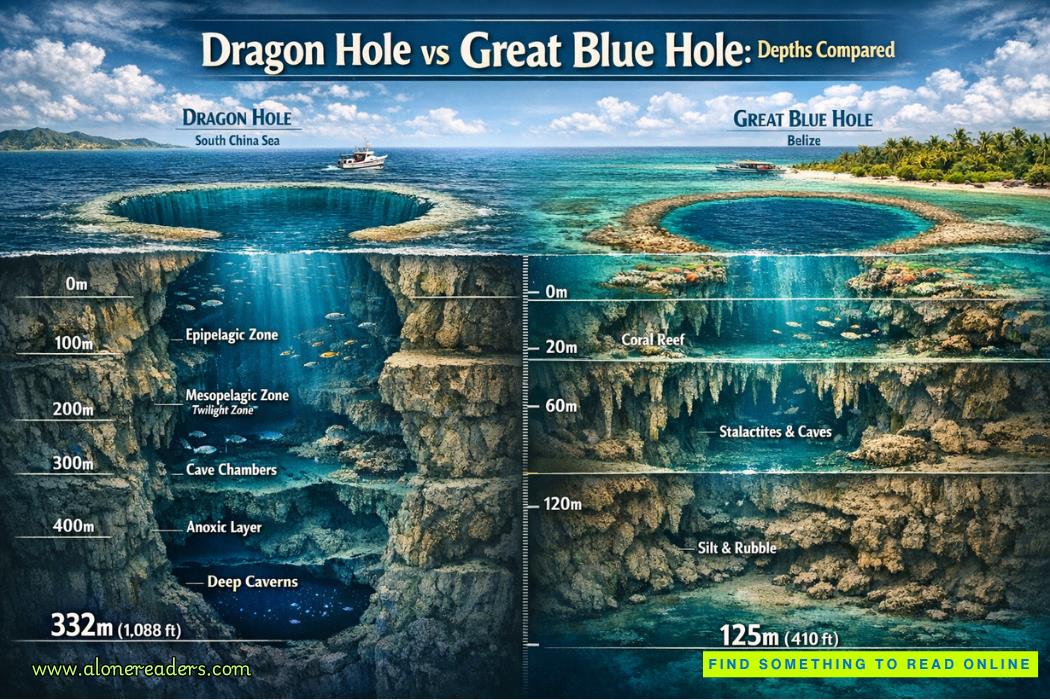
The comparison between Dragon Hole and Great Blue Hole represents more than a simple difference in depth; it is a confrontation between two fundamentally different geological systems, shaped by distinct environmental histories, hydrological processes, and oceanographic conditions. While both are classified as “blue holes,” their formation, ecological stratification, and structural characteristics diverge significantly when examined through a scientific lens.
Blue holes themselves are vertical marine sinkholes, typically formed in carbonate bedrock such as limestone or dolomite. Their distinctive deep blue coloration arises from the absorption of longer wavelengths of light, combined with minimal sediment disturbance and steep vertical walls. However, beyond this shared classification, Dragon Hole and the Great Blue Hole occupy entirely different ends of the spectrum in terms of scale, complexity, and scientific significance.
The most striking difference lies in their depth. Dragon Hole reaches an extraordinary depth of approximately 300 meters, making it the deepest known blue hole on Earth. In contrast, the Great Blue Hole measures around 124 meters deep. This means Dragon Hole is more than twice as deep, a disparity that has profound implications for pressure gradients, water chemistry, and biological distribution. At depths exceeding 200 meters, Dragon Hole enters a zone where sunlight penetration is virtually nonexistent, resulting in a permanently dark, stratified environment that supports very limited life. The Great Blue Hole, while still deep, remains partially within the mesophotic zone, allowing some degree of biological activity at intermediate depths.
Geologically, both structures originated during periods of lower sea levels, particularly during the last glacial maximum when large portions of continental shelves were exposed. Rainwater, slightly acidic due to dissolved carbon dioxide, eroded the limestone, forming subterranean caverns. As sea levels rose, these caverns collapsed or flooded, creating the vertical shafts we now observe. However, Dragon Hole’s formation is associated with more complex tectonic and hydrodynamic influences within the South China Sea basin. Its extreme depth suggests prolonged dissolution processes and possibly multiple phases of collapse, leading to a far more vertically extensive system than typical karst sinkholes.
In contrast, the Great Blue Hole is part of the Belize Barrier Reef system and exhibits a more classical karst profile. Its circular shape and relatively uniform walls indicate a single dominant collapse event. One of its most distinctive features is the presence of submerged stalactites and stalagmites, which formed when the cave was above sea level. These formations provide direct evidence of its terrestrial origin and offer valuable data for paleoclimate studies.
From an ecological perspective, the differences become even more pronounced. Dragon Hole exhibits strong stratification in its water column, including a marked halocline and thermocline. At certain depths, oxygen levels drop sharply, creating hypoxic or anoxic conditions. This severely limits the presence of higher marine organisms. Instead, microbial communities dominate, particularly extremophiles that can survive in low-oxygen, high-pressure environments. These organisms are of significant interest in astrobiology, as they may resemble life forms capable of surviving on other planets or moons with subsurface oceans.
The Great Blue Hole, while also exhibiting stratification, supports a more diverse marine ecosystem in its upper layers. Reef fish, sharks, and other pelagic species are commonly observed near the rim and upper interior. The presence of oxygenated water allows for a more conventional marine food web. However, as divers descend, they encounter increasingly barren zones, culminating in deeper regions where biological activity diminishes and geological features dominate the landscape.
Another critical distinction lies in accessibility and human interaction. The Great Blue Hole has become one of the world’s most iconic diving destinations, popularized in part by the explorations of Jacques Cousteau. Its relatively moderate depth, combined with clear visibility and manageable conditions, makes it accessible to experienced recreational divers. The site has also been extensively studied using submersibles, providing high-resolution mapping and detailed geological data.
Dragon Hole, on the other hand, remains largely inaccessible. Its extreme depth, coupled with challenging ocean conditions, limits exploration to advanced scientific missions using remotely operated vehicles and specialized equipment. As a result, much of its internal structure remains uncharted, and ongoing research continues to reveal new insights into its morphology and chemistry. This limited accessibility contributes to its status as one of the least understood major marine geological features on Earth.
Hydrologically, Dragon Hole exhibits a more complex interaction with surrounding ocean currents. Its depth allows for the trapping of dense, saline water layers that do not easily mix with surface waters. This creates a stable but isolated environment where chemical gradients can persist over long periods. The Great Blue Hole, being shallower and located within a reef system, experiences more frequent water exchange with surrounding waters, leading to less pronounced but still significant stratification.
From a geomorphological standpoint, Dragon Hole can be viewed as an extreme end member of blue hole evolution. Its vertical extent suggests that the processes responsible for its formation operated over a much longer time or under more favorable conditions for dissolution. The Great Blue Hole, while impressive, represents a more typical example of karst collapse within a marine setting.
The comparison also highlights the role of regional geology. Dragon Hole is situated within a tectonically active marginal sea, where subsidence and sedimentation patterns may have influenced its development. The Great Blue Hole, by contrast, is embedded within a relatively stable carbonate platform, where reef building and marine erosion have played a more dominant role.
In terms of scientific value, both sites offer unique opportunities. Dragon Hole serves as a natural laboratory for studying extreme marine environments, including anoxic ecosystems and deep water chemistry. The Great Blue Hole provides insights into past sea levels, climate changes, and the evolution of reef systems. Together, they illustrate the diversity of processes that can produce similar surface features but vastly different internal structures.
Ultimately, the comparison between Dragon Hole and the Great Blue Hole is not merely about which is deeper. It is about understanding how variations in geology, climate, and oceanography can shape the Earth in profoundly different ways. Dragon Hole stands as a testament to the power of prolonged geological processes, pushing the boundaries of what is known about blue holes. The Great Blue Hole, meanwhile, offers a more accessible window into the past, preserving evidence of ancient environments within its karst structure.
Both formations challenge our understanding of underwater landscapes and continue to attract scientists, divers, and explorers from around the world. Their study not only deepens our knowledge of Earth’s oceans but also provides analogs for extraterrestrial environments, making them relevant far beyond their immediate geographical contexts.
In the end, while Dragon Hole dominates in terms of sheer depth, the Great Blue Hole remains unmatched in its combination of accessibility, visibility, and historical significance. Each represents a different dimension of natural complexity, and together they form one of the most compelling comparative case studies in marine geology today.



 Château de Vincennes: France’s Forgotten Royal Fortress and Medieval Stronghold
 Château de Carcassonne: Europe’s Greatest Medieval Citadel and Fortress
 Château de Chenonceau: The Castle Built by Remarkable Women
 Château de Chambord: France’s Magnificent Renaissance Castle and Architectural Wonder
 Tehri Dam: India's Tallest Dam and the Debate Behind It
 Bhakra Nangal Dam: India's Temple of Modern Development